Annual report 2025-26
Foreword
Foreword from the Chief Commissioner
In recent years, disruption and volatility in the UK aid system have consistently been themes in ICAI annual reports. 2025-26 has been no exception: the UK’s development cooperation has continued to operate in an unstable context, characterised by sharp budget reductions, institutional change and acute global pressures. This context has complicated both the delivery of UK development cooperation and ICAI’s own work.
In 2025-26 ICAI delivered a small but strategic set of reviews, maintaining its core accountability role alongside foundational work to reset its work programme under the new Commission. ICAI reviews covered sectoral effectiveness in the review of the UK’s approach to supporting energy transition, a high-priority crisis response to conflict and humanitarian crisis in Sudan, and the value for money implications of the UK’s management of official development assistance (ODA)-related fiscal rules and spending targets.
The themes emerging from reviews echoed those of previous years. The themes of the year that you can read more about in this report included opportunities to strengthen strategic coherence across government, limited progress on localisation, and the importance of clear objectives and results to support monitoring, learning and evaluation, and called for a coherent approach to value for money. We found that UK government staff are highly valued for their technical expertise, relationship building and contextual knowledge, as well as the continuity that they have provided through periods of change, particularly in country programmes.
The year saw continued high rates of acceptance and partial acceptance of ICAI recommendations. 100% of recommendations made this year were either fully or partially accepted. Our work to follow up on outstanding recommendations from previous ICAI reviews showed that reviews led to government actions to improve impact and value for money. In response to ICAI’s review of the £500 million Blue Planet Fund, for example, the government strengthened management and oversight systems and discontinued programmes with a weak poverty focus. Follow-up of open recommendations from the 2021 ‘Tackling fraud in UK aid’ review found a more proactive approach to fraud detection and strengthened whistleblowing procedures.
In a year that saw another round of reducing ODA budgets, ICAI again flagged that predictability is a key determinant of impact and value for money. The same is true for ICAI itself. ICAI faced material uncertainty in the second half of the year, as its budget and its existence came under review. Uncertainty created financial and delivery risks, and ICAI’s ability to manage these was constrained by our dependence on Foreign, Commonwealth and Development Office (FCDO) systems, including recruitment. This led to delays in our work programme.
In March we were relieved to learn that ICAI would continue to perform its role, albeit with significantly reduced resources. From April 2026, ICAI will be operating with 40% less programme budget, and our budget for staff and operating costs has been reduced by more than 40% in real terms.
Independent scrutiny is a core pillar of credible development policy, which protects value for money, underpins public confidence, strengthens policy effectiveness and contributes to the UK’s reputation for effective development cooperation. At a time when the government has reduced ODA budgets for aid delivery, independent scrutiny and learning is more, not less, important. With a reduced budget, there will be fewer ICAI reviews and reduced feedback loops into policy and programme improvements. The savings achieved must be weighed against the increased risk of inefficient or ineffective development cooperation that comes from reducing scrutiny at a time of change and innovation in the UK’s approach.
ICAI’s mandate was expanded in August 2025, to align with the government’s new approach to development cooperation. Our reviews now cover the impact of UK development partnerships, expertise, and the UK’s policy influence on priority global development themes, as well as the value for money of UK ODA spending. Looking ahead, ICAI will continue to evolve, maintaining focus on delivery of its core function, while still making the case for a level of flexibility and operational independence commensurate with our status as an arm’s-length body.
The coming year will be marked by a significant transformation of ICAI’s form and function required to meet the reduced funding requirements, and we will manage a change process alongside our scrutiny work. Although ICAI will deliver fewer reviews in the coming years, we will maintain the quality that our stakeholders tell us they value, continue to balance scrutiny with learning, and increase our efforts to maximise the impact of reviews through both follow-up reviews and external engagement.
My thanks and gratitude go to everyone involved in ICAI’s work. I am grateful for the guidance and constructive challenge of the Chair and members of the International Development Committee and the wider community of Parliamentarians who use and support ICAI’s work. ICAI continues to depend on colleagues in FCDO, including the Sponsorship team, to support our operations and independence. Commissioners continue to find government department teams under review to be uniformly welcoming of our reviews, and the opportunity to learn and improve. We value their engagement, as well as the work involved in providing information and support to the review process. I must pay tribute to the expertise and skill of the ICAI supplier teams, as well as my fellow commissioners and colleagues in the ICAI Secretariat, who have consistently demonstrated resilience and patience in recent months. Finally, ICAI reviews would not be possible without each of the stakeholders in the UK and overseas, who give up their time and share their expertise as part of the review process, providing us with unique insights that inform findings and recommendations, while all errors and opinions remain ICAI’s own.

1. Reviews published during 2025-26
The Independent Commission for Aid Impact’s (ICAI) programme of reviews is agreed each year with Parliament’s International Development Committee (IDC). We choose our topics by consulting with a wide range of stakeholders and by using a number of selection criteria including: the amount of UK aid involved; relevance to the strategic priorities of UK aid and coverage of a wide range of Sustainable Development Goals; the level of risk; the potential evaluability of the subject and added value of an ICAI review.
During the reporting period (April 2025 to March 2026), ICAI issued four publications.
Table 1: ICAI 2025-26 publications
| Review title | Review type | Publication date |
|---|---|---|
| UK aid for Sudan | Full review | October 2025 |
| UK aid for energy transition | Full review | November 2025 |
| Management of the official development assistance spending target – an ICAI information note | Information note | July 2025 |
| Management of the official development assistance spending target 2021-25 | Full review | March 2026 |
Themes of the year 2025-26
In the year 2025-26, ICAI published four reports covering climate, conflict and official development assistance (ODA) management: ‘UK aid to Sudan’ (October 2025), ‘UK aid for energy transition’ (November 2025), ‘Management of the official development assistance spending target’ (July 2025 information note), and ‘Management of the official development assistance spending target 2021-25’ (March 2026).
The global context for international development during the reporting period has been extremely difficult. There have been significant reductions in global ODA (23% in 2025),1 resulting in only 28% of humanitarian needs being met.2 Global conflict is at its highest level since World War 2,3 with one in ten people worldwide now living near to armed conflict, a seven-fold increase since 2010. According to the latest Sustainable Development Goal (SDG) update, only one-third of 137 SDG targets are on track or making even moderate progress. Many have stagnated (17%) or gone backwards (18%) – a situation the UN describes as a ‘global development emergency’.4
Against this backdrop, ICAI reviews established that while the UK has shown leadership in responding to crises and tackling long-term development challenges, its impact has been constrained by the lack of an overarching strategy to marshal cross-government coordination, funding volatility, weakening clarity of focus on poverty reduction, and limited progress and inconsistent approaches to implementing its commitment to localisation.
The reviews demonstrated the UK’s ongoing commitment and leadership in both humanitarian response and development cooperation, highlighting how UK expertise and convening power are used in programming. The UK was the fourth-largest donor to the Sudan crisis by the end of 2024, committing £226.5 million both for the response in Sudan and for Sudanese people seeking refuge in neighbouring countries for the financial year 2024-25. ICAI’s review of UK aid to Sudan found that the UK demonstrated political leadership and convening power during key moments of Sudan’s transition (2019-21) and following the outbreak of conflict (April 2023 onwards), but that political attention was inconsistent over time. The UK government is viewed by its partners as technically strong and flexible, but the review found that British Office Sudan remained significantly under-resourced and overstretched, with insufficient staffing and support to match ministerial ambition.
Similarly, the review of UK aid for energy transition found longstanding political commitment, substantial funding commitments, and technical expertise which was valued by partners.6 Successive UK governments have supported energy transition both domestically and globally. The review found that the UK has played a central role in creating several international alliances and partnerships, including Just Energy Transition Partnerships, and has effectively mobilised private finance for energy transition.
Alongside strong commitment and demonstrable leadership, ICAI reviews highlight weaknesses in overall strategic coherence and coordination across portfolios, departments and instruments that are constraints to impact. On Sudan, ICAI found that while information flows between UK teams were strong, the absence of a regional strategy limited the UK’s ability to deliver a consistently coherent, joined-up policy and programmatic response to the Sudan conflict. The review identified opportunities to increase cross-government coordination: in particular, Home Office and Ministry of Defence engagement on Sudan was limited, despite high migration flows and the critical role of military cooperation in defence diplomacy.
ICAI’s review of UK aid for energy transition acknowledged that the UK’s International Climate Finance Strategy includes energy transition in all four of its pillars. However, the lack of a unified strategy focused on energy transition across the UK’s energy transition portfolio, which covers a diverse mix of delivery channels, programmes, financial instruments, and partnerships, was identified as a risk to coherence at a strategic and a programme level. The review also flagged that the split of responsibilities between the Foreign, Commonwealth and Development Office (FCDO) and the Department for Energy Security and Net Zero (DESNZ) was unclear, creating institutional tensions.
The opportunity to strengthen strategic coherence across government departments was also evident in ICAI’s review of the UK’s management of the official development assistance spending target.7 We found that, during the review period, the system for allocating ODA budgets across government was not always based on shared strategic priorities or evidence of value for money, and that processes were often narrowly focused on expenditure around the aid target.
ICAI reviews this year continue to show that UK international development efforts have been affected by funding volatility and short-term planning. The information note and subsequent review of the UK’s management of the official development assistance spending target highlighted the combined effects of several factors.8 These included the reduction of the ODA target from 0.7% to 0.5% of gross national income (GNI) in 2021, and subsequent reductions to 0.3% in 2027, and the treatment of the ODA target as both a ceiling and a floor. Other factors included the position of FCDO as the ‘spender and saver of last resort’ and the inclusion of in-donor refugee costs (IDRC). These are reported as ODA, which is allowable, but the UK does this in a more expansive way than other OECD Development Assistance Committee (DAC) donors. The review concluded that the system for allocating ODA budgets across government fell short of the lessons from the National Audit Office’s work on a planning and spending framework that enables long-term value for money. It acknowledged that the decision to remove FCDO’s role as spender and saver of last resort is a positive step, and that new processes from 2025 for ODA allocations across departments may contribute to improved value for money, but noted that the implications if future ODA outturns were to differ from 0.3% of GNI are not yet clear.
The impact of unpredictable ODA allocations was evident in ICAI’s review of UK aid to Sudan. The review highlighted that reductions in the UK aid budget, combined with uncertainty over future funding, undermined the UK’s reputation as a reliable donor and weakened relationships with partners. Funding volatility in-year affected programme delivery and future planning.
ICAI’s reviews in 2025-26 highlight the ways in which competing priorities and funding pressures can constrain the extent to which UK development cooperation is clearly and consistently focused on poverty reduction. The review of the UK’s management of the official development assistance spending target underscores the continuing pressures on ODA budgets for overseas programmes caused by rising IDRC, which reduce the funding available for overseas development programmes and humanitarian response. On energy transition, ICAI highlighted the trade-offs between focusing on higher-emitting, middle-income countries, prioritised for global mitigation impact, and ensuring sufficient support for adaption needs in low-income countries. The latter remain underserved, despite their acute vulnerability and greater dependence on concessional finance, with implications for the UK’s longer-term poverty reduction and equity goals.
Several UK strategies and statements have placed partnership at the heart of UK development cooperation, committing to move away from a traditional donor-recipient ODA model towards relationships based on patience, mutual respect, equity, and local ownership. In Sudan, ICAI found that progress on localisation had been constrained by a cautious approach, which curtailed the depth and reach of local partnerships. Across Sudan, local actors remained under-supported, despite often having the capacity to provide cost-effective and contextually grounded responses. UK compliance requirements were a significant constraint to accessing funding. The review of the UK’s aid for energy transition found that support channelled through partnerships is intended to support partner countries’ own plans but concluded that country ownership is not sufficiently consistent.
2. ICAI functions and structure
ICAI was established in May 2011 to provide independent evaluation and scrutiny of the impact and value for money of UK official development assistance (ODA), irrespective of the spending department. ICAI is an advisory non-departmental public body sponsored by the Foreign, Commonwealth and Development Office (FCDO). It delivers its programme of work independently and reports to Parliament’s International Development Committee (IDC).
In August 2025, the Minister of State for International Development confirmed a significant broadening of ICAI’s mandate, aligned with the government’s evolving approach to development. ICAI’s remit will expand beyond its established focus on assessing the impact of ODA to include scrutiny of the wider contribution of UK development activity. This encompasses the impact of development partnerships, the application of UK expertise, and the UK’s policy influence across priority global development themes.
This change reflects a strategic shift in the UK’s development model from a traditional donor role towards that of an ‘investor’, emphasising influence, partnerships and systemic impact. ICAI’s future work programme will be agreed with the IDC to ensure alignment with this broader mandate.
ICAI is led by a board of independent public appointees (the commissioners) who are supported by a civil service secretariat and external suppliers. These three component parts – commissioners, secretariat and suppliers – work closely together to deliver reviews. Figure 1 summarises the roles and responsibilities of the three parts of ICAI.
The ICAI team
Jillian Popkins, ICAI’s Chief Commissioner, leads the board of commissioners. ICAI’s other commissioners are Liz Ditchburn and Harold Freeman. The commissioners’ biographies are on the ICAI website.
Ekpe Attah leads ICAI’s secretariat of ten civil servants. They are responsible for review management (working alongside the external suppliers), supplier contract management, financial control and corporate governance, and communications and engagement. ICAI’s office is in Gwydyr House, Whitehall.
ICAI was supported in the research for its reports during 2025-26 by an external supplier consortium led by the specialist international development consultancy Agulhas Applied Knowledge. From July 2024, the consortium also included Ecorys UK, IOD PARC, and ITAD.
Figure 1: High-level roles and responsibilities
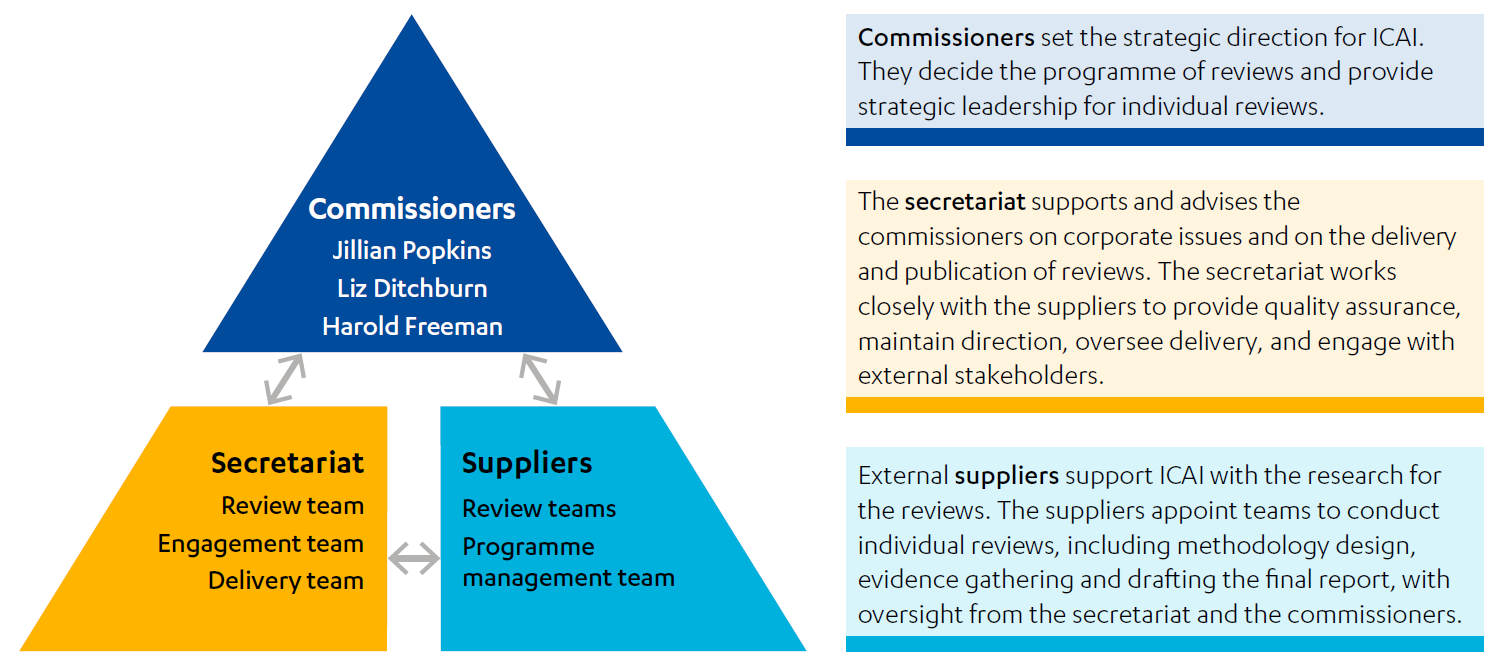
Commissioners set the strategic direction for ICAI. They decide the programme of reviews and provide strategic leadership for individual reviews.
The secretariat supports and advises the commissioners on corporate issues and on the delivery and publication of reviews. The secretariat works closely with the suppliers to provide quality assurance, maintain direction, oversee delivery, and engage with external stakeholders.
External suppliers support ICAI with the research for the reviews. The suppliers appoint teams to conduct individual reviews, including methodology design, evidence gathering and drafting the final report, with oversight from the secretariat and the commissioners.
3. Corporate governance
ICAI’s commissioners, who lead both the selection process for all reviews and the work on individual reviews, were appointed after an open recruitment process regulated by the Commissioner for Public Appointments. They hold quarterly board meetings, the agendas and minutes of which are published on ICAI’s website.
ICAI acts in accordance with the mandate agreed with the foreign secretary, which was broadened during this reporting period (as set out above).
A copy of ICAI’s Framework Agreement with the Foreign, Commonwealth and Development Office (FCDO), which is due for renewal, can be found on our website.
Risk management
The ICAI secretariat maintains a risk register which identifies and monitors ICAI’s corporate risks. It is reviewed regularly by commissioners at every Board meeting. ICAI’s risk register includes an assessment of gross and net risk, mitigating actions and assigned risk owners. It includes both risks relating to the operating environment and risks inherent to the production of ICAI reviews.
During this year ICAI reviewed its risk management approach and developed a new risk framework and appetite, reflecting independent expert advice. Our updated approach to risk management will be implemented early in 2026-27, and the framework and risk appetite statements will be published on our website.
Internal audit
ICAI’s 2025-26 internal audit report (conducted by FCDO’s Internal Audit Department and finalised in May 2026) assessed ICAI’s governance, risk management, and value for money arrangements. ICAI received an overall moderate assurance rating, with adequate controls and a moderate net risk profile, reflecting sound governance and a robust control framework, alongside a few areas for improvement.
The audit found that ICAI has effective governance structures, including established reporting mechanisms, active Board oversight, and clear processes for identifying and managing financial and operational risks. Strong internal awareness of external risks – particularly those arising from FCDO restructuring and evolving official development assistance (ODA) priorities – were identified as a key strength.
However, the review highlighted significant contextual challenges, reflecting the external uncertainty about ICAI’s future funding and delivery arrangements during this period, and found that these factors had limited ICAI’s ability to plan effectively and optimise delivery.
Key recommendations focused on strengthening risk management maturity – particularly through the development of a formal risk appetite (an issue we were already in the process of addressing, as set out above), improving key performance indicators (to bring them in line with the current Board’s priorities and objectives), and pursuing greater flexibility in programme funding arrangements.
Conflict of interest
ICAI takes conflicts of interest, both actual and perceived, extremely seriously. Our independence is vital for us to achieve real impact.
We publish our conflict of interest and gifts and hospitality policies on our website and update the commissioners’ conflict of interests register every six months. We review potential conflicts of interest for all supplier team members before beginning work on reviews.
We manage any potential conflicts of interest on a case-by-case basis. The specialist nature of our work, and the requirement for strong technical input, means that we need to weigh the risk of a possible or perceived conflict with the need to ensure that high-quality and knowledgeable teams conduct our reviews.
Whistleblowing
ICAI has limited capacity to investigate concerns raised by the public and this is not part of our mandate. Our whistleblowing policy is on our website.
In line with the policy, if we receive allegations of misconduct, we offer to put the complainant in contact with the relevant department’s investigations team, if appropriate, or with the National Audit Office’s investigation function.
Safeguarding
ICAI complies with FCDO safeguarding and reporting standards. There have been no reports this year under our safeguarding policy.
Complaint handling
ICAI’s complaints handling process is published on our website. This process is designed to be both proportionate to our role and size, and distinct from our established procedures for reporting fraud and safeguarding concerns.
We received no complaints during the reporting period.
Information rights
ICAI received no subject access requests under the Data Protection Act or General Data Protection Regulation during the reporting period.
We received four requests for information under the Freedom of Information Act (FOIA). In September 2024, reflecting best practice around information rights and transparency, ICAI initiated a publicly available log of responses to FOIA requests that we consider to be of wider public interest. We aim to update this at least every six months.
Theory of Change review
During the reporting period, ICAI commissioned Oxford Policy Management Ltd (OPM) to review our Theory of Change. The review assessed how effectively ICAI’s work influences UK aid policy and delivery, drawing on stakeholder interviews, document review, and previous impact analysis. It confirmed that ICAI contributes to change through two primary pathways: generating credible evidence and learning and strengthening accountability through formal scrutiny and engagement mechanisms.
The review found that ICAI’s thematic reviews are widely valued by government for informing decisions, shaping policy thinking, and supporting internal reform agendas, although the extent of learning varies across reviews. The credibility and relevance of findings – along with effective engagement with departments – are critical determinants of influence.
Accountability mechanisms, including published government responses, follow-up reviews, and scrutiny by the International Development Committee, help create a clear expectation that government will act on ICAI’s findings. There is also evidence that ICAI contributes to tangible changes in UK aid, including new initiatives, strengthened priorities, and reinforcement of existing reforms, although impact varies between reviews.
The OPM review concluded that ICAI’s effectiveness depends not only on the quality of its work but also on government willingness, capacity and leadership to respond, particularly in a context of reduced ODA and changing development priorities.
Drawing on the review’s findings, ICAI plans to finalise and publish a revised Theory of Change in 2026-27.
4. Financial summary
This chapter sets out:
- the overall financial position of ICAI
- expenditure for the financial year period April 2025 to March 2026
- the supplier cost of each ICAI review published in the financial year April 2025 to March 2026
Overall financial position
In the financial year April 2025 to March 2026, ICAI spent £2.635 million. This was within the Foreign, Commonwealth and Development Office total approved budget for ICAI of £4.01 million. Discharging ICAI’s remit means managing a rolling programme of reviews which often span financial reporting years. Consequently, costs payable to suppliers in any one financial year cover both reviews published in that year and initiation costs for those due for publication the following year.
Expenditure from April 2025 to March 2026
Total spend in the year for both programme and administration came to £2,634,620. The table below provides a breakdown of the main elements of the spend.
Table 2: ICAI spend April 2025 to March 2026
| Area of spend | Total expenditure April 2025 to March 2026 |
|---|---|
| Supplier costs | £1,454,599 |
| Secretariat pay costs | £796,931 |
| Commissioners’ pay and honoraria costs | £234,549 |
| Office rent costs * | £66,971 |
| Communications and engagement | £55,229 |
| Office costs including training and office equipment | £14,872 |
| Travel costs | £11,469 |
*The full accommodation costs for this financial year were £109,000. Actual spend was less because of adjustments from previous years.
In 2025-26, supplier costs were £1.455 million. This included the cost of reviews and projects.
As explained above, some of this cost is for work on reviews for publication after March 2026. This maintains the pipeline of review production. Table 3 sets out the supplier costs directly attributed to each review published between April 2025 and March 2026. This includes costs paid to all suppliers involved in the production of the review. These costs are paid over several financial years and not solely in the year of publication.
Table 3: Total supplier cost for each review published April 2025 to March 2026
| Review | Supplier cost |
|---|---|
| UK aid for energy transition | £349,759 |
| UK aid for Sudan | £379,142 |
| Management of the official development assistance spending target – an ICAI information note | £28,050 |
| Management of the official development assistance spending target 2021-25 | £258,425 |
The variation in the costs of ICAI reviews is driven by the breadth of the topic under review and the methodological approach required to provide robust and credible scrutiny of the topic (including whether and how many country case studies and visits may be required).
5. ICAI’s performance
This chapter sets out performance during the year against ICAI’s key performance indicators (KPIs) for 2025-26.
Table 5: Performance summary 2025-26
| Key performance indicator | Outcome |
|---|---|
| Proportion of ICAI recommendations accepted or partially accepted by the government for reviews published in 2025-26 | Out of 18 recommendations, 16 (89%) were accepted and 2 (11%) partially accepted by the government |
| International Development Committee (IDC) satisfaction with ICAI | Parliamentary stakeholders, including IDC, regard ICAI as key to supporting Parliament’s scrutiny role |
| ICAI communications and engagement activity | ICAI continues to promote its reviews effectively to stakeholders and the public, reaching different audiences through different channels |
| Media and social media coverage | ICAI continues to achieve accurate media coverage, and its social media channels continue to grow |
| Budgetary control | ICAI operated within budget |
Government responses to ICAI reviews
The government has six weeks to publish a response to an ICAI review. By the end of March 2026, we had received responses from the government for 2 of our reviews published during 2025-26.9 The response to the management of the official development assistance spending target 2021-25 review (published 12 March 2026) was received on 28 April 2026, and the numbers have been included in the above KPI analysis. The government does not formally respond to information notes. In government responses received by ICAI, the government accepted 16 of ICAI’s recommendations and partially accepted 2. No recommendations were rejected.
ICAI also followed up on recommendations made in previous reviews to check for progress. This included several recommendations from the previous Phase 3 Commission 10, the review of the Blue Planet Fund11 and the review of tackling fraud in UK aid.12
Working with the International Development Committee
ICAI’s work with the International Development Committee (IDC) plays a vital role in delivering real improvements to how UK aid is spent, through hearings in relation to our work or contributions to IDC inquiry evidence sessions.
In June 2025 ICAI held a successful Parliamentary launch for the Fourth Commission, in partnership with the IDC Chair who opened the event. This also featured speakers from the British Foreign Policy Group and the New Economics Foundation. In October 2025, Commissioner Liz Ditchburn gave oral evidence at an IDC session on the situation in Sudan, following the publication of ICAI’s Sudan review. In November 2025, Chief Commissioner Jillian Popkins appeared before the IDC for its annual session on the work of ICAI. Commissioners have also provided regular private briefings to the IDC on ICAI’s current and planned reviews.
ICAI continues to work with the IDC to consider how we can best support scrutiny by MPs and Peers of government aid spending. We also continue to engage other Parliamentary Committees and All-Party Parliamentary Groups as appropriate, to brief them on the findings of relevant ICAI reviews. We proactively share our work with the Parliamentary Libraries to help inform their briefings.
External engagement
ICAI’s remit includes ensuring that our work is accessible to the public. ICAI has continued to prioritise strategic engagement with all its key audiences – the government, Parliament, the development sector and the public – to promote interest in and the impact of its reviews. Positive and proactive engagement has taken place for each ICAI publication, with development sector stakeholders regularly consulted at all stages in the review cycle, through evidence-gathering roundtables and workshops, briefings, and events.
Events
ICAI runs and contributes to events to maximise the impact of its work and increase understanding and learning around its findings. We participated in or arranged more than nine events over the past year.
In addition to the June 2025 Parliamentary launch event, we organised events and roundtables in partnership with stakeholders including British Expertise International, the Center for Global Development and IPPR. Commissioners also contributed to Foreign, Commonwealth and Development Office and cross-government staff learning events on various international development themes.
In addition, we arranged pre-publication stakeholder briefings for our reports on topics including UK aid to Sudan and the UK’s management of the official development assistance (ODA) spending target.
We are grateful to the IDC, our panellists and our partner organisations for helping to make our events a success.
Media and digital
ICAI’s reviews generated media coverage throughout the year, and the media continues to play a key role in supporting scrutiny, impact and accountability.
In July 2025, ICAI’s information note on ODA management was covered widely by outlets including Press Association, the Spectator, Telegraph, Daily Express, Times, and i. The Sudan review, published in October 2025, received coverage from outlets including the Guardian, Devex and the National. In March 2026, the full review of the UK’s management of the ODA target was picked up by the Independent, Daily Mail, Daily Express, Guardian, GB News, Devex and Politico. Other proactive media engagement during the year included a Chief Commissioner op-ed for the House magazine in July 2025. In the first quarter of 2026, ICAI also handled significant national and trade media interest around the future of aid scrutiny and ICAI’s role, following comments made by the Development Minister at the IDC.
We continued to use social media to promote our work, publish Commissioner blogs and connect with our audiences. ICAI’s following on X remained stable at around 7,000. Our LinkedIn following grew to 2,800, an increase of over 20% on the previous year.
More than 60,000 people visited our website in the past year. Our most viewed web page was our ‘How UK aid is spent’ report, published near the end of the previous reporting year, with around 7,000 views. The most viewed publication from this reporting year was our information note on ODA management and the accompanying news story, with around 4,000 views combined.
ICAI’s planned publications April 2026 to March 2027
ICAI’s work plan for 2026-27 is published on our website: Future work plan – Independent Commission for Aid Impact. During the next year, we will be publishing a programme of topics including reviews on UK aid to tackle violence against women and girls, UK development partnerships, refugee host countries, and the UK as a lender and investor. ICAI will also publish an update to its previous work on how UK aid is spent.
References
- 1 Organisation for Economic Co-operation and Development, ‘A historic decline in foreign aid: Preliminary 2025 ODA data’, data explainer, 9 April 2026, (viewed on 8 June 2026) ↩
- 2 United Nations Office for the Coordination of Humanitarian Affairs, ‘Global Humanitarian Overview 2026’, December 2025, page 2, (viewed on 8 June 2026) ↩
- 3 Uppsala Conflict Data Program, ‘Uppsala Conflict Data Program – Department of Peace and Conflict Research’, March 2026, (viewed on 8 June 2026) ↩
- 4 United Nations, ‘The Sustainable Development Goals Report’, 2025, page 2, (viewed on 8 June 2026) ↩
- 5 Independent Commission for Aid Impact, ‘UK aid to Sudan’, October 2025 ↩
- 6 Independent Commission for Aid Impact, ‘UK aid for energy transition’, November 2025 ↩
- 7 Independent Commission for Aid Impact, ‘Management of the official development assistance spending target 2021-25’, March 2026 ↩
- 8 Independent Commission for Aid Impact, ‘Management of the official development assistance spending target – an ICAI information note’, July 2025; Independent Commission for Aid Impact, ‘Management of the official development assistance spending target 2021-25’, March 2026 ↩
- 9 Foreign, Commonwealth and Development Office, ‘Government responses to the Independent Commission for Aid Impact (ICAI) reports’, updated April 2026 ↩
- 10 Independent Commission for Aid Impact, ‘Government updates ICAI on progress implementing recommendations’, 17 October 2025 ↩
- 11 Independent Commission for Aid Impact, ‘ICAI welcomes progress in response to Blue Planet Fund review’, 12 December 2025 ↩
- 12 Independent Commission for Aid Impact, ‘ICAI welcomes government progress on fraud prevention but warns over staff cuts’, 25 March 2026 ↩