Building resilience to natural disasters
1. Purpose, scope and rationale
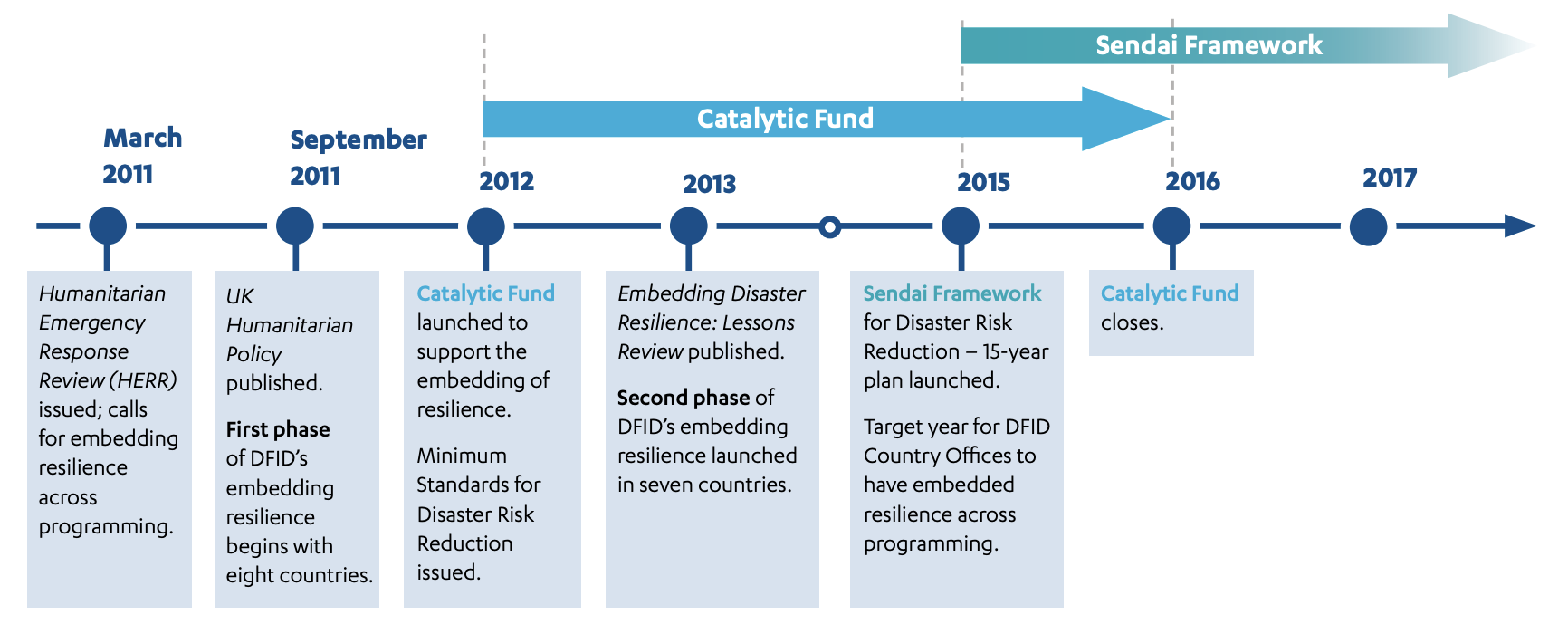
In 2011, the Humanitarian Emergency Response Review (HERR) recommended that resilience to disasters be made central to the UK aid programme, in both development and humanitarian aid.1 Resilience is now a prominent concept in DFID’s strategy.2 However, the International Development Committee has noted a continuing gap between DFID’s conceptualisation of the importance of resilience and its level of investment.3 With several African countries threatened by famine and fears that climate change is increasing the frequency of extreme weather events, this is an opportune time to assess the performance of DFID’s programming on disaster resilience.
Disaster resilience is defined by DFID as:
the ability of countries, communities and households to manage change, by maintaining or transforming living standards in the face of shocks or stresses – such as earthquakes, drought or violent conflict – without compromising their long-term prospects.
This performance review will assess the effectiveness of DFID’s approach to building resilience to natural disasters. ICAI performance reviews probe how efficiently and effectively UK aid is delivered, and assess its likelihood of delivering impact. Coming more than a decade after the first international commitment in this area (the Hyogo Framework for Action)4 and six years after the HERR, this review will provide Parliament and the public with the first ever independent assessment of DFID’s approach to disaster resilience, and analyse whether it has helped to reduce the risk of harm from natural disasters or the cost of response and recovery. It will also complement and expand on two earlier reports which focused on responding to crises and natural disasters, rather than on resilience: the 2016 National Audit Office report on DFID’s approach to responding to crises,5 and ICAI’s 2014 rapid review of DFID’s humanitarian response to Typhoon Haiyan in the Philippines.6 Furthermore, it will help generate lessons and good practices to inform the continuing development of DFID’s approach to building resilience to natural disasters.
This review will cover DFID’s work on disaster resilience from 2011 to the present. It will not focus on building resilience to epidemic diseases as this is being covered by a separate learning review on UK aid’s response to global health threats; and it will not specifically address resilience to conflict because of other recent and planned reviews in fragile and conflict-affected states, although we will look at resilience to natural disasters in a conflict setting.
The review will look at how resilience to natural disasters is embedded at the country office level through programmes specifically designed to build resilience to disaster (hereafter ‘vertical programmes’); how resilience has been embedded into sectoral programmes such as health, agriculture, social protection and water, sanitation and hygiene (‘horizontal programmes’); and how the resilience approach is integrated into programmes on disaster risk reduction, social protection and climate change adaptation (though we will not examine DFID’s work on adaptation more broadly). Centrally managed programmes that contribute to resilience building, including disaster preparedness, risk insurance, risk analysis, catalytic funding and other innovative programmes will also be covered.
2. Background
Disaster resilience first appeared on the international development agenda in the late 20th century after the United Nations declared the 1990s the International Decade for Natural Disaster Reduction.7 In May 1994, the Yokohama Strategy and Plan of Action for a Safer World was adopted,8 followed in 2005 by the Hyogo Framework for Action – a ten-year plan to make the world safer from natural disasters.9 In 2015, the Sendai Framework for Disaster Risk Reduction laid out a 15-year action plan focused on preventing new, and reducing existing, disaster risks.10 These agreements reflected international concern over the increased incidence of natural disasters, the increased levels of risk and vulnerability, and the increased economic impact of the disasters.
The HERR stated that “we are caught in a race between the growing size of the humanitarian challenge, and our ability to cope”.11 It stressed that resilience should be a fundamental objective of all DFID programming, including humanitarian and development work. It recommended that DFID “ensure that building resilience is part of the core DFID programme in at-risk countries, integrating the threat from climate change and other potential hazards into disaster risk reduction”.12 DFID’s management response included three strong commitments on disaster resilience:
- a commitment in the 2011 DFID Humanitarian Policy to “make building resilience a core part of DFID’s approach in all the countries where [DFID] works”13
- the publication of the ‘Defining Disaster Resilience Approach Paper’ in November 201114
- the establishment of the Catalytic Fund in 2012, which aimed to embed resilience within humanitarian and development programmes.
To support the rollout of the approach to resilience, in 2012 DFID issued its ‘Minimum Standards for Embedding Disaster Resilience in DFID Country Offices’. In 2013, DFID reviewed initial resilience programming in the eleven countries which were thought to be doing most work on resilience (‘Tier 1 countries’ under the Catalytic Fund – see section 5) to help inform programming in other countries. The lessons review contained 11 country-level recommendations and an additional ten recommendations to be adopted at headquarters.15 To further assist with embedding resilience at the country level, an interactive resource guide was issued in 2016 for resilience as well as for sectoral programme managers.
3. Review questions
This review is built around the criteria of relevance, effectiveness and learning, and will address the questions set out in Table 1.
Table 1: Our review questions
| Review criteria and questions | Sub-questions |
|---|---|
| 1. Relevance: Does DFID have a coherent approach to building resilience to natural disasters? |
|
| 2. Effectiveness: How effectively is DFID supporting the implementation of disaster resilience? |
|
| 3. Learning: How well is DFID learning in its resilience to natural disasters work? |
|
4. Methodology
This review will ensure robust triangulation of evidence using data collected through a variety of methods, including desk reviews of relevant strategic and operational literature (both internal and external to DFID) and in-depth analysis of DFID’s vertical and horizontal programming in seven countries, three of which will be visited for in-depth engagement with key stakeholders and partners. Figure 2 illustrates the four main methodological components.
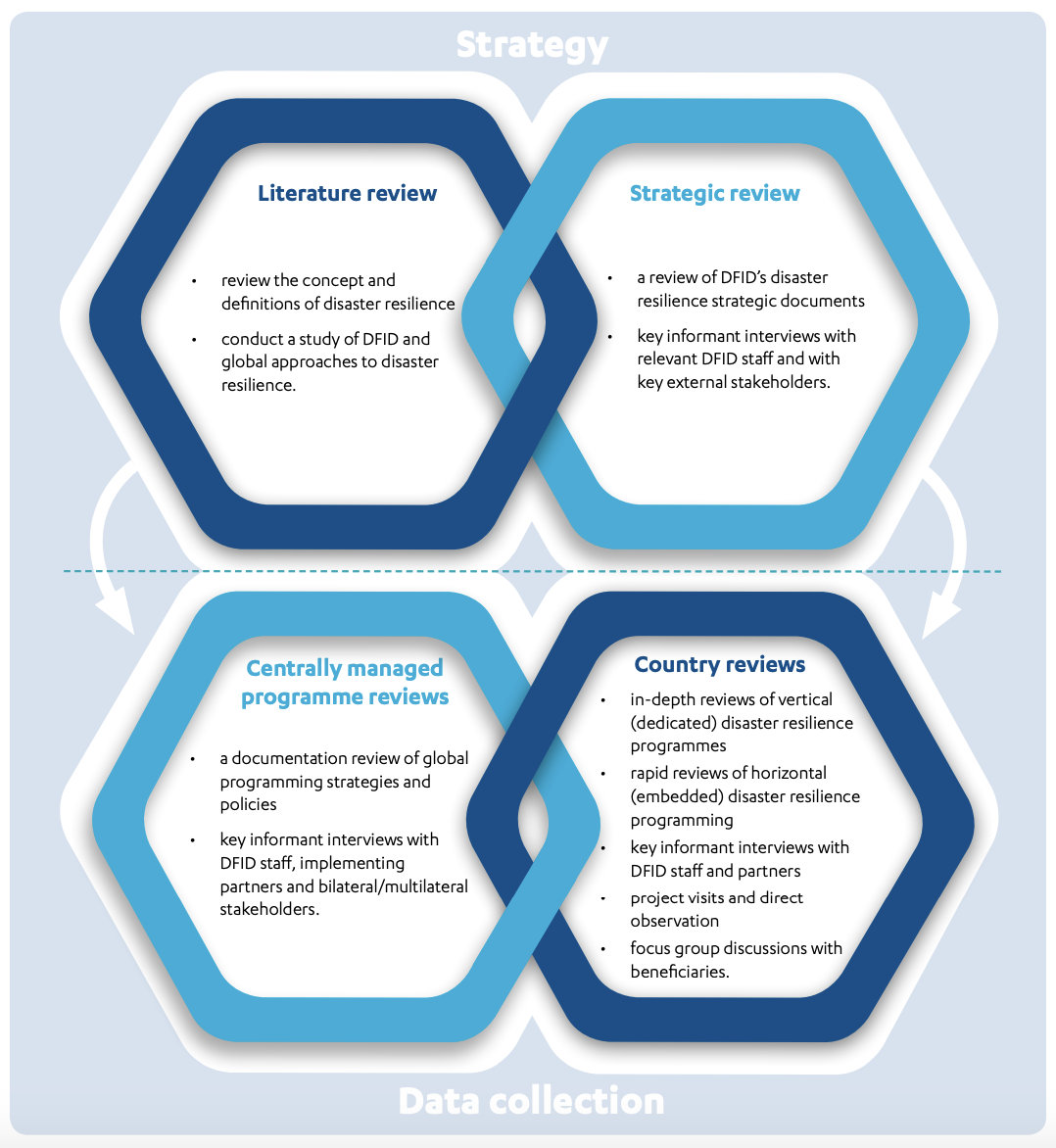
Component 1 – Literature review: In order to identify current trends and good practices, we will undertake an analysis of the literature on disaster resilience. We will explore how disaster resilience is being integrated into humanitarian and development plans and strategies. Where possible, the review will gather information on DFID’s approach relative to the approaches of other humanitarian and development stakeholders, such as recipient and donor governments, civil society organisations and the private sector. The literature review will explore different components of disaster resilience, including disaster risk reduction, disaster preparedness and disaster risk management. The literature review will enable us to situate DFID’s disaster resilience approach, efforts, achievements and learning within the broader context of disaster resilience thinking and action worldwide.
Component 2 – Strategic review: This component will explore DFID’s evolving approach to resilience through desk reviews of its key policies, strategies and guidance, and consultations with key stakeholders at headquarters level. We will review the degree of emphasis given to disaster resilience over time, and the relevance of the approach to DFID’s stated objectives and its analysis of the risks and challenges.
Where possible we will map expenditure on relevant programming. We will explore DFID’s coordination and cooperation with external partners at both national and international levels, including its influencing work at the multilateral level, such as strengthening international frameworks, advocating higher investment levels and strengthening the capacity of key international partners. We will analyse how well DFID is learning from its resilience building activities and adapting its overall approach and programming in response. We will review DFID’s approaches to measuring and maximising impact and value for money from disaster resilience activities.
Component 3 – Centrally managed programme reviews: While the main focus on building resilience to natural disasters is in country-level programmes, we have selected a sample of six centrally managed programmes that are relevant to the disaster resilience agenda: the Africa Risk Capacity programme; the Building Resilience and Adaptation to Climate Extremes and Disasters programme (BRACED); the Catalytic Fund; the Disaster Risk Insurance programme; one Humanitarian Innovation and Evidence programme; and the Strengthening Humanitarian Preparedness for Effective Response programme. We will review all six to assess how they facilitate in-country vertical and horizontal programming, and for their contribution to global efforts in this area. During our country visits, we will consult with DFID country office staff and review evidence as to what contributions these centrally managed programmes have made, including in generating data and evidence to inform programme design.
Component 4 – Country reviews: To assess how well resilience to natural disasters is built into DFID country portfolios, we will review the full range of relevant programmes, and associated influencing efforts, in seven countries (Nepal, Mozambique, Bangladesh, Ethiopia, Uganda, Afghanistan and the Occupied Palestinian Territories). In each case, we will assess DFID’s risk analysis, commitments made in country operational plans, the level of expenditure over time and the approach taken in vertical and horizontal programmes. We will assess both the adequacy of the investment, given identified risks, and the coherence of the approach.
For four of the countries (Ethiopia, Uganda, the Occupied Palestinian Territories and Afghanistan), these assessments will be desk-based, through reviews of relevant strategies and programme documentation and telephone interviews with the responsible DFID staff and, where appropriate, national counterparts and implementers.
For the remaining three countries (Mozambique, Nepal and Bangladesh), we will do a more in-depth review involving country visits. These country visits will allow for more detailed assessments of how resilience objectives are embedded across the country programme, and for the collection of feedback from national stakeholders on the relevance and effectiveness of DFID’s approaches. They will also enable us to investigate the effectiveness of programming in more depth, as is appropriate for a performance review. Having analysed the results data produced by the programmes themselves, we will collect feedback from national stakeholders and view a sample of results through site visits, in order to triangulate our findings. We will identify whether there is evidence of a long-term pattern of results from DFID’s portfolio (for example increased speed and efficiency of humanitarian responses to seasonal flooding in Bangladesh and Mozambique). The country visits will also allow for a more in-depth review of how well DFID works with local, national and international partners, and the extent to which its work is aligned with national strategies and coordinated with other development actors. During the field visits, most of our consultations and interviews will be with key stakeholders at the national level and implementing partners based in the capital. Where possible we will also visit a sample of project sites, interviewing key stakeholders from local government and consulting with implementing partners at the delivery level. This will provide an additional level of triangulation of DFID’s reported results and more context to judge their significance.
5. Sampling approach
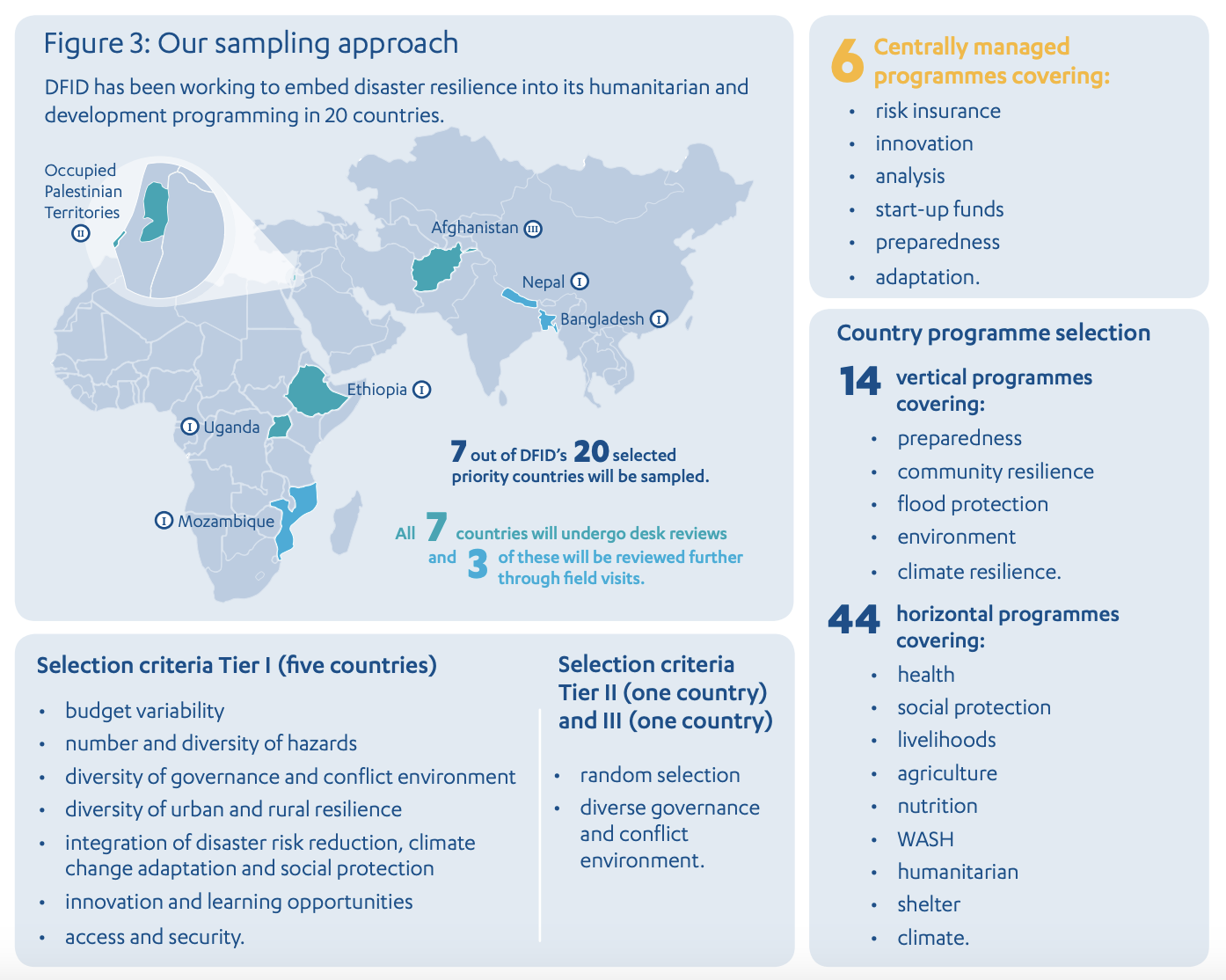
DFID’s centrally managed Catalytic Fund was established in 2012 to help country offices with the process of integrating resilience to natural disasters into their portfolios. It classified 20 DFID priority countries into three tiers according to experience of disaster resilience, based on a self-selection process. We have used this list as the basis for sampling for our country programme reviews.
We have decided to review seven of the 20 countries, with three country visits. This provides a representative spread of national contexts, risk levels and DFID programming. Five of them will be Tier I countries, where there is the greatest density of DFID programming and the longest history of resilience programming. We have also included one country each from Tiers II and III to assess the extent to which learning from Tier I has been adopted. Our criteria for sampling included: the level of risk; the density and diversity of relevant DFID programming; the presence of climate change adaptation and social protection programmes; diversity with regard to budget size, hazard numbers and type; innovation; and opportunities to review value for money. We selected Bangladesh, Mozambique, Nepal, Uganda and Ethiopia from Tier I on that basis; we also selected the Occupied Palestinian Territories from Tier II and Afghanistan from Tier III, which reflect DFID’s programming in fragile and conflict-affected countries.
Across these seven countries, there are around 58 relevant programmes (14 vertical and 44 horizontal). We will assess the coherence of the country portfolio as a whole through a rapid review of the approach taken across all of the programmes. This will enable us to assess the extent to which resilience is mainstreamed across the portfolio. We will then do in-depth assessments of each of the 14 vertical programmes across our seven country case studies. Additionally, we will do in-depth assessments of six of the 44 horizontal programmes (two from each of the countries visited), covering health, water, sanitation and hygiene, climate change, social protection and agriculture. In total, we will do in-depth reviews of 26 programmes (14 vertical, six horizontal and six global). The sampling approach is summarised in Figure 3.
6. Limitations of the methodology
Results measurement: There are no agreed methods for measuring the effectiveness and impact of disaster resilience programming. Our approach will be to investigate results achieved compared to targets and commitments and to assess how far DFID has come in identifying reliable methods for measuring results. We will also seek to identify any opportunities within our country reviews where it can be demonstrated that investments in disaster resilience led to reductions in the cost of recovery from natural disasters.
Value for money: Because results are preventative in nature and there are no standard results measurement approaches, value for money metrics are difficult to apply in disaster resilience programming. We will not attempt to make our own assessment of value for money, but instead will focus on whether DFID has developed and applied appropriate approaches for both measuring and maximising value for money over time, including through cost-benefit analysis in business cases, identifying and monitoring cost drivers and value for money assessments in annual reviews.
7. Risk management
| Risk | Mitigation and management actions |
|---|---|
| Access during field visits becomes limited/impossible | The team will coordinate and communicate with the relevant country offices and local networks in advance of field visits to inform planning and make contingency plans if access becomes more challenging for security reasons. The team will actively monitor developments within the chosen field visit countries to ensure that robust duty of care processes are in place. |
| Stakeholder presence during the August field visit timetable | Significant advance notice will be given for country visits. Where key stakeholders will be absent during country visits, interviews will be conducted remotely before and/or after the visits. |
| Risk of natural disasters before or during the field visit, meaning that DFID staff are diverted to humanitarian relief work | The team will monitor disaster risk for the selected field visit countries using Tropical Storm Tracker, Dartmouth Flood Observatory and longer-term weather prediction tools. They will also coordinate with the relevant country offices in advance of country visits and, where necessary, reorganise or delay in-country field visits. Where DFID staff are not available, remote interviews will be conducted after the country visits. |
8. Quality assurance
The review will be carried out under the guidance of ICAI Lead Commissioner Richard Gledhill, with support from the ICAI secretariat. The review will be subject to quality assurance by the service provider consortium. Both the methodology and the final report will be peer reviewed by Professor David Alexander from the Institute for Risk and Disaster Reduction at University College London. Professor Alexander is an expert on disaster risk, impact and response.
9. Timing and deliverables
The review will be executed over ten months, starting from March 2017.
| Phase | Timing and deliverables |
|---|---|
| Inception | Approach paper: June 2017 |
| Data collection | Country visits: July to August 2017 Evidence pack and emerging findings: September to October 2017 |
| Reporting | Likely report publication: January 2018 |
Footnotes
- Humanitarian Emergency Response Review, UK Government, March 2011, link.
- Promoting innovation and evidence-based approaches to building resilience and responding to humanitarian crises: a DFID strategy paper, DFID, 2012, p. 4, link.
- The World Humanitarian Summit: priorities for reform, International Development Committee, fifth report of session 2015-2016, July 2016, link.
- Hyogo Framework for Action 2005-2015: Building the resilience of nations and communities to disaster, World Conference on Disaster Risk Reduction, Japan, January 2005, link.
- Responding to Crises, National Audit Office, January 2016, link.
- Rapid Review of DFID’s Humanitarian Response to Typhoon Haiyan in the Philippines, ICAI, March 2014, link.
- International Decade for Natural Disaster Reduction, UN General Assembly, 22 December 1989, link.
- Yokohama Strategy and Plan of Action for a Safer World: Guidelines for Natural Disaster Prevention, Preparedness and Mitigation, World Conference on Natural Disaster Reduction, May 1994, link.
- See footnote 4.
- Sendai Framework for Disaster Risk Reduction 2015-30, United Nations, March 2015, link.
- See footnote 1, foreword.
- See footnote 1, p. 19.
- Saving lives, preventing suffering and building resilience: The UK Government’s Humanitarian Policy, DFID, September 2011, p. 11, link.
- Defining Disaster Resilience: A DFID Approach Paper, DFID, November 2011, link.
- Embedding Disaster Resilience: Lessons Review, CHASE, July 2013, unpublished.