ICAI follow-up review of 2016-17 reports
Executive summary
ICAI’s follow-up review is an important element in the scrutiny process for UK aid. It provides the International Development Committee and the public with an account of how well the government has responded to ICAI’s recommendations to improve spending. It is also an opportunity for ICAI to identify issues and challenges facing the UK aid programme now and in the future, which in turn helps to inform subsequent reviews.
This review follows up on progress made by aid-spending government departments and funds on addressing recommendations from the seven reviews we published between November 2016 and June 2017. It also revisits three issues identified as outstanding from last year’s follow-up review.
Table 1: Scope of the follow-up review: reviews by review type and outstanding issues from earlier follow-ups
| Review Type | Review Title and Date |
|---|---|
| Rapid reviews | The cross-government Prosperity Fund February 2017 |
| The UK's aid response to irregular migration in the central Mediterranean March 2017 | |
| Performance reviews | When aid relationships change: DFID's approach to managing exit and transition in its development partnerships November 2016 |
| Accessing, staying and succeeding in basic education – UK aid's support to marginalised girls December 2016 | |
| UK aid in a conflict-affected country: Reducing conflict and fragility in Somalia June 2017 | |
| Impact reviews | The effects of DFID's cash transfer programmes on poverty and vulnerability January 2017 |
| Learning reviews | DFID's approach to supporting inclusive growth in Africa June 2017 |
| Earlier reviews with outstanding issues | DFID's efforts to eliminate violence against women and girls On violence against women and girls (VAWG) May 2016 |
| DFID's approach to managing fiduciary risk in conflict-affected environments On fiduciary risk management August 2016 | |
| DFID's approach to delivering impact On results management at country and departmental level June 2015 |
In this summary, we look across the reviews and comment on some of the main achievements and unresolved issues. We include two tables with a brief account of the government’s response to each of our recommendations and outstanding issues (Tables 2 and 3).
Areas of progress
All ICAI reviews receive a formal government response setting out whether or not the recommendations are accepted and what actions will be taken to address them. In the follow-up exercise, we assess the actions taken to address our recommendations and concerns, and consider whether these were appropriate and sufficient.
This year’s follow-up review highlighted a range of positive actions, leading to significant progress in a number of areas of UK aid, most notably:
- Managing the Prosperity Fund: Our review of the Prosperity Fund had warned that the rapid scale-up of the Fund posed significant value for money risks, given the responsible departments’ relative inexperience with managing large-scale official development assistance (ODA) programmes. The Treasury accepted our recommendation to slow down the rate of spending, extending the lifetime of the Fund by two years, while slightly reducing its total planned spending from £1.3 billion to £1.22 billion.
- Marginalised girls’ education: In February 2018 DFID launched a new education policy, which included a strong focus on reaching marginalised girls, reflecting ICAI’s recommendations. This was further supported by the greater focus on equity in DFID’s new value for money guidance, which emphasises the inclusion of marginalised groups even when this involves additional effort and costs. We also found that DFID had made efforts to ensure that its flagship centrally managed programme on marginalised girls’ education, the Girls’ Education Challenge, is better aligned with its in-country programmes.
- Do no harm: A key principle of good development practice is that aid programmes should avoid causing inadvertent harm to vulnerable individuals, particularly in conflict-affected settings. Our reviews of the UK’s aid response to irregular migration and the use of UK aid to address conflict and fragility in Somalia, recommended that interventions should be underpinned by careful analysis of the drivers of conflict and human rights risks. In our review of cash transfers, we recommended greater attention to mitigating the risks of harm, such as increased domestic violence against women beneficiaries. We found that DFID has taken action to strengthen analysis and risk management in all three cases – but we also noted that the cross-government Conflict, Stability and Security Fund (CSSF) has more to do in this area.
- Irregular migration: The irregular migration review recommended that departments should not label development programmes as migration-related unless they target specific groups with a known propensity to migrate irregularly, and can offer a testable theory of change as to how they will influence migration choices in order to avoid making tenuous impact claims. While DFID has not revisited existing programmes to address this recommendation, its latest migration-labelled programming and research do explore the complex interactions between development and migration patterns.
- Inclusive growth: Our review of DFID’s approach to inclusive growth in Africa recommended improvements in the diagnostic tools that DFID used to design its country portfolios, in the areas of inclusivity, political economy analysis and prioritisation. DFID is now developing new diagnostic tools that address many of the concerns underpinning ICAI’s recommendations.
Many of these improvements relate directly to issues and recommendations raised in ICAI’s reviews, although we acknowledge that progress cannot be solely attributed to ICAI. The aid programme is continually evolving, and there are many instances where we make recommendations with the aim of influencing or encouraging departmental initiatives and reforms that are already underway.
Areas of concern
There were also a number of areas where the responses to our recommendations were weaker, or where implementation had not progressed as far as we would have expected, in particular:
- Cash transfers: We had found that DFID’s cash transfer programmes were making a strong contribution to poverty reduction. We therefore recommended that DFID consider scaling up its financial contributions where this could help to extend the coverage of national social protection systems. DFID only partially accepted this recommendation, stating that the “mix of support we provide (including financial contributions) continues to be made on a case-by-case basis”. In practice, however, our follow-up on this recommendation did not find any examples where programmes had been expanded. We perceived a move away from the direct funding of cash transfer programmes, and towards technical assistance to national government-funded schemes.
- Managing exit and transition from aid relationships: Although there were some country exceptions, our transition review found weaknesses in the way that DFID approaches exit or transition away from traditional development partnerships – typically for lower-middle-income countries that are ‘graduating out’ of the need for bilateral or financial aid.1 DFID accepted or partially accepted all the review’s recommendations. It responded that a number were already being implemented as part of DFID’s broader work, but that other recommendations were not pursued in full since there had been no exits or transitions in the period after the publication of the ICAI review. The department has only recently begun to develop working principles for successful exits and transitions, as part of its ‘strategic directions’ work. We re-emphasise the importance of taking steps to address all our recommendations in preparation for the next round of transitions to post-aid relationships and will return to this topic in next year’s follow-up review.
The National Security Capability Review, Cabinet Office, March 2018
Looking to the future, we will be innovative in developing new tools and partnerships that can better meet the needs of emerging lower middle income countries and deepen the UK’s economic relationships with growing markets.
- Sustaining the focus on marginalisation: In our review of marginalised girls’ education, we flagged a tendency for DFID’s bilateral programmes to lose their focus on tackling marginalisation as they grappled with implementation challenges. DFID has subsequently made improvements to individual programmes, but has not yet identified mechanisms for addressing the problem more broadly.
- Monitoring and measuring results in the Prosperity Fund: Our review found that the Prosperity Fund had committed funding and approved programmes before clear objectives and portfolio-level results indicators had been developed. We noted that this could lead to a fragmented portfolio and weak results management. While the Fund is currently in the process of developing portfolio-level results indicators, this is being done only after 19 business cases have already been approved.
- Ensuring inclusion in economic development: Our inclusive growth review recommended that DFID strengthen its approach to inclusion in each country portfolio, striking a balance between promoting structural change and growth, and ensuring that risks of exclusion are identified and managed. DFID has not yet produced guidance or taken practical measures to address this challenge.
Cross-cutting themes
This follow-up process has highlighted issues of strategic importance to UK aid spending that cut across many of our 2016-17 reviews. We will continue to monitor these in ongoing and future reviews:
- Leaving no one behind: Four of our seven reviews in 2016-17 made recommendations related to the UK government’s commitment to embed the principle of ‘leaving no one behind’ across its ODA programming. Our follow-up shows that further efforts are necessary to ensure that inclusion goals are integral to all UK aid initiatives, from the planning stage all the way through implementation.
- Learning: We issued learning-related recommendations in all of our 2016-17 reviews. DFID commissions a lot of high-quality research and analysis with important implications for programming. However, we often found it difficult to see how new knowledge is shared and translated into practical action. We also note that the new cross-government funds have struggled with setting up timely and robust monitoring, evaluation and learning practices.
- Non-DFID aid: Our review of the Prosperity Fund was the first of a series of reviews of aid spending by major cross-government funds that are not managed by DFID. These reviews found that the funds face a steep learning curve, building up aid management capacity and developing, testing and bedding down processes to ensure that their work meets the high standards expected from UK aid. Scrutinising these funds and other non-DFID aid will continue to be an important focus for ICAI.
Outstanding issues
Overall, there has been a good level of engagement with ICAI’s recommendations across the reviews. But there are also a number of areas where the responsible departments could be doing more. We have identified four areas of strategic significance that merit further follow-up next year, either because the response has fallen short of what we expected or because government actions were only at the planning stage during our follow-up exercise:
- Transitioning from traditional aid relationships: We will assess DFID’s progress on putting in place key principles for managing its changing relationships with partner governments and civil society organisations in middle-income countries as they ‘graduate’ from conventional bilateral or financial aid.
- Prosperity Fund: We will explore the Fund’s progress with (i) developing portfolio-level results indicators and associated systems for measuring results and learning from experience; and (ii) implementing its new procurement framework. We will also assess whether the newly merged governance arrangements of the Prosperity Fund and the CSSF include explicit and challenging procedures to assess the ODA eligibility of programmes proposed for funding.
- Irregular migration: We will assess (i) progress on identifying and managing the risks of harm to vulnerable migrants in the UK’s migration-related programming; and (ii) the monitoring and evaluation arrangements for DFID’s new flagship programme, the Safety, Support and Solutions Programme for Refugees and Migrants.
- Inclusive growth: We will assess the progress that DFID has made on refining its approach to inclusion in economic development programming, at both the country portfolio and individual programme levels.
Table 2: Summary of the government’s response to ICAI recommendations
| ICAI recommendation | Govt's initial response | Our assessment of progress since then | Overall |
|---|---|---|---|
| The cross-government Prosperity Fund, February 2017 | |||
| Slow down planned rate of expenditure to match delivery capacity. | Accept | The Treasury has extended the Prosperity Fund's lifespan from five to seven years. | Positive action in all areas |
| Refine strategic objectives and align portfolio-level results indicators with these. | Partially accept | The Fund's broad strategic objectives have not been refined, but portfolio-level indicators are in the process of being developed. | |
| The process for ensuring ODA eligibility should be explicit and challenging. | Accept | Programme approval now includes a clear yes/no question on ODA eligibility, but more could be done to ensure that development goals are the primary purpose of programmes. | |
| Formalise and be more open about the Fund's engagement with UK and international firms. | Accept | A procurement framework for letting contracts to private actors is now in place, with more efforts made to communicate better with potential suppliers. | |
| Improve transparency on the Fund's procedures. | Accept | Transparency on spending and results is slowly improving. | |
| The UK's aid response to irregular migration in the central Mediterranean, March 2017 | |||
| Only label programmes as migration-related if they credibly influence migration choices. | Partially accept | There is improved guidance on categorising new programmes. The government has chosen not to revisit existing programmes, but a new flagship programme is clearly migration-focused, with an approach addressing issues arising along the whole migration route. | Positive action in all areas with progress at an early stage |
| Adapt monitoring and evaluation to reflect the long causal chains from intervention to migration decision. | Partially accept | Research has been commissioned to inform evidence-based programming on why people migrate. There is resourcing in place to develop migration-sensitive monitoring and evaluation frameworks, although this is at an early stage of development. | |
| Ensure that the UK aid response to irregular migration does not do harm to vulnerable refugees and migrants. | Accept | Measures have been taken to ensure that programmes identify, assess and mitigate potential risks of human rights violations and other forms of harm. It is too early to assess the results of this. | |
| When aid relationships change: DFID's approach to managing exit and transition in its development partnerships, November 2016 | |||
| Establish a central point of responsibility and redress the lack of policy, guidance and learning on transition. | Partially accept | There is now a central point of responsibility for transition as well as a central learning hub. DFID says it has recently begun developing a set of working principles for managing transition processes. | A mixed response. Most actions are at the planning stage |
| Improve coordination between UK departments when managing bilateral relationships during transition or exit. | Accept | DFID said it was already implementing this recommendation, as working across government is core to DFID's policy and operating model. However, we did not find that any significant action had been taken to address the particular weaknesses found in our review. | |
| Strengthen accountability and transparency on what kinds of aid continue after transition. | Accept | DFID said it was already implementing this recommendation. ODA reporting, including when spent by departments other than DFID, is on an improving trajectory. DFID could be clearer when communicating to the public what it means to 'end financial aid'. | |
| Assess consequences for, and decide whether to support, local civil society partners through the transition process. | Accept | DFID intends to address this issue in its working principles on managing transition. However, reforms to civil society organisation funding mechanisms have made access to support from DFID more difficult for local civil society organisations. | |
| Accessing, staying and succeeding in basic education – UK aid's support to marginalised girls, December 2016 | |||
| Develop country-specific strategies for marginalised girls' education to ensure coherence across programmes. | Accept | DFID's new education policy has a strong focus on marginalised groups. Measures have been taken to improve coordination and coherence between the Girls' Education Challenge Fund and DFID's other education work. | Positive action in most areas |
| Ensure that the focus on marginalised girls is not lost during implementation. | Partially accept | The emphasis on marginalised groups in the new education policy will help, but DFID has not yet introduced any new practical measures to support this in programme design and monitoring. Significant improvements have been made in those programmes where we had noted a loss of focus. | |
| Specify how to approach value for money when targeting marginalised groups. | Partially accept | New internal guidance explains how and when to consider equity within a comprehensive value for money framework, but could be more detailed. | |
| UK aid in a conflict-affected country: Reducing conflict and fragility in Somalia, June 2017 | |||
| Develop a more systematic and shared understanding of the drivers of conflict. | Accept | There is a range of new research and analysis, including a new Joint Analysis of Conflict for Somaliland and a macro-level analysis of conflict risks and conflict drivers for Somalia. | Positive action in some areas, limited progress in others |
| Promote inclusion and human rights across the portfolio of UK aid to Somalia. | Accept | DFID has begun an initiative to improve inclusion of marginalised groups, but this has not yet led to noticeable changes in practice. | |
| If programmes are intended to contribute to peace- and stability-related outcomes, this should be built into their objectives. | Partially accept | The refresh of the government's strategy for Somalia has more clearly articulated the connection between some programmes and their objectives, but not across the board. | |
| Provide sufficient oversight and support to private contractors, and ensure they are accountable to national authorities. | Partially accept | No significant initiatives. | |
| The CSSF should strengthen its focus on monitoring, evaluation and learning. | Accept | The CSSF has committed to improving its monitoring, evaluation and lesson-learning capabilities for Somalia, but there have been no significant actions yet. | |
| All CSSF ODA-funded activities should have clear developmental objectives. | Partially accept | Some initiatives to strengthen the focus on ODA eligibility assessment in the design phase and annual review of CSSF programmes, and in the refresh of the government's strategy for Somalia. | |
| Adopt a more systematic approach to learning on what works in addressing conflict and fragility. | Accept | There is a cluster of new learning initiatives and research on what works, initiated by both DFID and the CSSF and involving cross-government collaboration. | |
| Greater integration between DFID and the Foreign Office on operations in Somalia. | Accept | Some useful IT improvements and other changes to encourage cross-government working. | |
| The effects of DFID's cash transfer programmes on poverty and vulnerability, January 2017 | |||
| Consider scaling up cash transfer programmes when appropriate. | Partially accept | Direct funding for developmental cash transfer programmes has not increased since the review. We discern a move away from direct funding towards technical assistance. | Positive action on two out of four recommendations |
| Be clearer on impact goals and reflect these goals in programme design and monitoring. | Accept | DFID has revisited the monitoring arrangements for its programmes. It has not, however, revisited the alignment between programme aims and programme design. | |
| Follow through on commitments to empower women through cash transfers. | Accept | A five-year £19 million gender and social protection programme has been approved, and there is stronger guidance on assessing and monitoring safeguarding risks. | |
| Take a more strategic approach to technical assistance on national cash transfer systems. | Accept | The publication of new guidance on technical assistance has been delayed by three months and is now scheduled for July 2018. | |
| DFID's approach to supporting inclusive growth in Africa, June 2017 | |||
| Use diagnostic and planning tools to prioritise investments into areas most likely to contribute to transformative growth. | Accept | DFID informs us it is taking ICAI's recommendation into consideration as part of its current process of updating its diagnostic tools. | A mixed response |
| More guidance on balancing investment in long-term structural change and supporting livelihoods for the poor. | Partially accept | DFID prefers to let country offices decide on the sequencing and balance between economic growth and social inclusion programmes. | |
| Prioritise learning on how to combine politically smart and technically sound approaches to economic development. | Accept | The new diagnostic tools will include more detail on political economy. A number of research programmes are underway, designed to generate a better understanding of which institutions matter for economic growth. | |
| Address the exclusion of women, young people and marginalised groups in programme designs and results frameworks. | Accept | DFID is beginning a drive to disaggregate its results data and the new diagnostics will have 'inclusion' as one of their pillars. However, no specific measures have been taken to improve the monitoring of distributional impacts. | |
Table 3: Outstanding issues from earlier reports
| ICAI recommendation | Our assessment of progress since then | Overall |
|---|---|---|
| DFID's efforts to eliminate violence against women and girls (VAWG), May 2016 | ||
| Mainstreaming VAWG initiatives into DFID sectoral programmes and the CSSF portfolio. | VAWG remains a priority for DFID, confirmed in its March 2018 Strategic Vision for Gender Equality, but it is competing with a broader range of priorities than previously. There has not yet been any scaling up of programming on VAWG at country level. However, progress on research and central planning tools is creating a strong platform on which to base mainstreaming and the scale-up of country programming from 2019 onwards. | Some progress, but moving slowly |
| DFID's approach to managing fiduciary risk in conflict-affected environments, August 2016 | ||
| Strengthening oversight of implementers in complex delivery chains. | Since last year's follow-up, there have been improvements in learning mechanisms, aligning country offices with central teams and encouraging multilaterals to adopt more transparent measures. However, DFID acknowledges that much remains to be done. | Emerging good practice and increased momentum, but more to do |
| DFID's approach to delivering impact, June 2015 | ||
| Aggregating and reporting on development results above the programme level. | While DFID has removed global results targets from its most recent single departmental plan, country offices still collect data on their contribution to a number of global targets. There is, however, no results reporting at country portfolio level and no reporting of transformative results, such as policy influence or developing national capacity. DFID informs us that it is reviewing its approach to aggregate results reporting in preparation for the next UK government spending review. ICAI will have an opportunity to look again at this in the follow-up to the value for money review in 2019. | No significant improvements |
1 Introduction
1.1 The Independent Commission for Aid Impact (ICAI) helps to improve UK aid through robust, independent scrutiny, providing assurance to taxpayers about UK aid spending. A crucial part of that scrutiny is our follow-up process, where each year we return to the recommendations from the previous year’s reviews to see how well they have been received and acted upon by the relevant government department.
1.2 The aid-spending departments subject to an ICAI review are required to provide a formal government response to recommendations contained in the report within an agreed timescale – three weeks for the recommendations covered by this follow-up review, but recently extended to six weeks to allow departments more time to consider the recommendations and proposed actions. The government response indicates whether it accepts, partially accepts or rejects each recommendation and sets out what actions it plans to take to address them.
1.3 We then conduct a formal follow-up exercise, investigating the extent to which the government has done what it promised to do – whilst considering any additional relevant actions – and determining whether we find this to be a suitable and adequate response to the original recommendation.
1.4 This report presents the results of this annual follow-up exercise. It provides a record for the International Development Committee and the public of how well the UK government has responded to ICAI’s recommendations and findings. The follow-up process is also an opportunity for additional interaction between ICAI and responsible staff in DFID or other government departments, offering feedback and learning opportunities for both parties. The follow-up process is a central part of our work to ensure maximum impact from our reviews.
1.5 ICAI published seven reviews in 2016-17. All of the 31 recommendations made in these reviews were accepted or partially accepted. The follow-up exercise was conducted between six and 12 months after these reviews were published. We also followed up on three issues that had been identified as outstanding in the previous year’s follow-up.
2 Methodology
2.1 When we follow up on our past reviews, we focus on four aspects of the government response:
- whether the actions proposed in the government response are likely to address the recommendations
- progress on implementing the actions set out in the government response, as well as other actions relevant to the recommendation
- the quality of the work undertaken and how likely it is to be effective in addressing the concerns raised in the review
- the reasons why any recommendations were only partially accepted (none of the 2016-17 recommendations were rejected).
2.2 We begin by asking the relevant government department to prepare a brief note, accompanied by documentary evidence, summarising the actions taken to implement the response to our recommendations. We then check that account through interviews with the responsible staff, both centrally and in country offices, and by examining relevant documentation. Where necessary or useful, we also interview external stakeholders, including other UK government departments, multilateral partners and implementers. To ensure we maintain sight of broader developments, we also assess whether ICAI’s findings and analysis have been influential beyond the specific issues raised in the recommendations.
2.3 The follow-up process for each review concludes with a formal meeting between the lead commissioner and the senior civil service counterpart in the responsible department.
2.4 At the end of the follow-up process, we identify issues of continuing strategic importance where we judge the action taken by the department in question to have been inadequate or incomplete. These issues are flagged for further follow-up the following year.
2.5 We also use the follow-up process to inform internal learning for ICAI about the impact of our reviews on UK aid and how we communicate our findings and recommendations in order to achieve maximum traction with the government.
Box 1: Limitations to our methodology
Assessing the impact of ICAI recommendations is not straightforward. UK aid programming is not static, with new policies and strategies launched every year. Often our recommendations concern areas of activity already undergoing important changes, and sometimes ICAI’s reviews are only one among several reports highlighting similar issues or making similar recommendations. Attributing particular reforms or policy changes directly to ICAI reviews is therefore not always possible. Instead, we consider relevant changes that have occurred since our reviews, where it is plausible that ICAI has influenced the action taken
3 Cross-cutting themes
3.1 During the course of our follow-up exercise, we noted three themes that recurred across several reviews and which we believe are likely to be of strategic importance in the coming years. These issues continue to be important, also appearing in recently completed and ongoing reviews.
Leaving no one behind
3.2 One of the major changes in DFID’s work in recent years has been its commitment to leaving no one behind. DFID was an advocate for including the principle in the Sustainable Development Goals (or Global Goals), which were adopted in 2015, and has promised that it will embed consideration of the interests of the poorest, most vulnerable and marginalised in society across all its programming.
Leaving no one behind: Our promise, DFID, January 2017
We believe that no one should face the indignity of extreme, absolute, chronic poverty, no one should be denied the opportunity to realise their full potential or to share in progress, no-one should be unfairly burdened by disaster or a changing climate, and no-one should have their interests systematically overlooked. We believe it is in all of our interest to leave no one behind and to ensure a fair opportunity for all, now and for the future.
3.3 DFID is still working through the far-reaching practical implications of this commitment. It affects how programmes are designed, implemented and monitored. It means finding an appropriate balance between maximising reach and ensuring that specific target groups are being included (addressing equity, even where it is costly to do so). It means encouraging implementing partners to focus on remote geographical areas and hard-to-reach social groups. It means monitoring whether programmes inadvertently exclude certain categories of people. It also involves building DFID’s knowledge of the social forces that drive the exclusion of women, the elderly, people with disabilities and ethnic and religious minorities.
3.4 In our 2016-17 reports, ICAI made a number of recommendations on leaving no one behind, including that:
- DFID should ensure that it does not lose focus on marginalised girls during the implementation phase of its education programmes.
- DFID should follow through on commitments to empower women through cash transfers, while also paying closer attention to the heightened risk of domestic violence against women beneficiaries of cash transfer schemes.
- State-building programmes in Somalia should promote more inclusive participation and the portfolio of UK aid there should have a stronger focus on human rights and on counteracting the exclusion of women.
- DFID should ensure that its long-term strategic objectives to support structural change, economic growth and job creation include the poorest and most marginalised in society by:
- addressing the exclusion of women, young people and marginalised groups in programme designs and results frameworks,
- developing more guidance on how best to balance investment in long-term structural change and job creation with shorter-term programmes aimed at supporting livelihoods for the poor.
- DFID should continue its efforts to mainstream initiatives to combat violence against women and girls across its programming.
3.5 These recommendations have generally led to positive government actions, as the individual review sections in the next part of this report show. For instance, in response to our review on marginalised girls’ education, DFID country offices made important improvements to the individual programmes that the review had critiqued for losing focus on their inclusion goals in the implementation phase. DFID has demonstrated that it can achieve results for marginalised groups when its programmes are explicitly designed to focus on the issue. However, the ‘leave no one behind’ commitment goes further than that: it requires the government to bring an inclusion lens to all its aid programming as a matter of standard practice. This means building inclusion into programme targets and systems for measuring results and value for money, so that it becomes central to the way it holds its implementers – and itself – to account.
3.6 Efforts to include or target marginalised groups are not always endorsed by the UK’s partner governments or subscribed to by local communities. Discriminatory practices can be socially or culturally entrenched, making it a challenging task to ensure that inclusion goals are consistently adhered to across the lifespan of a programme. Constant attention to this challenge is needed, if inclusion is to be meaningfully pursued in the implementation of UK aid programmes.
Learning and the use of evidence for improvement
3.7 Learning is an area of strong interest in all ICAI reviews. We encourage DFID and other responsible departments to strive for continuous improvement in their aid programming. We are keen to see how well they tackle new challenges, by identifying knowledge and evidence gaps and working to fill them in a structured way. We also pay close attention to how knowledge is synthesised, shared and used to inform action.
3.8 In 2016-17, we issued a series of recommendations relating to research and learning, including:
- improvements to monitoring, reporting, evaluation and learning in the Prosperity Fund
- building better evidence on the causes of irregular migration and the complex links between development outcomes and migration patterns
- a more structured approach to learning what works in using aid to address conflict and fragility in Somalia
- a more active monitoring and learning approach in economic development programmes, to track distributional impacts and identify winners and losers
- improvements to monitoring and reporting results at the country portfolio level, to capture transformative and cross-cutting results.
3.9 There were good responses to most of these recommendations. We saw several examples of new research being commissioned, or monitoring and evaluation frameworks being put in place as part of the government response. DFID, in particular, has a track record of commissioning high-quality research and analysis with important implications for programming – both its own and that of others.
3.10 However, both in our original findings and in our follow-up exercises, we have often found it difficult to see how the new knowledge generated through research and evaluation is being shared and translated into practical action. The use of evidence in business cases is patchy and DFID’s decentralised evaluation function makes it more difficult to build evidence on what works in a systematic way. In the case of the Prosperity Fund, we are concerned that too many of the learning tasks are contracted out, which heightens the risk that learning is seen as an ‘add-on’ rather than an essential part of the programming cycle. We also noted in our irregular migration and Somalia reviews that the CSSF is struggling with weak monitoring, learning and evaluation practices. This finding was confirmed in our 2018 review of the CSSF’s aid spending.2
Non-DFID aid and cross-government funds
3.11 The last few years have seen a rapid increase in the share of the UK aid programme spent by departments other than DFID (see Figure 1), which can stretch existing capacity and systems. In some cases, spending departments or agencies are new to the norms and standards that apply to aid and are inexperienced in designing and managing large aid programmes.
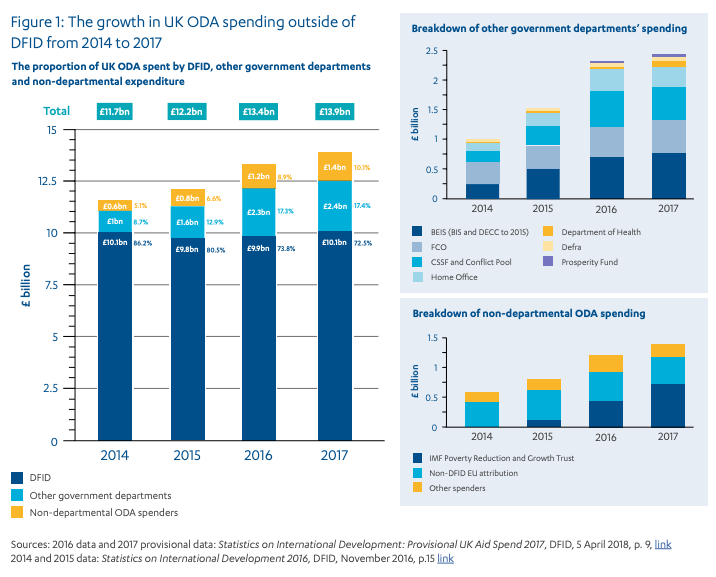
In 2017 DFID accounted for 72.5 per cent of UK ODA, whereas 5 years ago (2013) it accounted for 87.8 per cent.
Statistics on International Development: Provisional UK Aid Spend 2017, DFID, 5 April 2018, p. 9
3.12 The Prosperity Fund review was the first of a number of ICAI reviews focused on aid spending by large, newly created cross-government funds, intended to help the responsible departments put in place the systems and processes required to ensure the effectiveness and value for money of aid expenditure.3
3.13 Our findings from the Prosperity Fund, Somalia and irregular migration reviews, as well as from reviews we have published since 2016-17, show that ensuring compliance with the international definition of ODA and, where applicable, the UK’s International Development Act, can be challenging for funds and departments that are new to aid programming. In particular, where the funds bring a UK national interest perspective to their work, they need to ensure that promoting development and poverty reduction remains the primary purpose of the assistance. The Prosperity Fund has responded to our recommendations in this area by introducing a more rigorous screening process for ODA eligibility.
3.14 Since then, the National Security Capability Review (NSCR), published in March 2018, has set out a ‘fusion doctrine’ of national security, where all UK government departments work collectively to promote National Security Council priorities. The NSCR aims to align the cross-government funds more closely with the National Security Council strategy. It will be an important challenge in this context to ensure that the cross-government funds’ aid programmes are not just ODA eligible, but also reflect good practice for the effective and efficient use of ODA to achieve development goals.
3.15 Building up the necessary aid management capacity at a pace commensurate with the planned scale-up of expenditure has involved a steep learning curve for the responsible departments. Beyond ODA eligibility, considerable time and effort is required to develop, test and bed down processes to ensure that aid programmes meet the high standards expected of UK aid. Scrutinising non-DFID aid will therefore continue to be an important focus of our work.
3.16 The secretary of state for international development announced in April 2018 that she had brought together all ODA spending departments and the National Security Council to agree “a package of tools and training to be delivered by DFID to enable them to spot opportunities to design and manage their programmes really well”. This is a welcome step towards improving the effectiveness and efficiency of non-DFID ODA spending.
The National Security Capability Review, Cabinet Office, March 2018
We launched the cross-government Prosperity Fund and significantly expanded the CSSF in the [Strategic Defence and Security Review], recognising the potential for these innovations to make a major impact on delivery of our national security objectives. As a result of the NSCR, we will enhance the cross-government funds by improving strategic direction through the Fusion Doctrine, governance through a new Ministerial committee, and efficient administration by merging the secretariats into a single Funds Unit.
4 Findings from individual follow-ups
4.1 This section presents the results of our follow-up investigations of the government’s responses to our 2016-17 reports and of three outstanding issues identified in last year’s follow-up. We present the results of each follow-up assessment in turn, focusing on the most significant results from, or gaps in, the response. We have organised the presentation of the follow-up of individual 2016-17 reports according to type of review (see Box 2), including the rapid review, a new type of review first introduced for our analysis of the Prosperity Fund.
Box 2: Different types of ICAI reviews
Rapid reviews are short reviews carried out in real time to examine an emerging issue or new area of UK aid spending. Rapid reviews provide an initial analysis with the aim of influencing programming at an early stage. They are not scored. We conducted two rapid reviews in the period covered by this follow-up: on the cross-government Prosperity Fund and on the UK aid response to irregular migration in the central Mediterranean.
Performance reviews look at how efficiently and effectively UK aid is being spent on a particular area, and whether it is likely to make a difference to its intended beneficiaries. Performance reviews aim to identify improvements in processes and ways of working to increase effectiveness and value for money. We conducted three performance reviews in 2016-17: on transitioning from aid, marginalised girls’ education and the UK aid effort in Somalia.
Impact reviews examine results claims made for UK aid to assess their credibility and their significance for the intended beneficiaries, We examine the quality of results data generated by aid programmes and whether the data is being used to improve results over time. We also assess value for money – that is, whether DFID or other spending departments are maximising the return on UK aid invested. We conducted one impact review in 2016-17: on cash transfers.
Learning reviews explore how knowledge is generated in novel areas and translated into credible programming. While learning reviews do not attempt to assess impact, they offer a critical assessment of progress to date and whether programmes have the potential to produce transformative results. We conducted one learning review in 2016-17: on inclusive growth.
The cross-government Prosperity Fund
4.2 ICAI’s first rapid review was of the then recently established Prosperity Fund. The Prosperity Fund is a cross-government fund that blends ODA with a small amount of non-ODA to reduce poverty and promote inclusive growth, particularly in emerging markets and middle-income developing countries, while at the same time creating opportunities for UK and international business. It is a complex and ambitious fund, with systems and processes that were still under development during the ICAI review, and that have continued to evolve after its publication.
4.3 When ICAI began its review, the Fund had already started provisionally allocating funding but had not begun to roll out programmes. The review therefore looked at factors affecting the future effectiveness of programmes, such as the Fund’s strategic objectives, governance structure, monitoring and evaluation arrangements and its approach to determining whether programmes conformed to the internationally recognised definition of ODA. As with all rapid reviews, it was not scored. The review noted considerable progress in the Prosperity Fund’s procedures and practices over the course of the review period, but also highlighted a range of concerns. We made five recommendations, in the areas indicated in Table 4.
Table 4: Summary of recommendations and the government’s response
| Subject of recommendation | Govt's response |
|---|---|
| Slow down planned rate of expenditure while developing the Fund's delivery capacity. | Accept |
| Refine strategic objectives and align portfolio-level results indicators with these. Develop monitoring, reporting and evaluation processes at both portfolio and programme level. | Partially accept |
| The process for ensuring ODA eligibility should be explicit and challenging. | Accept |
| Formalise and be more open about the Fund's engagement with UK and international firms. | Accept |
| Establish the Fund's procedures on the basis of full transparency in line with the government's public stance on this issue. | Accept |
Slow down planned rate of expenditure
4.4 Our original review found that the planned scale and pace of the Prosperity Fund’s aid spending posed a number of risks. Chief among them was the risk that government departments that had little or no experience of large-scale aid programming would struggle to design and deliver credible programmes. ICAI therefore recommended slowing down the planned rate of expenditure to reflect the Fund’s delivery capacity.
4.5 The government responded quickly to this recommendation. The Treasury decided to move £150 million allocated for spending by the Prosperity Fund into the next spending review period, to give the Fund time to strengthen design and assurance processes and to help ensure delivery departments focus on impact and value for money. Following Treasury agreement to a further extension of the Fund’s lifespan, total funding is now expected to be £1.22 billion over seven years instead of the original £1.3 billion over five years.
4.6 We are pleased with this prompt response to our recommendation, which illustrates the usefulness of early scrutiny and rapid reviews.
Refine strategic objectives and align portfolio-level results indicators with these
4.7 The breadth of the Fund’s strategic objectives, combined with an allocation process based on government departments bidding into the Fund for individual programmes, risked creating a highly fragmented portfolio. We were concerned that this would make it difficult for the Prosperity Fund to achieve and demonstrate strategic impact greater than the sum of individual programme parts, commensurate with an ODA investment of this size. The review therefore recommended that the “Fund should refine its strategic objectives and develop a set of portfolio-level results indicators, to which each programme should align”.
4.8 We were also concerned that the Fund was relying heavily for its monitoring, reporting, evaluation and learning (MREL) work on external suppliers, including for the creation of results indicators. While we accept the value of independent evaluation, it is a high-risk choice not to have stronger in-house ownership and capacity. The review therefore recommended that the Fund’s MREL services should be integrated with management and learning processes at both portfolio and programme levels.
4.9 The Prosperity Fund’s response has been positive, but much remains to be done. The Fund’s strategic objectives have not been refined since the review, but portfolio-level indicators are now in the process of being developed using external expertise. However, since 19 business cases have already been endorsed by the cross-departmental Portfolio Board,4 there will inevitably be an element of retrofitting the indicators (when finalised) to what has already been approved. This is not good practice.
4.10 Responsibility for MREL contracts was transferred from the Foreign Office (FCO) to the Cabinet Office after our review, which resulted in delays. While the MREL plans are appropriate, they are coming on stream late in the approvals process.5
4.11 On a more positive note, the Fund’s management has put in place extensive training for Prosperity Fund staff in the UK and overseas, hired gender and social development expertise, issued a suite of guidance notes for all staff and engaged closely with its MREL service providers.
The process for ensuring ODA eligibility should be explicit and challenging
4.12 We were not convinced that the concept notes we reviewed ensured that programmes would satisfy the requirements of the international ODA definition. The review therefore recommended that “the process for ensuring ODA eligibility should be explicit and challenging” and that business cases should include “a plausible strategy for delivering primary purpose and secondary benefits, based on sufficient evidence and analysis, and give adequate consideration to gender equality, in compliance with the International Development Act”.
4.13 Since our review, the Prosperity Fund has put in place significant additional guidance and training on both gender equality and ODA requirements. The Prosperity Fund Management Office has assessed two further rounds of concept notes, bringing in an independent assessor with international development expertise to strengthen the assessment of the proposed programmes’ primary purpose. A crucial improvement is that the assessment of concept notes now includes an explicit ‘yes/no’ question on ODA eligibility, as recommended by ICAI. However, we would also like to see a more explicit weighting of primary purpose (development goals) over secondary benefit (UK interests) at the business case stage of the design of ODA-funded programmes.
4.14 The National Security Capability Review (NSCR), published in March 2018, launched a new ‘fusion doctrine’ for a whole-of-government, collective approach to national security. As a result of this review, governance of the two cross-government funds, the Prosperity Fund and the CSSF, will be through one single ministerial committee, chaired by the minister for the cabinet office, and the funds will be administered by a single merged funds unit.6 Both funds manage a combination of ODA and non-ODA funding and both combine the aims of furthering the UK’s national interest with tackling ODA-related challenges, such as poverty reduction, inclusive growth, humanitarian crises and instability in developing countries. In line with its objectives, the NSCR places more emphasis on the UK’s national interest aims than on development objectives. We will follow up next year to check that the new merged governance structure of the two funds has explicit and challenging procedures in place to assess the ODA eligibility of programmes proposed for funding.
Improved transparency and engagement with suppliers
4.15 The last two recommendations related to the Prosperity Fund’s engagement with potential suppliers and a lack of openness around its procedures. The Fund had an opaque and selective approach to communicating with potential suppliers, with adverse implications for the procurement process. The review therefore recommended that the “Prosperity Fund should formalise and be more open about its engagement with UK and international firms. It should manage its supplier pool with a view to avoiding conflicts of interest, securing value for money and achieving both primary purpose and secondary benefits.” We also noted that there was little public information on how the Fund spent its money, and recommended that it should improve reporting standards in line with the UK government’s commitment to aid transparency.
4.16 Since the publication of the review, the Fund has put a procurement framework in place which all government departments are free to use (we have been informed that DFID plans to use its own pre-existing framework). There is a clearer separation of functions and clarity of roles within the FCO after a Prosperity Fund delivery unit (responsible for delivering those Prosperity Fund programmes for which the FCO is the lead department) was set up as a separate entity from the Prosperity Fund Management Office (which has since been merged into the Joint Funds Unit under the National Security Secretariat). The FCO has recently published business cases for two of its Prosperity Fund programmes.7
4.17 Transparency on spending and results is slowly improving. The Prosperity Fund has published an annual report on its first year of activities with some useful information.8 Improvements are partly driven by a commitment across the UK government to achieve a ‘good’ score by 2020 on the Aid Transparency Index, based primarily on data published under the International Aid Transparency Initiative (IATI). There are therefore good prospects that improvements on transparency will continue from their low base.
4.18 The way data is presented on the IATI registry is not easily understood by a non-expert audience. We would therefore also like to see the Prosperity Fund working with DFID to make more systematic use of the more user-friendly Development Tracker website,9 where there is currently limited information on the Fund.
Conclusion
4.19 The March 2018 capability review of the cross-government funds confirms their central role as tools of UK foreign and development policy that also have “additional benefits: supporting UK commercial interests and reducing domestic threats”.10
Capability review of the cross-government funds: summary review, Cabinet Office, March 2018
[The] CSSF and [Prosperity Fund] gain greater strategic importance as a result of the UK’s decision to exit the European Union. Redefining Britain’s place in the world will require us to use our diplomatic, development and defence assets to best effect.
4.20 For ODA spent through these funds, this emphasis on Britain’s place in the world must sit alongside the development goals that are the primary purpose of ODA-funded programmes. While we commend the significant improvements in the Prosperity Fund’s procedures and practices in response to our recommendations, it needs to continue with their implementation in order to be able to demonstrate that it can successfully combine strong development objectives with UK national interests, justifying the investment of £1.22 billion of ODA over seven years.
The UK’s aid response to irregular migration in the central Mediterranean
4.21 Our second rapid review, published in March 2017, looked at a new area of UK aid spending: responding to irregular migration across the central Mediterranean route through North Africa into southern Europe. Under the rules governing the use of ODA, reducing the numbers of undocumented migrants arriving in Europe cannot be the main purpose of ODA-funded programmes. The review focused on how well the UK government was designing and implementing relevant and effective aid programmes in response to irregular migration in the central Mediterranean.
4.22 We offered three recommendations, summarised in Table 5, aimed at DFID and the CSSF, which implement programmes in this area.
Table 5: Summary of recommendations and the government’s response
| Subject of recommendation | Govt's response |
|---|---|
| Only label development programmes as migration-related if they target specific groups with a known propensity to migrate irregularly. | Partially accept |
| Adapt monitoring and evaluating methods to the long causal chains between interventions and migration. | Partially accept |
| Ensure that the UK aid response to irregular migration does not do harm to vulnerable refugees and migrants. | Accept |
Limit the ‘migration-related’ label to programmes that target specific groups with a known propensity to migrate irregularly and adapt monitoring and evaluation methods to the long causal chains between intervention and migration
4.23 While acknowledging that this was a new area of expenditure, our review found that many ‘migration-related’ programmes were pre-existing programmes relabelled as such. They were not designed with the aim of targeting populations and individuals more likely to migrate irregularly, and did not have theories of change setting out how the intervention would influence migration choices. Nor did they have a clear approach to monitoring and evaluation and building an evidence base on what works in achieving these aims.
4.24 In its initial response, the government only partially accepted these two recommendations related to labelling, monitoring and evaluation. It agreed on the need for a better conceptual framework to categorise programming. It also agreed on the need to improve the evidence base to understand why people migrate, but argued that this was “best done through our extensive structured research that helps us understand the complex relationships and informs our programming”. The government also preferred a broader definition of ‘migration-related’ interventions, arguing that social development programmes in a range of areas could over time impact on migration choices.
4.25 Nonetheless, in the year since the review, the government has begun to implement measures to address the two recommendations. The government has made the reasonable choice not to revisit existing migration-labelled programmes to retrofit theories of change and monitoring arrangements. It has instead concentrated its efforts on the design of a new £78 million programme, the Safety, Support and Solutions Programme for Refugees and Migrants Phase 2 (SSS II). The SSS II programme is developed within a whole-of-route perspective, in accordance with the latest research on migration dynamics. A theory of change is included in the design, and an independent third party will be contracted to monitor and evaluate outcomes. The evaluation methodology has yet to be agreed.
4.26 DFID has also commissioned research on why people move, in order to inform more evidence-based programming. We agree that focusing efforts on new research and programmes in response to our recommendation is an appropriate prioritisation, considering limited resources.
Ensure that the UK aid response to irregular migration does not do harm to vulnerable refugees and migrants
4.27 Initiatives to address irregular migration flows often take place in fragile or conflict-affected countries with poor national law enforcement standards. Within such settings, there is a risk that programming could, without due attention to conflict dynamics and political economy challenges, cause unintended harm to vulnerable migrants. We found that the risk of inadvertently causing harm was not sufficiently addressed in the UK’s aid response to irregular migration. The review therefore recommended that programmes should be informed by robust conflict, human rights and political economy analysis, fed in at an early stage of project or programme design, and that programme documentation should contain a clear articulation of ‘do no harm’ risks and risk appetite.
4.28 The government accepted this recommendation and has implemented several measures to improve risk assessments and mitigation activities. After our review, the FCO-DFID North Africa joint unit reviewed and strengthened its procedures to document and assess the risk of harm, and DFID’s department for migration and modern slavery delayed elements of the new SSS II programme in order to strengthen its risk analysis. The SSS II programme has strong procedures in place to ensure that ‘do no harm’ risks are considered and documented. In its engagement with the European Commission, DFID has emphasised the importance that the EU Trust Fund, through which much of the EU’s funding to address irregular migration in the central Mediterranean is channelled, assess and monitor the risks of harm caused by EU programming along the irregular migration route.
4.29 We are encouraged to hear that there is now a clearer and stronger focus on assessing and mitigating risks in the design of programmes, in the requirements provided to implementing partners, and in communications with those partners. This is an area which needs constant vigilance and active monitoring, particularly for programmes in Libya. Independent monitoring and evaluation is essential, and there should be a willingness not just to delay, but also to cancel programmes if the risk of human rights violations or other harm is high and cannot be effectively mitigated.
Conclusion
4.30 Although the government only partially accepted two of the three recommendations from this review, there has been useful action to address ICAI’s concerns on all the issues raised. Most importantly, we can discern more careful thinking around the ‘do no harm’ principle and how aid can and should be used in the context of irregular migration.
4.31 Much action is at an early stage. For instance, some projects have been delayed while human rights and ‘do no harm’ concerns are assessed. We would like to look at the results of these assessments in next year’s follow-up exercise. We would also like to revisit the plans for SSS II monitoring and evaluation, as these are rolled out. We will therefore come back to these topics in next year’s follow-up exercise.
When aid relationships change: DFID’s approach to managing exit and transition in its development partnerships
4.32 Many of DFID’s traditional developing partner countries have succeeded in moving from lower-income to middle-income status, and others are set to follow over the next decade. As they do so, DFID must look to forge new partnerships, offer other forms of assistance than bilateral or financial aid,11 and build new relationships based on mutual interests in addressing global challenges. ICAI conducted a performance review of how DFID managed this process in seven recent or ongoing cases of transitioning or exiting from a traditional aid relationship. The review was published in November 2016 with an amber-red score. It noted problems with poor planning and communications with external stakeholders, and some risks to past development gains. We made four recommendations in the areas shown in Table 6.
Table 6: Summary of recommendations and the government’s response
| Subject of recommendation | Govt's response |
|---|---|
| Establish a central point of responsibility for exit and transition and redress the lack of central policy, guidance and lesson learning. | Partially accept |
| DFID and other UK government departments should work together to improve relationship management with bilateral government partners through transition. | Accept |
| DFID should report and be accountable to UK taxpayers regarding commitments to end aid or change aid relationships in a transparent manner. It should state clearly which parts of aid spending will end and which will continue, and this information should be readily accessible to the public. | Accept |
| During exit and transition, DFID should assess the likely consequences for local civil society partners, including both financial and other impacts, and decide whether to support them through the transition process. | Accept |
4.33 DFID’s initial departmental response reflected some disagreement with ICAI’s framing of the problem: with no planned exits or transitions this issue was not an immediate operational priority for DFID. However, there has recently been renewed attention to the topic. DFID has begun to develop working principles for successful exits and transitions as part of its ongoing ‘strategic directions’ work. The bases for this work are the 2016 Bilateral Development Review, the 2017 Economic Development Strategy and the March 2018 National Security Capability Review. All of these emphasise that the forging of strong UK relationships with countries transitioning out of poverty is central to the UK government’s development policy.12
Rising to the challenge of ending poverty: the Bilateral Development Review 2016, DFID, December 2016
As countries increase their capacity to finance their own development, the nature of their relationship with the UK will change … We will use carefully targeted technical assistance to support this transition, and our partnerships will increasingly shift from one based on grant aid towards trade and investment.
Create a central point of responsibility within DFID and redress lack of policy, guidance and lesson learning
4.34 Without a clear policy or guidance on transition or exit, our review found that DFID did not consistently prepare transition plans or articulate clearly what kind of a changed aid relationship it was aiming to achieve. This sometimes led to misunderstandings with national counterparts, which hampered the transition process. With some country-level exceptions, learning was largely unstructured, with unmet demand for support at country office level. We therefore recommended that there should be a central point of responsibility for transition, better policy and guidance, and a central repository for learning and lesson sharing.
4.35 DFID partially accepted the recommendation, accepting the need for a central point of responsibility and for greater emphasis on lesson learning. DFID has followed through with significant improvements. It has nominated a central point of responsibility at the level of director general, delegated to a deputy director and their team. It has developed a central learning hub on transition, linked to the department’s central learning functions. DFID’s 2016 Bilateral Development Review and its 2017 Economic Development Strategy, published after the ICAI review, set out clearly DFID’s policy direction on changing aid relationships during transition.
4.36 DFID is currently preparing to conduct diagnostic work to assess country contexts ahead of the next spending review. In some partner countries, a central aspect of this will be how to manage transition and establish a new development partnership. DFID has underlined that each transition is country-specific and therefore unique, but our review found that some challenges and problems recurred across our country case studies. We were told of plans to develop a set of working principles on portfolio and relationship management, learning and knowledge sharing, development diplomacy and working as part of a wider cross-government platform.
Cross-government cooperation on relationship management with bilateral government partners
4.37 Good relationships with emerging powers and other middle-income countries are central to the UK’s post-Brexit international outlook. Relationships with these countries will depend more on broad partnerships involving a range of technical inputs from across UK government departments than on financial aid. Our review found three cases where cross-government cooperation on managing the relationship with partner governments through transition and exit was hampered by inadequate consultation and communication between departments.
4.38 In its response to our recommendation to improve intra-government communication and coordination, DFID stated that it was already implementing this. It had created joint units with other UK government departments, such as the DFID-FCO joint unit on North Africa and the Good Governance Fund for Eastern Europe, and there was an increasing use of integrated ‘One HMG’ delivery plans and cross-government ODA funds such as the Prosperity Fund, the Global Challenges Research Fund and the CSSF. DFID told us that cross-government cooperation would be central to the working principles under development (as described above).
Accountability and transparency on aid spending after transition and exit
4.39 Some of the transition processes covered by the ICAI review were subject to strong media attention. The government had previously made clear public commitments to end bilateral or financial aid to countries like India and China. For a non-specialist audience, it might be difficult to understand why aid flows had nevertheless continued, albeit in different forms, into these and other middle-income countries. We recommended that DFID should be clearer in communicating to a non-expert audience about which parts of aid spending would end and which parts would continue, and make reporting on aid in post-transition countries more transparent.
4.40 DFID has taken several relevant actions that help address the concerns underlying this recommendation. The most important among these is that it has now been made clear that DFID is responsible for gathering all data on UK aid, whether spent by DFID or by other government departments or cross-government funds. DFID is implementing a two-year reform process of its ODA reporting systems, including its online Development Tracker which shows where and how the UK spends aid money.13 These reforms are aimed at improving reporting of centrally managed programmes from DFID and programmes managed by other government departments, and linking these to the benefiting country. When completed, the Development Tracker will present a comprehensive and transparent picture of all UK ODA spending by country, regardless of which spending mechanism is used. We would still like to see improvements in communicating to the public what it means to ‘end financial aid’ in different country cases.
Support to local civil society partners through the transition process
4.41 Our review found that DFID’s decisions to phase out bilateral or financial aid led in some cases to a sharp reduction in funding for local civil society partners, at a time when other donors were also exiting the same countries. Loss of ‘moral’ support and political cover from DFID also led in some cases to reduced access to policy makers for civil society organisations. This impact, although unintentional, could put at risk many years of past UK investment in building a strong civil society able to hold governments to account. Our report therefore recommended that “DFID should assess the likely consequences for local civil society partners, including both financial and other impacts, and decide whether to support them through the transition process”.
4.42 DFID shares our concern over the legacy of its investments in civil society after transition. After a country has transitioned out of bilateral and financial aid, local civil society organisations can no longer obtain funding through DFID country offices, and it is unclear to what extent other funding mechanisms can make up for that loss. DFID’s forthcoming preparations for the spending review and the development of working principles for transition offer opportunities to identify how best to support local civil society organisations. British civil society organisations have shown a keen interest to engage on the topic and would be useful stakeholders in this analysis. We will return to this topic in next year’s follow-up review.
Conclusion
4.43 Despite some disagreements over the framing of the challenge, DFID has shown a willingness to move ahead on a number of key recommendations in the review. These efforts are now coming together as part of the department’s new ‘strategic directions’ work, with a central focus on changing aid relationships. DFID is aware that successful transitions will be an increasingly important issue in the years to come, as many of the UK’s development partners are expected to ‘graduate’ from aid in the next five to ten years. We are pleased to learn that DFID is beginning to develop a set of working principles and is building a learning hub to make sure that future transition processes, although highly context-specific, will build on good practice and draw on lessons learnt from previous transition processes. We will revisit DFID’s working principles on how to manage relationships during transition in next year’s follow-up review.
4.44 A central concern for DFID in managing transitions is how to enable local civil society partners to continue their efforts to keep society open and governments accountable. In next year’s follow-up exercise, we will inquire into DFID’s efforts to consider the potential negative impacts of transition on civil society organisations and to include measures to mitigate these in its working principles.
Accessing, staying and succeeding in basic education – UK aid’s support to marginalised girls
4.45 Some 62 million girls worldwide are missing out on a basic education. DFID has made substantial investments over several years to improve this statistic. Our performance review awarded an amber-red score to DFID’s work to help marginalised girls access, and stay and succeed in, basic education. We made three recommendations, outlined in Table 7, aimed at ensuring that the strategic focus on marginalised girls is not lost and that value for money calculations do not discourage efforts to target hard-to-reach girls. The recommendations have had a strong impact. Despite initially only partially accepting two of the three recommendations, DFID has since made impressive improvements to address the shortcomings identified by all three, both within individual programmes and in its education policy as a whole.
Table 7: Summary of recommendations and the government’s response
| Subject of recommendation | Govt's response |
|---|---|
| Develop country-specific strategies for marginalised girls' education. | Accept |
| Ensure that the focus on marginalised girls is not lost during the implementation of education programmes. | Partially accept |
| Specify how to approach value for money analysis, including equity, when targeting marginalised groups. | Partially accept |
Develop country-specific strategies for marginalised girls’ education
4.46 The ICAI review identified a lack of a clear strategic approach on marginalised girls’ education to help promote coherence and complementarity across the various strands of DFID’s work.
4.47 DFID’s response to this recommendation has been positive. In particular, its new education policy, published in February 2018, provides a clear direction for all education programming to focus on marginalised groups. It shows DFID’s commitment to “step up targeted support to the most marginalised” and to “champion hard-to-reach girls”. DFID has allocated £500 million to phase two of the Girls’ Education Challenge (GEC). The fund manager has increased the GEC’s country-based capacity, and DFID has created new regional adviser positions to help ensure that GEC learning informs wider policy and programming, and that the GEC and DFID’s bilateral programming is coherent. DFID has also bolstered mechanisms for using learning within the GEC and for sharing learning between the GEC and DFID’s wider education portfolio. We are very encouraged by these actions, although it is too early to tell how effective they will be in practice.
Keeping focus on marginalised girls during implementation of education programmes
4.48 The challenge of focusing attention on marginalised girls goes beyond including their needs in education programme design and business cases. Our review found a range of obstacles that hindered the implementation of objectives set out in the business cases of DFID’s bilateral education programmes. These included: a lack of expertise in girls’ education among implementing partners; girls’ education objectives being overridden by other priorities within the programmes; a lack of influence with partner governments’ priorities in government education programmes that DFID helps fund; poor programme design; and the challenges of implementing programmes in difficult operating environments.
4.49 DFID has not yet introduced any new practical measures to ensure that a focus on marginalised girls is retained during the implementation of bilateral education programmes. Nevertheless, the clear direction provided by the new education policy is likely to help ensure this. We are also pleased to note that programmes we had criticised for having lost focus on girls, and especially marginalised girls, have made significant improvements since our review (see Box 3).
Box 3: Strengthening education programmes’ focus on marginalised girls since the ICAI review
As part of our follow-up, we asked for updates on the programmes we had criticised for losing focus on marginalised girls, and found that they had improved markedly. Some of the actions taken since our review include:
- The Education Quality Improvement Programme Tanzania has developed and is implementing a girls’ education strategy. It is training teachers and programme implementers on gender and inclusion, and it is piloting a new approach to preparing girls for secondary school.
- As part of the Khyber Pakhtunkhwa Education Sector Programme in Pakistan, DFID has encouraged the government of the province to develop an equity strategy to identify key barriers to education and adopt measures and allocate funds to overcome these. It is also introducing gender targets in the programme’s school voucher scheme and in its new school initiative.
- The implementing partner for the Girls’ Education in South Sudan programme has brought in expertise to design gender sensitivity and behaviour change training for staff delivering radio programmes and community mobilisation activities, and has focused more on gender issues within the research component of the programme.
How to approach value for money when targeting marginalised groups
4.50 DFID’s approach to value for money focuses on maximising the impact of each pound spent to improve poor people’s lives. Simple value for money calculations such as cost per beneficiary can become obstacles for targeting harder-to-reach groups, which often warrant higher per capita costs. Our marginalised girls’ education review found examples where the emphasis on cost-efficiency worked against a focus on the most marginalised, and we recommended that DFID pay more attention to equity when looking at value for money in education programmes. In its response, DFID noted that its value for money guidance encouraged consideration of equity, in addition to the ‘3Es’ of economy, efficiency and effectiveness, and it therefore only partially accepted the recommendation. However, DFID recognised that the commitment to equity could be made more explicit.
4.51 Since then, DFID has pursued an approach to value for money in education policy that emphasises more firmly the principle of leaving no one behind. New and updated internal guidance, including formally changing to a ‘4E framework’, explicitly explains how and when to consider equity in programming and value for money assessments. For phase two of the Girls’ Education Challenge, the fund manager has strengthened its approach to equity as part of its value for money approach. It has created a value for money index to assess and score proposals based on a range of variables, including equity measured in terms of the level of marginalisation of the girls being targeted.
Conclusion
4.52 The publication of the ICAI review was timely. The review’s recommendations fed into the education policy and helped drive its emphasis on the goal of assisting marginalised girls in accessing, and staying and succeeding in, education. With the policy in place, DFID now has the opportunity to put equity at the centre of its education programmes, so that the commitment to leave no one behind translates into practical measures to ensure that education opportunities reach the hardest-to-reach girls.
UK aid in a conflict-affected country: Reducing conflict and fragility in Somalia
4.53 ICAI conducted a performance review of the UK aid effort to reduce conflict and fragility in Somalia. This was published in June 2017, shortly after the London conference on Somalia in May 2017. We awarded a green-amber score, concluding that the UK’s aid activities were making a positive contribution to state-building and stability in Somalia in extremely challenging circumstances. However, the review also noted that there were several important areas where improvement was required. It made eight recommendations, listed in Table 8.
Table 8: Summary of recommendations and the government’s response
| Subject of recommendation | Govt's response |
|---|---|
| Develop a more systematic and shared understanding of the drivers of conflict. | Accept |
| Promote inclusion and human rights across the portfolio of UK aid to Somalia. | Accept |
| If programmes are intended to contribute to peace- and stability-related outcomes, this should be built into their objectives. | Partially accept |
| Provide sufficient oversight and political support to private contractors and ensure they are accountable to national authorities. | Partially accept |
| The CSSF should strengthen its operational management focus on monitoring, evaluation and learning. | Accept |
| All CSSF activities funded as ODA should have clear developmental objectives. | Partially accept |
| Adopt a more systematic approach to learning on what works in addressing conflict and fragility. | Accept |
| Greater integration between DFID and the FCO of working space, systems and processes to make 'One HMG' even more of a reality for UK aid in Somalia. | Accept |
Develop a more systematic and shared understanding of conflict drivers
4.54 Some of the programmes assessed in this review were managed by DFID; others were managed by the CSSF and delivered by the FCO. We found divergent understandings of the causes of Somalia’s problems among different departments delivering aid in the country, and we recommended that the government “should develop a more systematic and shared understanding of the drivers of conflict and fragility there, to help target aid programmes and ensure that they ‘do no harm'”.
4.55 The government accepted this recommendation in full and responded with substantial improvements. As one stakeholder put it, there has been a “significant cultural change”, with the clear acceptance that a deep understanding of conflict drivers is central to the aid effort in Somalia. Since our review, a new, formal Joint Analysis of Conflict for Somaliland, and a macro-level analysis of conflict risks and conflict drivers for Somalia, have been undertaken. Though more progress is needed, these and other recent analyses are likely to support more sensitive programming and to mitigate the risk of doing unintentional harm through UK-funded interventions.
4.56 This said, we also noted that the CSSF’s Somalia management appears latterly to have developed an overlapping concept of ‘political sensitivity’, which we were told was intended to capture the effects of UK government actions on local political dynamics and the consequent conflict risks. The lack of clear guidance on the meaning and application of this concept and its relationship to the government’s ‘do no harm’ policy is a concern. A more recent review of the CSSF, published in March 2018 and primarily assessing other CSSF programmes,14 expressed similar concerns. This review, which did not include Somalia as one of its case studies, found that the CSSF had insufficient safeguards against unintentional harm, and tended to focus more on reputational risks to the UK than harm to local populations when assessing risks. It therefore recommended that “programmes should demonstrate more clearly and carefully how they identify, manage and mitigate risks of doing harm”. We will continue our scrutiny of this issue when we conduct our follow-up of the CSSF review next year.
Promote inclusion and human rights across the aid portfolio in Somalia
4.57 Our review found that UK aid efforts in Somalia often did not include civil society and local communities in state-building processes, and programmes were missing opportunities to mainstream inclusion, human rights and gender equality. The government addressed only parts of our recommendation to “do more to promote inclusion and human rights across the portfolio of UK aid to Somalia”. It has made few concrete commitments on engaging local communities in state-building efforts. The Stabilisation Unit is developing an approach to human rights through DFID’s security and justice programming, but this seems to be precautionary, focused more on ensuring that DFID-funded projects do not have a negative impact on human rights, rather than actively aiming at improving human rights conditions. DFID has commissioned a pilot project examining barriers to aid for marginalised groups in Somalia, but this has yet to lead to significant changes in the practices of implementing agencies.15
If programmes are intended to contribute to peace- and stability-related outcomes, this should be built into their objectives
4.58 Most DFID humanitarian and economic programmes we looked at claimed to have an impact on peace- and/or state-building, but seldom explained how and why this would happen. This weakness in programme design hampers the monitoring of progress in these areas at outcome level. Our review therefore recommended that “if economic development and humanitarian programmes are also intended to contribute to peace- and stability-related outcomes, this should be specified as part of their objectives and built into their associated delivery plans and monitoring and reporting arrangements”.
4.59 The government has taken some useful action in response to this recommendation. The refresh of the government’s strategy for Somalia has more clearly articulated the overall connection between some programmes and their overriding objectives. DFID teams have addressed these questions more explicitly in annual reviews, in discussions of programme results and in commissioned analyses. We are disappointed, though, that more has not been done to avoid making statements about intended outcomes that are not clearly derived from the work of the programme being described.
Provide sufficient oversight and political support to private contractors
4.60 We had been impressed by the contribution made by individual private sector delivery partners but noted that some seemed not to receive the support they need to engage effectively with the UK’s Somali counterparts. We were also concerned that opportunities were missed for delivery partners to collaborate, learn lessons and avoid duplication or working at cross-purposes. The review therefore recommended that DFID and the CSSF should ensure that they provide sufficient oversight and political support to their private contractors, and agree with their counterpart government authorities’ memoranda of understanding to provide a clear framework of accountability.
4.61 The government only partially accepted this recommendation, choosing to focus on the question of formal memoranda of understanding (which it said it would consider on a case-by-case basis) rather than the broader issue of addressing the challenges of the remote management of delivery partners in volatile settings. The government pointed to the implementation of the new partnership for Somalia, agreed at the London conference, which provides the overall framework for engagement between the Somali government and donor partners. It also noted that it is in the process of signing project implementation agreements with the relevant federal member state authorities for the second phase of the UK’s Public Resource Management (PREMIS) programme.
‘One HMG’ integration of DFID and FCO operations in Somalia
4.62 DFID and CSSF programmes in Somalia are managed from different offices and with separate budgets, management systems and staffing arrangements. Our review therefore recommended that DFID and the FCO should explore opportunities for greater integration of working space, programme management systems, documentation and terms and conditions of tenure. The government has since made some useful IT-related improvements, making cross-governmental teamwork easier. There is also evidence of efforts to ease cross-team working through virtual teams and cross-government policy discussions in a number of forums. The DFID and CSSF Somalia teams have also chosen to share adjacent office space to foster better collaboration and coordination.
CSSF programmes: ODA eligibility and monitoring and evaluation
4.63 Recommendations 5 and 6 of the Somalia review were concerned with how the CSSF designs and develops ODA-funded projects. Our recommendation to improve monitoring and evaluation was accepted by the CSSF, which committed to “take steps by spring 2018 to improve further our monitoring, evaluation and lesson-learning capabilities for the CSSF in Somalia”. It is imperative that it follows up on this commitment: the findings in our Somalia review were reflected in our March 2018 review of the CSSF, which highlighted continuing shortcomings in the Fund’s results management practices.
4.64 The Somalia review also found tensions between developmental and national security objectives in some CSSF projects and recommended that the Fund ensure that all ODA programmes had development-related primary outcomes. The CSSF only partially accepted this recommendation, arguing that all its ODA-funded activities in Somalia were vigorously tested to ensure they fully met the internationally agreed ODA rules. The government nevertheless committed to address this issue in the refresh of the UK National Security Strategy for Somalia, and in the design phase and annual review of CSSF programmes. In our recent CSSF review, we found the Fund to have satisfactory ODA eligibility procedures.
More systematic learning on what works in addressing conflict
4.65 We recommended that “departments operating in Somalia should adopt a more systematic approach to the collection and dissemination of learning on what works in addressing conflict and fragility, particularly for programmes that are intended to be experimental or adaptive in nature”. This was based on our findings that learning was not sufficiently built into the design of programmes that aspired to be adaptive or experimental in nature, that the sharing of learning about failure was not incentivised, and that implementing partners were often not required to support learning activities.
4.66 This recommendation led to a cluster of initiatives that will go far in remedying our underlying concerns. There is a section on lesson learning in the new Somalia strategy. The second phase of the Somalia Stability Fund will enhance third-party monitoring, lessons from which will be shared across all government departments operating in Somalia. Several processes are in place to ensure joint learning across departments. DFID has introduced a special ‘learning lessons’ review of adaptive programmes, while the CSSF will use the annual review process to scrutinise what works in adaptive programming and ensure that lessons are shared between programmes. The CSSF has developed cross-government ‘challenge workshops’ to spread learning and best practice. These are also used to test and challenge assumptions about new, sensitive programmes. This strong response will improve both learning and cross-government collaboration, encouraging working as ‘One HMG’.
Conclusion
4.67 Somalia is a challenging operating environment for aid activities. The government has responded well to our recommendations on improving its understanding of conflict drivers and on more systematically learning lessons on what works. However, there is scope for more action in response to the other recommendations. Overall, the government’s response to this review is likely to have a positive impact on the quality of UK aid delivery in Somalia.
The effects of DFID’s cash transfer programmes on poverty and vulnerability
4.68 Our January 2017 impact review of DFID’s support for cash transfers to help alleviate poverty and vulnerability among the poorest households gave its efforts a green-amber score overall. It found that DFID had made a significant contribution to promoting the use of cash transfers in national social protection systems in partner countries, but suggested that, despite some promising examples, more could be done to help partner countries improve the targeting and efficiency of their own cash transfer systems and ensure future financial sustainability. We made four recommendations, outlined in Table 9. The response from DFID has been mixed, with no new commitments to fund developmental cash transfers directly since the review.
Table 9: Summary of recommendations and the government’s response
| Subject of recommendation | Govt's response |
|---|---|
| Consider scaling up cash transfer programmes when there is appropriate national government commitment. | Partially accept |
| Be clearer on impact goals and reflect these goals in programme design and monitoring. | Accept |
| Follow through on commitments to empower women through cash transfers. | Accept |
| Take a more strategic approach to technical assistance on national cash transfer systems. | Accept |
Scaling up cash transfer programmes when appropriate
4.69 Noting that the national cash transfer programmes that DFID supports were well short of national coverage of the poorest and most vulnerable households, the review suggested that “DFID should consider options for scaling up contributions to cash transfer programmes where there is evidence of national government commitment to improving value for money, expanding coverage and ensuring future financial sustainability”. DFID partially accepted this recommendation. However, there has been a perceived move away from the direct funding of cash transfer programmes since the ICAI review was published: there has only been one case of new or increased funding for a government cash transfer scheme since that time (a cost extension for a programme in Kenya).
Be clearer on impact goals, and reflect these goals in programme design and monitoring
4.70 Unconditional cash transfers can have a wide range of impacts depending on how households choose to spend them. Our recommendation to be clearer on impact goals and how to achieve them was in response to our finding that there was often a weak alignment between stated objectives (relating to, for example, health, nutrition, education and women’s empowerment), design (whether eligibility criteria and complementary interventions to cash transfers would promote and optimise achievement against stated objectives) and the actual results of the cash transfer programmes we reviewed. This resulted in under-reporting of some impacts, and underachievement in other areas. In response, DFID has revisited the monitoring arrangements for its programmes to ensure alignment of objectives with stated results frameworks, but has not attempted a more systematic review of programme designs against stated objectives.
Follow through on commitments to empower women and mitigate risks of harm
4.71 Recommendation 3 reflected the concern that, although the cash transfer programmes we reviewed had a strong commitment to empowering women, relatively weak monitoring meant that the results were not always known. In addition, the risks of negative unintended consequences, such as the threat of domestic abuse against vulnerable women beneficiaries, were not identified and mitigated.
4.72 DFID has taken this recommendation, and the risks it identified, seriously. Following the publication of the review, and after broad consultations, DFID has approved a five-year, £19 million Gender and Social Protection programme. The programme will aim to generate “robust, operational evidence on what works to deliver gender transformative outcomes from social protection investments” and improve “the effectiveness and efficiency of the programmes and policies of DFID, partner governments and other international organisations working on social protection in stable and fragile contexts”.
4.73 In addition, DFID conducted a light touch review of its risk management practices in June 2017. It found that its approach to mitigating the risk of violence against women was weaker than its risk management approaches for fiduciary and delivery risks. DFID is currently updating its risk management guidance for cash transfer programmes to ensure that this risk receives more attention. The department’s violence against women and girls helpdesk also offers a new service to help programmes address this risk.
Take a more strategic approach to technical assistance on national cash transfer systems
4.74 DFID agreed with the ICAI recommendation to take a more strategic approach to technical assistance for partner governments, and noted that “greater consideration can be given to prioritisation and sequencing of technical assistance”. After the publication of the ICAI review, DFID has begun a review of the purposes, types and approaches of technical assistance, good practices, challenges, and monitoring and evaluation methods, and is developing guidance based on the review findings. After some delay, the guide is now scheduled for publication in July 2018. Although we have not yet had an opportunity to review the contents of the guide, this represents a promising response to our recommendation.
Conclusion
4.75 Since the publication of the ICAI review, DFID has not scaled up its direct funding for its cash transfer programmes. Instead, DFID has maintained its direction of travel towards a greater focus on technical assistance and national system-building. However, we have seen useful and appropriate actions to improve women’s empowerment and to develop a technical assistance guide for working with partner governments. We agree with DFID that the scaling up of cash transfer schemes should only be considered in the appropriate context, and when working with engaged and committed partner governments.
DFID’s approach to supporting inclusive growth in Africa
4.76 In recent years, DFID has dramatically increased its investment on economic development, with its portfolio doubling from £934 million in 2011-12 to £1.8 billion in 2015-16. Our review focused on whether the department had a credible approach to promoting inclusive growth (growth that benefits all) in Africa. We welcomed DFID’s increased level of ambition towards creating jobs through economic transformation, and awarded it a green-amber score for its overall approach. However, we pointed out some substantial challenges that still needed to be addressed, to ensure that its programmes were adapted to each national context and focused on achieving sustainable poverty reduction, including for marginalised groups. We made four recommendations, outlined in Table 10.
Table 10: Summary of recommendations and the government’s response
| Subject of recommendation | Govt's response |
|---|---|
| Use diagnostic and planning tools to prioritise investments into areas most likely to contribute to transformative growth. | Accept |
| More guidance on balancing investment in long-term structural change and job creation with programmes aimed at supporting livelihoods for the poor. | Partially accept |
| Prioritise learning on how to combine politically smart and technically sound approaches to economic development. | Accept |
| Build opportunities for addressing the exclusion of women, young people and marginalised groups into programme designs and results frameworks. | Accept |
Diagnostic and planning tools for investment into transformative growth
4.77 While we welcomed the ambition in DFID’s Economic Development Strategy (January 2017) towards promoting structural economic change, we found that it did not offer clear guidance to country offices on how to prioritise their interventions. To avoid the risk of resources being spread too thinly for strategic impact, the review recommended that DFID’s diagnostic and planning tools encourage country offices to prioritise their investments in economic development, based on DFID’s comparative advantage alongside other development actors.
4.78 ICAI’s recommendation has been taken into account in DFID’s ongoing work to develop its next iteration of diagnostic tools. However, there was little engagement from DFID with our recommendation that prioritisation decisions should take more account of DFID’s comparative advantage relative to other development actors.
4.79 While it is too soon to know whether these improved diagnostics will, in fact, drive a more targeted approach to economic development programming, we found the work done so far on preparing the diagnostic to be sound, with the potential to address a number of issues raised in our report.
Balancing long-term structural change with supporting livelihoods for the poor
4.80 We welcomed the new focus on economic transformation and job creation, but noted that it should not come at the expense of supporting the development of livelihoods for the poorest – particularly in countries where large-scale industrial development is still some way off. We therefore recommended that “DFID should provide more guidance on how to build a portfolio that balances investments in long-term structural change and job creation with programming to increase incomes for the poor in existing livelihood areas, taking into consideration the time required for economic transformation in each country context”.
4.81 While DFID partially accepted the recommendation, it has not yet identified any concrete actions to address it. Ongoing work on results measurement in the economic development portfolio should provide a stronger evidence base for balancing country programmes. However, DFID has not committed to developing any new guidance in this area, preferring to let country offices make their own decisions on sequencing and balance.
Politically smart and technically sound approaches to economic development
4.82 The review found weaknesses in DFID’s use of political economy analysis in its growth diagnostics, partly due to a lack of strong engagement by governance specialists. We recommended that, “[r]ecognising the centrality of the state to economic transformation alongside the private sector, DFID should prioritise learning on how to combine politically smart and technically sound approaches to economic development”.
4.83 There has been good engagement with this recommendation, at both central and country level. DFID is developing a new diagnostic which takes a cross-disciplinary approach and will include both governance and political economy components. In addition, the centrally managed research programme Economic Development for Institutions (£15 million from 2014 to 2020) is developing an analytical tool to assess which institutions have the greatest payoff for economic growth. As this work is ongoing, we are not yet able to assess its quality, but it should help DFID to develop more effective strategies for promoting economic transformation, particularly in countries where political conditions are not conducive.
Addressing the exclusion of women, young people and marginalised groups
4.84 While DFID’s Economic Development Strategy contains strong commitments on inclusion, we found that country offices were unclear about their implications for individual economic development programmes. The programmes covered by our review had not clearly identified which marginalised groups to target and how, and their monitoring arrangements were not tracking distributional issues (that is, who benefits and who is excluded). We therefore recommended that “DFID should ensure that, in each of its partner countries, opportunities for addressing the exclusion of women, young people and marginalised groups are identified and built into programme designs and results frameworks wherever feasible, and that distributional impacts (whether intended or unintended) of its programming are routinely monitored and assessed”.
4.85 DFID is carrying out work to improve its analysis of distributional impacts and inclusion, and to map social policy in partner countries in order to better understand national-level commitments to addressing inclusion. DFID has also issued new internal guidance on equity in value for money assessments, which emphasises that it is legitimate to target marginalised groups even if this results in higher unit costs. As part of its wider ‘leave no one behind’ commitment, DFID has also begun to disaggregate results data by sex, age, disability status and geography. This is an important first step, in that it will help determine if interventions reach marginalised groups, but it is not sufficient for monitoring distribution impacts or obligations to ensure programmes do not cause unintended harm.
4.86 DFID is yet to come up with a clear approach for addressing inclusion in economic development programmes. But in all three of the case study countries for this review, practical efforts have been made to act on our recommendation and bring a stronger inclusion focus into programming.
Conclusion
4.87 We are pleased that DFID has taken account of our recommendations in the development of its diagnostics, which will address both inclusion and political economy issues. However, there has been no new guidance or other concrete action to ensure that inclusion is addressed at both country portfolio and programme level. As a result, we are not yet confident that DFID is in a position to achieve the commitments in its Economic Development Strategy to reaching women, young people and marginalised groups. We will therefore revisit the issue of inclusion in next year’s follow-up review.
Outstanding issues from the Year 5 follow-up review
4.88 In last year’s follow-up exercise, we identified three issues of strategic importance where DFID’s progress on implementing our recommendations had been inadequate and flagged them for further follow-up this year.
Violence against women and girls
4.89 In last year’s follow-up review, we noted that our recommendation to scale up the mainstreaming of initiatives to tackle violence against women and girls (VAWG) across programming had received a positive response from the central policy team, but had achieved little traction at country level, where most programmes are designed. We wrote that: “DFID appears to face a significant challenge in maintaining its commitment to cross-cutting issue like VAWG across a decentralised programme”. We therefore decided to return to the question of what progress has been made in integrating VAWG initiatives into DFID’s wider sector programmes and into its CSSF portfolio.
4.90 This year’s follow-up confirms that VAWG remains a priority for DFID. It is one of five pillars in the new Strategic Vision for Gender Equality, published in March 2018 (it was one of four pillars in the previous version of the document). The Strategic Vision notes the need to include VAWG considerations not just in development programming, but also in the context of the conflict, stability and humanitarian work conducted by DFID, the FCO and other government actors, including through the CSSF. The Strategic Vision also places greater emphasis on intersectionality – the compound effects of different types of discrimination and marginalisation, including gender and disability. DFID has promised to strengthen its own safeguarding procedures and is working with partners to organise a global safeguarding conference later this year, to strengthen efforts to combat sexual abuses and harassment in the aid sector.
4.91 Nevertheless, it appears that, with two changes in secretary of state since the publication of the ICAI review, VAWG now competes with a wider range of ministerial priorities and its relative prominence has been reduced. At the central level, research programmes and central planning tools continue to make good progress. New understandings of mainstreaming and scale-up have been developed and guidance – described as a ‘learning journey’ – on VAWG is about to be launched. However, at country level – which was our original concern and which is where most programming is developed – there has not been any scaling up or significant mainstreaming of VAWG initiatives.
4.92 WhatWorks is a flagship research programme into effective interventions to prevent violence against women and girls. The five-year, £25 million programme remains on track and has developed a good focus on dissemination and interim reporting. Its main results are expected during 2018. Findings from this considerable research and evaluation effort will be available to feed into programming from 2019 onwards. We would like to see DFID make use of this evidence base to adopt a more intentional approach to country-level scale-up.
Fiduciary risk management
4.93 In our 2016 report, DFID’s approach to managing fiduciary risk in conflict-affected environments, we found that DFID’s oversight of bilateral programmes implemented by multilateral partners (‘multi-bi’ programmes) was insufficient to adequately manage fiduciary risks.16 Oversight arrangements for individual programmes depended on relationships with multilateral managers at the local level, rather than being determined by an objective risk assessment. We also found examples where multilateral agencies had been slow to disclose instances of fraud and corruption.
4.94 As a result, ICAI recommended that DFID urgently improve its approach to managing fiduciary risk in multi-bi programmes in conflict-affected states. In our follow-up on this review last year, we found that DFID had improved the accountability of multilaterals at the central level, but that its oversight of multilateral partners at the local level remained ad hoc.
4.95 On returning to the issue again in this year’s follow-up exercise, we have found some significant improvements. DFID has strengthened its internal and external guidance on delivery chain mapping for multi-bi programmes, which should empower DFID country office staff to push for greater transparency. The department has begun to roll out the use of an online facility for delivery chain mapping and is working with its multilateral partners to ensure they understand and implement it. Together, these improvements give the department greater insight into who ultimately spends aid. As a result, we have seen evidence that fiduciary risk management has already improved in specific cases.
4.96 However, we also note that DFID’s management information systems are not yet able to effectively manage the delivery chain data being collected. Additional guidance on managing the challenges and complexities of delivery chain mapping was delayed from summer 2017 and had still not been published at the time of writing. DFID’s Better Delivery Department informed us that it is working directly with its counter-fraud section to provide a bank of case material to promote lesson learning and deepen knowledge on fiduciary risk management.
4.97 Evidence from Syria, Somalia and Yemen supports DFID’s assertion that its efforts to improve transparency have had good results with certain multilateral agencies. However, we found that results are still often relationship-driven, rather than based on formal procedures and requirements. For other multilaterals and in the case of trust funds, DFID acknowledges that it needs to do more to push for change.
4.98 During the course of 2018, DFID aims to roll out new memoranda of understanding with multilateral agencies, which will include specific clauses on transparency and risk management. These new memoranda of understanding will be critical in ensuring that DFID has access to the information it needs. In addition, the new strategic relationship management process for contractors, which DFID introduced after the supplier review,17 could also be applied to strengthen the coherence between DFID’s country-level engagements and central relationships with multilateral partners.
4.99 In conclusion, there is now evidence of emerging good practice and increased momentum in DFID’s engagement with multilaterals on transparency and accountability. This momentum can be seen, for instance, in the publication in February 2018 of a transparency agenda for UK aid.18 But, as DFID also acknowledges, there is still more to do. ICAI’s recommendation is not the only factor spurring action in this area. DFID’s attention to the topic also results from the discovery of serious fiduciary risk issues in Syria, as well as the UK government’s Grand Bargain commitments made at the 2016 World Humanitarian Summit.19 We therefore expect that DFID will continue its efforts to improve its fiduciary risk management in multi-bi programming.
Aggregating and reporting on results above programme level
4.100 This issue emerged from a June 2015 ICAI report on DFID’s approach to delivering impact.20 It noted a number of concerns with DFID’s global results framework, particularly an over-reliance on reach indicators. These indicators count the number of beneficiaries reached by particular types of programmes (such as child vaccination or water and sanitation programmes). While these are a good way of signalling the scale and level of ambition of UK aid, they provide an incomplete and in some ways misleading picture of results. They risk distorting the incentives of DFID staff and delivery partners by encouraging them to focus on numerical targets, rather than on the quality of services provided or the ultimate impact of the interventions on people’s lives. Focusing on quantitative targets also risks discouraging the targeting of populations that are the hardest to reach and hardest to help, due to discrimination and marginalisation, thus potentially undermining the UK government’s ambition to leave no one behind in the quest for sustainable development.
4.101 Our original recommendation read: “At the departmental level, DFID should develop a results framework that better reflects the range of impacts it seeks to achieve, capturing not just the breadth of its engagement but also its transformative impact, including successes in institution building and policy influence.”
4.102 The single departmental plan of February 2016 significantly reduced the number of global output or outcome targets, from 21 to five. These showed welcome signs of increased attention to the quality, and not just the quantity, of results – for example by greater focus on the quality of education, the sustainability of water, sanitation and hygiene services and the intensity of nutrition interventions. However, the 2016 single departmental plan did not increase DFID’s focus on transformative impact, as recommended in the original ICAI report. We therefore decided to look yet again at the issue.
4.103 DFID has since issued two further single departmental plans, in December 2017 and in May 2018.21 Both versions set out strategic objectives, work areas and key performance data, but without quantitative results targets. DFID informs us that the results targets in the 2015 single departmental plan had come from the 2015 government manifesto. As the 2017 manifesto no longer sets targets for the aid programme, they are not included in the current single departmental plan. DFID country offices are nonetheless still required to collect data on their contributions to a number of global results targets, and these will be included in the department’s annual report.
4.104 DFID does not report on its results at the country portfolio level. This means that there is no reporting on transformative results or on progress towards transformative objectives such as economic reform or building national capacity. While we are pleased to see that the May 2018 single departmental plan now links each of its targets to specific Sustainable Development Goals (SDGs), there is no reporting on DFID’s contribution to implementing the SDGs in partner countries.
4.105 We therefore conclude that DFID still lacks an adequate process for reporting on transformative results at the country and global levels. DFID informs us that it is reviewing its approach to reporting aggregate results in preparation for the next spending review. We will have an opportunity to look again at this in the follow-up to the value for money review in 2019.
5 Conclusions
5.1 Overall, the government’s response to our recommendations in the 2016-17 reviews has been positive. Our recommendations have had a constructive impact on improving practice, at times feeding directly into the development of new diagnostic tools, guidance or policy reviews. While a number of our recommendations were initially only partially accepted, the responsible department often proceeded to deal with the issue in a useful and pragmatic manner.
5.2 However, we were disappointed by the response to several of our recommendations. Some were misunderstood. In other cases, parts of the recommendation were ignored. Reflecting on departmental responses, we will continue our efforts to make our recommendations and problem statements clearer and more specific. We will continue to discuss our recommendations with relevant government departments prior to the publication of our reports, to ensure that they are understood. Where appropriate, we will identify more precisely, and engage directly with, the target audience within the department for a particular recommendation. And we will endeavour to continue the discussion of our recommendations with government in the period after the publication of our reports.
5.3 We do not expect all our recommendations to have equal resonance. But among the inadequate or too-early-to-tell responses to the 2016-17 recommendations, some are of strategic importance or are in areas of UK aid delivery which ICAI follows closely, such as non-DFID ODA spending, ‘do no harm’, and ‘leave no one behind’. Some of these are likely to be revisited in future reviews. We have identified four issues that we will return to again in next year’s follow-up exercise:
- Transitioning from traditional aid: Many of DFID’s partner countries are set to reach middle-income status within the next decade. We will assess DFID’s progress on articulating its working principles for managing relationships with governments and other national actors (including civil society) in preparation for, during and after transition out of traditional aid relationships and into new partnerships.
- Prosperity Fund: The recently published National Security Capability Review underlines the increasing importance the UK government places in its cross-government funds on delivering ODA-funded initiatives that serve both development purposes and the UK national interest.22 While we recognise the improvements made over the past year in the Prosperity Fund’s ODA management processes, they nevertheless remain at an early stage. We will therefore look again at the Fund’s progress with (i) developing a set of portfolio-level results indicators and associated systems for measuring results and learning from experience; and (ii) implementing its new procurement framework. We will also assess whether the newly merged governance structure of the Prosperity Fund and the CSSF has explicit and challenging procedures in place to ensure that aid-funded programmes are ODA eligible.
- Irregular migration: The migrants who attempt to travel the central Mediterranean irregular migration route face widespread dangers of violence and abuse along the way. In this setting, UK aid programmes need robust procedures to ensure that they do not contribute to the risk of harm that migrants encounter. We will assess progress on (i) identifying and managing the risks of harm to vulnerable individuals in the UK’s migration-related aid programming, particularly for programmes in Libya; and (ii) the development of monitoring and evaluation arrangements for phase two of DFID’s Safety, Support and Solutions Programme for Refugees and Migrants.
- Inclusive growth: We will assess DFID’s progress on refining its approach to inclusion – to leave no one behind – in economic development programming, both at the country portfolio and individual programme levels.
5.4 In addition to these topics we will also follow up on the reviews published in 2017-18. We hope that the government will use this scrutiny to improve UK aid on behalf of beneficiaries.
Footnotes
- Bilateral aid, as opposed to multilateral aid, is assistance provided directly from a donor country to a developing country. It can be budget support (general or earmarked for particular sectors) to partner governments or it can take the form of assistance to non-governmental organisations, public-private partnerships and research institutions, project-type interventions, experts and technical assistance, debt relief, other in-donor expenditures and administrative costs not included elsewhere in the aid budget.Financial aid is a slightly narrower term. It comprises bilateral aid to developing countries provided for them to spend in support of a government policy and their expenditure programmes whose long-term objective is to reduce poverty. It does not include technical assistance or administrative costs. For more on these definitions, see When aid relationships change: DFID’s approach to managing exit and transition in its development partnerships, ICAI, November 2016, Annex 7.
- The Conflict, Stability and Security Fund’s aid spending, ICAI, March 2018.
- Subsequent reviews of the Global Challenges Research Fund and Conflict, Stability and Security Fund have been published by ICAI in 2017-18.
- The Prosperity Fund is overseen by a ministerial board. Beneath this is the portfolio board, which executes the Fund’s strategy, including recommending to the ministerial board which programmes should be approved for funding.
- Business case: Monitoring, Reporting, Evaluation and Learning in the Prosperity Fund, HM Government, August 2017.
- National Security Capability Review, Cabinet Office, March 2018.
- The two business cases were published in March and May 2018 respectively on gov.uk.
- The Prosperity Fund: Annual Report 2016/17, HM Government, December 2017.
- The Development Tracker can be accessed here: https://devtracker.dfid.gov.uk/
- Capability review of the cross-government funds: summary review, Cabinet Office, 28 March 2018, p. 4.
- See definitions of bilateral and financial aid in footnote 1.
- National Security Capability Review, UK Government, 28 March 2018, p. 41.
- The Development Tracker can be accessed here: https://devtracker.dfid.gov.uk/
- The Conflict, Stability and Security Fund’s aid spending: A performance review, ICAI, 29 March 2018.
- Somalia Humanitarian Action Support Hub: Ensuring equitable and effective humanitarian support to the most vulnerable, pilot project, final report, Centre for Humanitarian Change, September 2017, unpublished.
- Fiduciary risk is the risk that DFID’s implementing agents do not use funds as they were intended, or do not properly account for them.
- DFID’s Supplier Review, DFID, 4 October 2017.
- Open aid, open societies: a vision for a transparent world, DFID, February 2018.
- The Grand Bargain is an agreement between donors to increase funding for humanitarian aid while committing to reforms and innovations to make the aid more efficient.
- DFID’s approach to delivering impact, ICAI, June 2015.
- Department for International Development single departmental plan, DFID, December 2017; Department for International Development single departmental plan, DFID, May 2018.
- The same issue has also been addressed in two of our 2017-18 reviews, on the Global Challenges Research Fund (September 2017) and the Conflict, Stability and Security Fund (March 2018). We will cover these in next year’s follow-up exercise.