ICF-Inception-Report-FINAL
1. Introduction
1.1 The Independent Commission for Aid Impact (ICAI) is the independent body responsible for scrutinising UK aid. We focus on maximising the effectiveness of the UK aid budget for intended beneficiaries and on delivering value for money for UK taxpayers. We carry out independent reviews of aid programmes and of issues affecting the delivery of UK aid. We publish transparent, impartial and objective reports to provide evidence and clear recommendations to support UK Government decision-making and to strengthen the accountability of the aid programme. Our reports are written to be accessible to a general readership and we use a simple ‘traffic light’ system to report our judgement on each programme or topic we review.
1.2 We are conducting a review of the International Climate Fund (ICF). The ICF is a central part of the UK Government’s response to climate change. Poor people in developing countries are the most vulnerable to the effects of climate change, which threatens to undermine progress that has been made in reducing poverty globally. As a result, development aid programmes and action to respond to climate change are inextricably linked.
1.3 The ICF is a £3.87 billion initiative, jointly run by the Department for International Development (DFID), the Department of Energy and Climate Change (DECC) and the Department for Environment, Food and Rural Affairs (DEFRA) in order to fund programmes that will support developing countries to reduce their emissions and adapt to the impacts of climate change. This joint facility is shown at Figure 1. Much of this money is spent through multilateral institutions focussed on climate change. Ministerial oversight of the ICF is provided by the Secretaries of State of these departments together with the Chief Secretary to the Treasury and is conducted in consultation with the Foreign Secretary.
Department for International Development
£2.40 billion
Department of Environment Food and Rural Affairs
£140 million
Department of Energy and Climate Change
£1.33 billion
Inter-ministerial oversight committee:
DFID, DEFRA, DECC Secretaries of State
Chief Secretary to the Treasury
Foreign Secretary
International Climate Fund
£3.87 billion
Contributing departments
1.4 This Inception Report sets out the assessment questions, methodology and work plan for the review. The methodology and work plan are flexible enough to allow lines of inquiry to emerge over the course of the review.
2. Background
2.1 Warming of the climate system is unequivocal and since the 1950s, many of the observed changes are unprecedented over decades to millennia. The atmosphere and ocean have warmed, the amounts of snow and ice have diminished, sea level has risen and the concentrations of greenhouse gases have increased. Each of the last three decades has been successively warmer at the Earth’s surface than any preceding decade since 1850. The rate of sea level rise since the mid-19th century has been larger than the mean rate during the previous two millennia. The atmospheric concentrations of carbon dioxide, methane and nitrous oxide have increased to levels unprecedented in at least the last 800,000 years. Carbon dioxide concentrations have increased by 40% since pre-industrial times, primarily from fossil fuel emissions and secondarily from net land use change emissions.2
2.2 The most recent report of the Inter-Governmental Panel on Climate Change concluded that ‘human influence on the climate system is clear’. This is evident from the increasing greenhouse gas concentrations in the atmosphere, positive radiative forcing, observed warming and understanding of the climate system. Observational and model studies of temperature change, climate feedbacks and changes in the Earth’s energy budget together provide confidence in the magnitude of global warming in response to past and future forcing. Continued emissions of greenhouse gases will cause further warming and changes in all components of the climate system. Limiting climate change will require substantial and sustained reductions of greenhouse gas emissions.3 If prompt action is not taken to reduce emissions and adapt to the changes in climate that people across the world are already experiencing, climate change threatens to reverse hard won development progress.4
2.3 Any delay in greenhouse gas mitigation is likely to lead to more severe and frequent climate extremes in the future and will likely contribute to further disaster losses. There must be a consideration that, in some cases, today’s climate extremes will be tomorrow’s normal weather. Tomorrow’s climate extremes may, therefore, challenge our capacity to manage change as never before.5
2.4 Reliance on conventional technologies to meet energy needs to power growth and development in poorer countries is a significant source of global greenhouse gas emissions. In addition, demand for food, land and fuel places immense pressures on forests which sequester carbon and provide valuable services to the poor, particularly in developing countries. Deforestation and forest degradation are another substantial source of greenhouse gas emissions. At the same time, poor people and poorer countries are the most vulnerable to the impacts of climate change. For example, the livelihoods of people who depend on agriculture for subsistence will be disrupted by changes in rainfall. Poor people are also most vulnerable to extreme weather events such as hurricanes and typhoons. Climate change is therefore a paramount development challenge.6 The ICF represents the UK’s effort to respond to this development challenge, in the context of efforts to secure ambitious action to address climate change by all countries around the world.
2.5 Further background to this review is described in the Terms of Reference.7
3. Purpose and methodology
3.1 This review will examine how well DFID, DECC and DEFRA are delivering on the transformational aspirations of the ICF and the emerging impacts that programmes are beginning to have in some of the countries to which finance has been directed. We will assess how likely it is that the work the ICF is funding will meet its objective of supporting international poverty reduction by helping developing countries to adapt to climate change, take up low carbon growth and tackle deforestation. We will consider whether the ICF is having a catalytic role in this context.
3.2 The review will focus on the following core questions:
- Is the ICF strategy coherent in support of its five core high-level objectives (see paragraph 3.4)?
- Is it likely to achieve transformational impact i.e. is the ICF making a meaningful difference at the global level through its more transformative interventions?
- Are the early programmes funded by the ICF designed well, organised effectively and likely to meet beneficiary needs?
3.3 The ICF has three key priorities:
- to help poor people to adapt to the effects of climate change;
- to reduce carbon emissions through promoting low carbon development and enabling poor countries to benefit from clean energy; and
- to reduce deforestation and protect the livelihoods of the 1.2 billion people who depend on forests.
3.4 The ICF is now funded to a total of £3.87 billion over the period 2011-16 to meet the following five objectives:8
- to build global knowledge and evidence that low-carbon, climate-resilient development supports growth and reduces poverty;
- to develop, pilot and scale up innovative low-carbon, climate-resilient programmes and approaches to reduce emissions, support adaptation and protect forests, including biodiversity;
- to support country-level action on low-carbon, climate-resilient development;
- to build an enabling environment for private sector investment and to engage the private sector to leverage finance and deliver action on the ground; and
- to make climate change an integral part of UK official development assistance (ODA), EU development assistance and lending by multilateral development banks.
3.5 As of February 2014 £1.49 billion has been spent.
What is distinct about our approach?
3.6 The review will take a holistic view of the ICF’s performance to date, reflecting findings from evaluations and assessments of various aspects of the Fund’s portfolio. It will provide an independent view of potential opportunities to strengthen the contribution of the fund to UK development assistance objectives and global efforts to support ambitious action on climate change. Alongside the regular model of scrutiny from ICAI, a particular added value of this review is that it will create an opportunity for civil society and private sector stakeholders in the UK to provide input on key issues of interest with regards to the ICF through structured consultations.
3.7 The review will also undertake beneficiary consultations at the three levels of global, national and intervention identified in the Terms of Reference. At each level, the beneficiaries vary as do their interest and engagement with the ICF. At the global level, developing countries are key beneficiaries and their perspective on the value of these funds is important to understand. At the national level, the ICF uses diverse delivery channels and we will seek to understand how each of these is engaging with intended beneficiaries in country. At the intervention level, it is less likely that direct beneficiaries will be aware of the source of the funds but we will seek to understand how the programmes are achieving ICF objectives and benefitting people on the ground, including by interrogating progress against relevant key performance indicators (KPIs).
3.8 The ICF is an ODA funding channel that is managed through three departments, DFID, DECC and DEFRA. Ministerial oversight of the ICF is provided by the Secretaries of State of these departments together with the Chief Secretary to the Treasury and is conducted in consultation with the Foreign Secretary. It thus provides an opportunity for ICAI to review a fund working across three departments and working with two others. The ICF is therefore, an ambitious example of cross Whitehall working.9
Our proposed approach
3.9 Our proposed approach works on three levels: global, national and intervention. We will assess the progress of the ICF to date against its five objectives using these three levels as follows.
3.10 At the global level, we will explore the degree to which the ICF is making a difference in global policy and processes such as the United Nations Framework Convention on Climate Change (UNFCCC) and the degree to which it is succeeding in mainstreaming climate change into international development and finance systems. We will consider how well the ICF sits with other donors’ efforts and priorities and whether or not the UK approach is informing the approaches taken by other donors. We will achieve breadth in the review by:
- collating international climate finance literature and commentary to assess the degree to which the ICF is influencing global knowledge, engaging global knowledge brokers such as the World Bank and contributing to building global evidence;
- examining international development finance programming documentation to assess the degree to which climate change is being mainstreamed;
- conducting key informant interviews with other multilateral and bilateral donors, private sector and civil society representatives to understand what difference supported programmes are making in achieving ‘transformation’; including on the margins of international meetings such as the GCF meeting in Indonesia in February 2014;
- conducting further desk research, including independent evidence from international organisations, think tanks and civil society; and
- carrying out further key informant interviews in person and by telephone as required.
3.11 At the national level, we will seek insights from recipient stakeholders. We will also conduct country visits, selected to provide an ‘on the ground insight’ into both the suite of ICF funded global programmes that are ongoing there and the bilateral programmes that are underway. Through these visits we will have the opportunity to understand the perspectives of a sub-set of beneficiaries in greater depth. They will also give insights into perceptions of the effectiveness of the ICF strategy as a whole. Our work will include visits to project sites in country, to understand the impact programmes are having on the ground. At the intervention level, we will look in further depth to examine how far intended beneficiaries have been impacted by ICF interventions so far. We will ensure that we achieve depth from our country visits by:
- conducting semi structured key informant interviews with stakeholders from government agencies and ministries, civil society, think tanks, development banks and other donors active in the country,
- examining national level planning documents including Nationally Appropriate Mitigation Actions and National Adaptation Programmes of Action;
- consulting the ICF Mid-term Evaluation (MTE) and Climate Investment Fund (CIF) Review findings where relevant; and any reporting against KPIs; and
- undertaking further desk research and telephone interviews where required.
3.12 At the intervention level, we will examine how far intended beneficiaries have been impacted by ICF interventions. We will achieve further depth in the review by looking at, for example, the number of jobs created, the number of people supported to cope with the effects of climate change, the level of installed capacity of clean energy and the number of hectares where deforestation and degradation is avoided. We will do this by:
- examining internally commissioned reviews of ICF programmes and any reporting to date against the ICF’s KPIs;
- conducting key informant interviews with local government, local civil society and the private sector, including with ultimate beneficiaries where possible;
- visiting project sites to see specific interventions on the ground and understand impacts;
- consulting the ICF MTE and CIF Review findings where relevant; and
- conducting further desk research and telephone interviews where required, including drawing on independent evidence.
What will we do?
3.13 Figure 2 outlines the key steps we will take in our approach to this review.
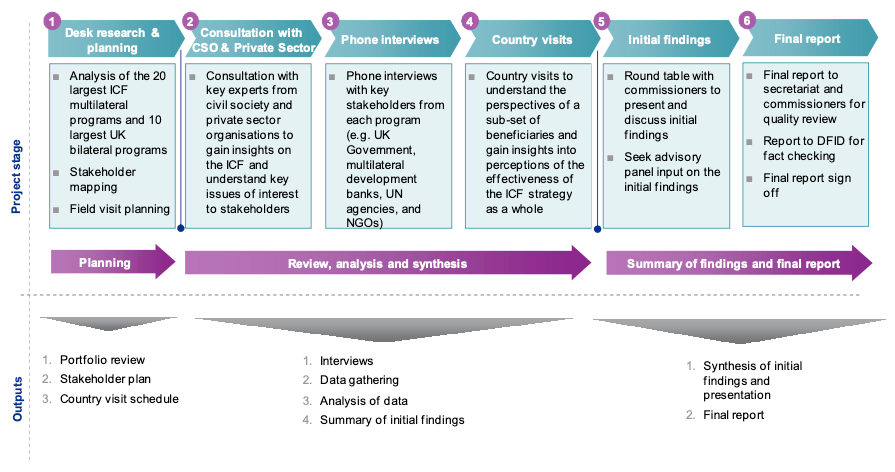
3.14 We will prepare an analysis of all business cases and associated project documentation for the 10 largest ICF multilateral programmes and 6 largest UK bilateral programmes. Together these initiatives account for more than 80% of ICF spending to February 2014, thereby achieving breadth across the ICF.
3.15 We will analyse any interim reviews, reports or project evaluations that have been completed, with a particular view to understanding the theories of change involved, the impacts and outcomes expected.
3.16 We will host formal consultations with UK civil society and private sector representatives to create a platform for stakeholder input and feedback into the key issues to consider in completing this analysis. Through our literature review we have identified a number of key expert commentators from research institutions, civil society and the private sector on the ICF: their views will be sought on the key issues identified as the focus of the review.
3.17 We will complement this desk review with interviews with at least two key informants for each programme, including one individual who has been involved with programme implementation and another who can provide a more independent perspective on its likely effectiveness, prioritising perspectives from recipient countries. Informants will include representatives of UK Government (including but not limited to DFID, DECC and DEFRA), representatives of multilateral development banks, UN agencies and other organisations including non-governmental organisations (NGOs) that have been implementing entities for programmes and government, private sector and civil society organisations (CSOs) in recipient countries who are intended to be amongst the end beneficiaries of these programmes.
3.18 We propose to trace the impact of at least two ICF funded interventions from national to global levels, in order to understand how the theories of change and implementation modalities of the ICF are working in practice. We will seek to include programmes that have engaged the private sector, given that this is an important aspect of the ICF’s transformative impact.
Country visits
3.19 Given the wide geographic scope of the ICF, any country visits will offer only a partial glimpse into its effectiveness. We will undertake two country visits: one to Indonesia, a middle income country; and a second to Ethiopia, a low income country. Indonesia has one of the most established bilaterally managed programmes and is where the UK Government has pioneered an interdepartmental working approach with DFID, Foreign and Commonwealth Office (FCO) and DECC staff. Indonesia is also the fifth largest emitter of greenhouse gases globally and one of the most bio diverse countries in the world. Indonesia has the largest area of forest, and contains 15% of all species of plants, mammals, birds and fish. Most of the global programmes that the ICF is supporting are also active in Indonesia. DFID Ethiopia has two main ICF-funded bilateral programmes: the Climate High-Level Investment Programme (CHIP) and Strategic Climate Institutions Programme (SCIP). Few global funds are active in Ethiopia (or indeed in any of the ICF priority countries in Sub-Saharan Africa) but the ICF has also invested in Ethiopia through some of its multilateral programmes such as the Climate Development and Knowledge Network and partnered with other knowledge and development brokers including the African Development Bank, the World Bank and the Green Growth Institute. An Ethiopia visit offers a complementary perspective into how the ICF is working in a low income country.
Quality control and peer review
3.20 Given the wide-ranging objectives of the review, we have constituted a high-level expert advisory panel to guide the work and ensure that key issues and considerations have been addressed and that our analysis is robust. The panel includes representatives of academia, the private sector and think tank community who are all experts on climate change and associated finance issues. It will provide the primary peer review function for the review.
4. Roles and responsibilities
4.1 The Team Leader will be the primary point of contact with DFID. KPMG will provide oversight of this review under the overall leadership of the ICAI Project Director. Supplementary analysis and peer review will be provided by KPMG staff.
4.2 The team will comprise the following members:
Team leader (Agulhas)
The team leader’s expertise is in international development and sustainability, with a particular focus on managing the risks around climate disruption, having been a member of the core team on the Stern Review of the Economics of Climate Change. She has several years of policy and advisory experience working with multilateral banks, bilateral donors, companies and civil society organisations to improve their climate resilience, reduce their emissions and enable them to become more climate smart. She has led or co-authored a number of papers on the risks and responses to climate change and on the experience of countries in the international climate finance architecture. She has worked on a number of previous ICAI reviews including the Pakistan, Bangladesh Climate Change, PPAs and Private Sector Development reviews.
She will lead the review with overall management responsibility for all stages and will ensure delivery of the outputs.
Deputy Team Leader
She is a Research Fellow in the Climate Change Environment and Forests Programme at ODI where she leads the work stream on finance to help developing countries address climate change. She has more than 10 years of experience on energy, climate change and international finance. She was previously a Senior Associate in the Institutions and Governance Programme at the World Resources Institute where she led research and engagement programmes on climate finance, the environmental impacts of development finance and the governance of electricity in major developing countries. She also developed a programme of work addressing governance of forests in the context of global efforts to reduce emissions from deforestation and degradation. Earlier in her career she worked on rural electrification in East Africa with the United Nations Development Program. She holds an MSc in Environmental Policy and Regulation from the London School of Economics and Political Science (UK) and a BA in Government and Environmental Studies from Dartmouth College (USA). She is the Deputy Team Leader and will also lead the literature review.
Team member 1 (KPMG)
He is a strategy consultant with KPMG. He works with leading private and public sector institutions to develop strategies to manage the challenges and opportunities created by climate change. His current work concentrates on climate finance with a particular focus on mechanisms to increase private sector flows in low carbon development. He is also active in the debate around the design of the Green Climate Fund under the UNFCCC. He serves as Vice President of Policy for the board of Climate Markets Investment Association (CMIA), is the lead author of KPMG’s thought leadership papers on climate finance and often presents at public fora on matters pertaining to climate change and low-carbon development. Before KPMG, he worked for the European Commission, Businesseurope and Ricardo-AEA. He holds a Masters degree in Energy Systems and a Bachelors degree in Chemicals Engineering. He speaks English, German and Greek. He will lead on the private sector aspects of the review.
Team member 2 (ODI)
She is a research officer in climate finance at the ODI in London. She is a PhD Candidate at the University of East Anglia’s School of International Development, awaiting her final examination. Her research has focussed on investigating the allocation of official mitigation finance in comparison to that of overall official development aid at the global, multilateral, bilateral and individual donor levels. Having worked at UNDP Indonesia and various NGOs and conducted a series of quantitative research, she has acquired significant expertise in the area of macroeconomics, with a particular focus on climate finance, international development aid and econometric techniques for time series and panel data. She has published papers based on her PhD project and institutional reports. In 2013, she was recognised by the British Council and the Guardian as an exemplary post-graduate research student in the UK. She will lead on data analysis and capture, will also work on the literature review and will provide core support to the Indonesia visit, given her in depth country expertise.
Team member 3 (KPMG)
He works in KPMG’s International Development Assistance Services group in the UK and has a range of professional experience in research, analysis, project management and policy advisory services in a wide range of organisations in the government, diplomatic and international development sectors. He has previous experience in the U.S. Department of State, U.S. Senate, European Bank for Reconstruction and Development and the BBC. He will ensure that ICAI processes and procedures are followed throughout and support the team leader during the ICAI drafting phase. He will support the portfolio mapping process of the ICF and the examination of the programme and financial management of the ICF across the three Whitehall departments.
Team member 4 (KPMG)
She has over ten years’ international experience as a management consultant, tackling issues within the private, public and development sectors and within a range of cultural settings including the Middle East, China, East and West Africa.
She joined KPMG in 2005 as a management consultant in the public sector department. She has delivered strategy and implementation support to clients and her expertise includes policy design, options appraisals, project design and project management, evaluation, stakeholder engagement and capacity building support, in a range of sectors including health and education. She has also worked in the UK Cabinet Office, on local regulation as part of the Better Regulation Executive, Tony Blair’s Africa Governance Initiative to lead the health work stream in Sierra Leone and most recently as Global Change Manager to KPMG’s Global Chairman’s Office. She will assist the Ethiopia field visit.
Team member 5
She has a background in planning and policy-making as a practitioner and researcher focussing on climate change finance and planning at international, national and sub-national scales of governance. She established the UK Climate Impacts Programme which provided global leadership and tools for stakeholder-led assessments of impacts for adaptation. She has also researched and worked on low carbon policy, particularly renewable energy and has participated in the UNFCCC process for 20 years in various roles.
Team member 6 – Peer reviewer
He specialises in aid effectiveness, governance and institutional development. He is on the core consortium team delivering ICAI’s reports. He has led ICAI reviews considering Learning, PPAs, Bangladesh Climate Change, UNDP’s management of elections, DFID’s programmes of Health and Education in Bihar and its support for Rural Livelihoods in Western Odisha. He will lead the peer review process on the team, alongside the expert panel. The peer reviewer will also lead on any conflict of interest, quality and oversight issues.
Team member 7 – Low carbon development expertise
He is a Fellow at Agulhas Applied Knowledge and Senior Research Fellow at the University of Exeter. He is an experienced economist and researcher with particular expertise on low-carbon development policy in developing countries and in the UK. He has provided high-level policy advice to governments and international civil society organisations. He has held several senior policy posts in international NGOs. He has worked in DECC, DFID and within the office of the Mayor of London. He was head of international policy at Christian Aid, leading analysis of debt, trade and corporate social responsibility. He was also subsequently head of policy and campaigns at ActionAid and has also worked for Save the Children-UK. He was on the team for the ICAI PPA review, providing a strategic perspective on the relationships between DFID and CSOs.
Team member 8 (University of Manchester) – Methodological review
He has more than 10 years’ experience of teaching undergraduate and MA & MSc students development microeconomics (theory and applied) and supervising and teaching PhD students quantitative and qualitative research methods in British (University of East Anglia) and Indian higher education institutions. He has been in charge of extensive primary data collection exercises with a development economics angle in India (Western Uttar Pradesh, Andhra Pradesh, Coastal and Central Karnataka, Delhi, Mumbai), in Nepal and in East Africa. These included household surveys, tracking of in-depth interviews documenting the working life histories of (young and other) migrants, interviews with local political leaders and behavioural experiments. He is the editor of the Journal of South Asian Development. His academic publication record features a wide range of poverty and development-related themes. He will provide challenge for the overall methodology.
5. Management and reporting
5.1 A first draft report will be produced for review by the ICAI Secretariat by w/c 2nd June 2014. The review will be signed off for publication in w/c 25 August 2014.
6. Expected outputs and time frame
6.1 The main deliverables will be:
| Phase | Timetable |
|---|---|
| Planning Drafting ToRs Drafting Inception Report Initial meeting of Advisory Panel | November 2013-February 2014 |
| Phase 1: Field Work UK based work Indonesian and Ethiopian field work | February-April 2014 February and May 2014 |
| Phase 2: Analysis and write-up Roundtable with Commissioners Second meeting of Advisory Panel First draft report Commissioners sign off Report to DFID for fact checking Final report sign-off | w/c 12 May 2014 late April/early May 2014 w/c 2 June 2014 w/c 21 July 2014 w/c 28 July 2014 w/c 25 August 2014 |
7. Risks and mitigation
7.1 The following sets out the key risks and mitigation actions for this review.
| Risk | Level of risk | Specific Issues | Mitigation |
|---|---|---|---|
| Inability to access key documents and information | Medium | Further delay to publication of DFID MTE. Further delay to publication of CIF review. Unable to access all relevant DFID/DECC/DEFRA files. Unable to interview key global climate finance interlocutors. | DFID allows early sight of draft final MTE report. DFID work with World Bank/Multilateral Development Banks to agree to allow early sight of CIF draft final report. Ensure clear authorisation is given at start up. Ensure that DFID partners are informed of our key information requirements at least two weeks before country visits. Liaise with them directly to ensure they fully understand what is required prior to our visit. Ensure DFID/DECC/DEFRA enable the introductions at the appropriate level. Allow sufficient time to work with partners, to clarify any further information requests. |
| Lack of impact data makes impact assessment difficult. | Low-medium | The ICF has disbursed £1 billion so far. The on-going ICF MTE and CIF reviews will generate more impact data which this review can interrogate. The nature of much of ICF activity (i.e. programming through multilaterals) makes the results chain long and attribution difficult. | The review team will examine a range of programmes and projects across the two case study countries, to seek to obtain additional results data as well as interrogating findings from two ongoing reviews. |
| Commercial confidentiality of some private sector work makes it difficult to share information | Low | The ICF seeks to leverage additional finance with the private sector. The review may encounter co-financing deals where there is sensitive information. | If necessary only refer to this information in a confidential annex or anonymise the information. |
| The structure of the ICF means that DFID, DECC and DEFRA (with FCO and HMT) may all wish to review and fact check the report. This may take additional time. | Low | The ICF is an inter-departmental fund with a governance system that reflects this. The review may require fact checking at this level. | Agree with DFID as the lead department that it will ensure that this process can be done in a timely fashion in line with the two week deadline. |
8. How this ICAI review will make a difference
8.1 The ICF is the key instrument in UK climate and development policy. Its objectives include mainstreaming climate change into development assistance, with an ambition to be transformative by unlocking scale and replication potential through supporting programmes that seek to do this. Climate change is one of the most important constraints on development, with its impacts potentially able to disrupt or demolish the gains already made in, for example, the Millennium Development Goals (MDGs). This thematic review will thus assess a central plank of UK development policy, with broader ramifications for security and prosperity internationally. This is also one of the larger items of spend in the overall aid portfolio.
8.2 This review therefore presents an opportunity for ICAI to make a contribution to the development of a critical area of the UK development and climate programme. It will also inform the forthcoming work on the ICF proposed by the International Development Committee (IDC). We understand that this is likely to be at a higher strategic level.
8.3 This ICAI review will also look explicitly at how effective the ICF has been in supporting and influencing global efforts to build knowledge and evidence and mainstream climate issues into development assistance. Lessons learned will be of wider interest to DFID, DECC and DEFRA programmes and to those of the multilateral banks, other donors and new instruments in the international climate finance architecture.
Footnotes
- The Secretaries of State and Foreign Secretary are represented by their respective director generals as per the following document: International Climate Fund (ICF) Implementation Plan 2011/12 – 2014/15, Technical Paper, ICF, https://www.gov.uk/government/uploads/system/uploads/attachment_data/file/67454/uk-International-Climate-Fund-techncial-working-paper.pdf.
- Intergovernmental Panel on Climate Change Fifth Assessment Report, Climate Change 2013, the Physical Science basis, 2013.
- Intergovernmental Panel on Climate Change Fifth Assessment Report, Climate Change 2013, the Physical Science basis, 2013.
- The geography of poverty, disasters and climate extremes in 2030, ODI, Met Office and RMS, October 2013.
- Managing climate extremes and disasters in Asia, Africa and Latin America: Lessons from the IPCC SREX report, 2012.
- Managing climate extremes and disasters in Asia, Africa and Latin America: Lessons from the IPCC SREX report, 2012.
- Terms of Reference: The UK’s International Climate Fund, ICAI, http://icai.independent.gov.uk/wp-content/uploads/2014/01/ICAI-Study-The-UK-International-Climate-Fund-ToRs.pdf
- The sum was increased from £2.9 billion to £3.87 billion in the 2013 Resource Allocation Round to reflect the ongoing need for this support in the wider context of UK international climate policy objectives. The time frame was extended from 2015-16.
- ICAI is keen to look at these kinds of cross-departmental efforts to understand their effectiveness, see for example: Evaluation of the Inter-Departmental Conflict Pool, ICAI, July 2012, http://icai.independent.gov.uk/wp-content/uploads/2013/12/Evaluation-of-the-Inter-Departmental-Conflict-Pool-ICAI-Report.pdf and FCO and British Council Aid Responses to the Arab Spring, ICAI, June 2013, http://icai.independent.gov.uk/wp-content/uploads/2013/12/FCO-and-British-Council-Aid-Responses-to-the-Arab-Spring-Report.pdf.