Rapid Review of the Prosperity Fund
1. Purpose, scope and rationale
The purpose of this rapid review is to assess whether the Prosperity Fund has developed the systems and procedures to allocate its funding effectively in support of its objectives, and has adequate governance arrangements in place. Through an analysis of relevant policies, governance frameworks and other documentation; of how bids to the Fund have been sought and assessed; and of how results are to be judged, the review will reach conclusions as to the relevance of the portfolio and its potential for achieving its objectives.
This review will also consider the extent to which lessons from other major UK aid funds, such as the International Climate Fund and the Conflict, Security & Stabilisation Fund, have informed the design of the Prosperity Fund.
The review is timely given the UK government’s commitment under the 2015 National Security Strategy1 and Aid Strategy2 to introduce a cross-government fund to support economic prosperity. This review will build on earlier work carried out by ICAI on cross-government funds in the Annual Report 2015-163, the Information Note for the IDC on the Overseas Development Assistance (ODA) allocation process in 20154 and the forthcoming review of DFID’s approach to transition.5
2. Background
The Prosperity Fund was announced in the 2015 Strategic Defence and Security Review as one of several new cross-government ODA funds.6 It has a planned allocation of £1.3 billion over five years to promote growth and prosperity in key partner countries, particularly across emerging markets and middle-income countries such as China, India and Brazil. Centrally established priorities for the Fund include improving the business climate, competitiveness and operation of markets, energy and financial sector reform, and increasing the capacity of partner governments to tackle corruption. The Strategic Defence and Security Review placed emphasis on creating opportunities for international business, including UK companies. Any department can bid for Prosperity Fund resources.
The Fund is predominantly ODA and spending must be fully consistent with the International Development Act and OECD DAC criteria. The Prosperity Fund can therefore only spend its ODA funds on programmes that it considers likely to contribute to a reduction in poverty.7 In addition to this primary benefit, the Prosperity Fund aims to achieve secondary benefits of promoting global prosperity and creating opportunities for international business. Prosperity Fund programmes are intended to promote economic development, remove barriers to trade and develop key growth sectors.
The Prosperity Fund is under the authority of the National Security Council and governed by a Ministerial Board. It is supported by a Portfolio Board, with a Prosperity Fund Management Office housed in the Foreign and Commonwealth Office.
3. Review questions
This rapid review is built around the evaluation criteria of effectiveness and learning. It will address the following questions.
Table 1: Our review questions
| Review criteria and questions |
|---|
| Effectiveness: Are the systems and procedures of the Prosperity Fund adequate to ensure effective programming and good value for money? Learning: Has the design of the Prosperity Fund been informed by learning from other cross-government aid funds and instruments? |
4. Methodology
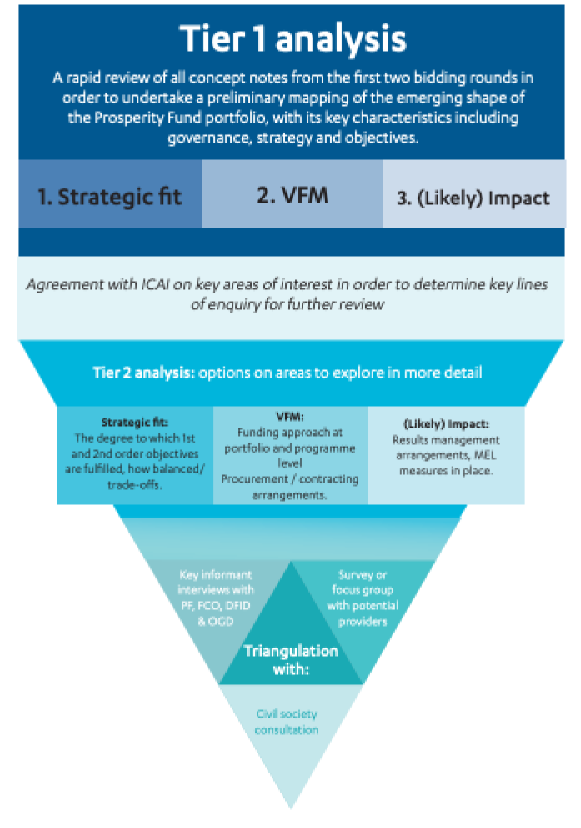
The methodology will include a rapid review of all bids made into the Fund to date, key informant interviews to explore strategy and governance arrangements, and a more detailed review of selected issues arising from the rapid review. We will also seek to gather the views of external stakeholders on issues identified through documentary analysis. Figure 1 provides an overview of our methodology.
Document review
The review will be carried out in two phases. The first phase will be a mapping process. We will undertake an initial analysis of all the concept notes submitted into the two bidding rounds to date. We will assess the process for bid selection against the three grouped areas identified by the Fund: strategic fit (15%), value for money (30%) and impact (55%). This will allow a preliminary mapping of the emerging shape of the Fund portfolio with its key characteristics (Tier 1 mapping).
We will also undertake an initial assessment of effectiveness by reviewing key Prosperity Fund documents covering governance and management arrangements, strategy and objectives, the funding approach at portfolio and programme levels and results management. To avoid duplication and overlap, we will draw upon the Infrastructure Project Authority’s September 2016 review, which follows up on its March 2016 review.8
We will assess learning by looking at how the design of the Fund has been informed by learning from other cross-government aid funds and instruments and by steps being taken to build lesson learning into funded programmes.
The results of the first phase mapping process will inform subsequent decisions on our key lines of enquiry for the second phase of our work.
Key informant interviews
We will conduct interviews with staff from the Fund, DFID, the FCO and from the other government departments bidding into the Fund, in order to assess their experience of Prosperity Fund governance and management processes. These will cover core areas including the application process, the approval/rejection process, procurement and contracting processes, results management and lesson learning. Communication and linkages across departments and countries will be considered, along with coherence with existing aid programming in country.
Tier 2 analysis
After the Tier 1 mapping, we will identify our key lines of enquiry for Tier 2. This will include key informant interviews with submitting departments, to explore their experience with the process and their plans regarding procurement, results management and learning. We will also explore the level of coordination and communication across departments and with other aid-funded activities. We will assess emerging governance and management arrangements and the alignment of the emerging Prosperity Fund country portfolio with other aid-funded activities.
As part of the Tier 2 analysis we will consider a survey with external stakeholders, such as possible implementing partners to the Fund, together with a consultation with civil society.
5. Limitations to the methodology
Preliminary findings: The Prosperity Fund is still at an early stage of development. Its operating framework has only just been adopted and some of its core systems and processes are still under design. This provides an opportunity for us to influence their development. However, it also means that our findings from this review will be of a preliminary nature.
Overlaps in independent scrutiny arrangements: The Infrastructure Projects Authority (IPA) has just undertaken its second six-monthly review of the Prosperity Fund. The National Audit Office (NAO) is also undertaking background research on the fund. We have agreed to work with the NAO where possible in conducting this review.
6. Risk management
We propose the following risk mitigation strategies for this rapid review:
| Risk | Mitigation and management actions |
|---|---|
| The Prosperity Fund and departments do not share documentation or provide access for interviews in a timely manner. | Secretariat works closely with Prosperity Fund to agree protocols for sharing information. |
| NAO and ICAI overlap during the review work. | ICAI and NAO work closely together to ensure streamlined working. |
7. Quality assurance
The review will be carried out under the guidance of ICAI Lead Commissioner Francesca Del Mese, with support from the ICAI Secretariat. The review will be subject to quality assurance by the Service Provider consortium.
Both the methodology and the final report will be peer reviewed by Richard Manning, Senior Research Fellow at the Blavatnik School of Government at Oxford University and former Chair of the OECD’s Development Assistance Committee.
8. Timing and deliverables
The study will be executed within five months from September 2016 until January 2017.
| Phase | Timing and deliverables |
|---|---|
| Inception | Approach Paper: November 2016 |
| Data collection and report drafting | November – December 2016 Document analysis, portfolio mapping, key informant interviews Commissioner consultation post Tier 1 mapping Emerging findings from Tier 2 analysis as a skeleton draft Report drafting |
| Reporting and publication | FCO Fact Check: late December 2016 – early January 2017 Copy-Edit / Design: January 2017 Report Publication: end of January 2017 |
Footnotes
- National Security Strategy and Strategic Defence and Security Review, HM Government, November 2015, link.
- UK aid: tackling global challenges in the national interest, HM Government, 2015, p. 3, link.
- Annual Report 2015 to 2016, Independent Commission for Aid Impact, June 2016, link.
- The ODA allocation process: an information note from the IDC, Independent Commission for Aid Impact, December 2015, link.
- When aid relationships change: DFID’s approach to managing exit and transition in its development partnerships. Approach Paper, Independent Commission for Aid Impact, May 2016, link.
- UK aid: tackling global challenges in the national interest, HM Government, 2015, p. 3, link.
- International Development Act 2002, section 1, link. A small proportion of the Fund (£33m in years 1-4) is eligible for non-ODA projects.
- Cabinet Office, Infrastructure and Projects Authority, Project Validation Review 2228 Prosperity Fund, March 2016 and Cross Whitehall Prosperity Fund Gateway Report V1.0, September 2016. Neither document is available online.