The UK’s aid response to the migration crisis in the central Mediterranean
1. Purpose, scope and rationale
For decades there has been irregular migration1 from sub-Saharan Africa into Europe, across the central Mediterranean, caused by disparities in economic opportunity and the lack of regular migration options. In recent years, the number of boat crossings – and deaths at sea – has increased dramatically, due to increased levels of conflict and insecurity in Africa and the Middle East. The UK government’s aid response involves several departments and includes development programming in source countries, security and justice interventions to counter people smuggling, and humanitarian and protection operations.
Because the aid response is at an early stage, we have opted to conduct a rapid review, focusing on: (i) the relevance and proportionality of the response, given what is currently known about the nature and scale of the problem; and (ii) the likelihood of it meeting the UK government’s objectives of reducing migratory push factors and addressing the humanitarian crisis caused by irregular migration in the central Mediterranean. The review will focus mainly on strategy and programme design, so as to inform the continuing development of the aid response. We are focusing on the migration route via the central Mediterranean because of the risks the journey poses to the people involved, and because many of the migrants on this route come from DFID priority countries in Africa, which provides us with an opportunity to examine the UK’s migration-related aid response in countries of origin.
The review will not address the UK’s asylum and immigration policy, which is not within ICAI’s remit. It will cover aid programming by DFID, the Conflict, Security and Stability Fund (CSSF) and other departments in response to the migration crisis in the central Mediterranean, drawing on learning from the UK response to the Syria crisis and elsewhere. It will not cover the use of aid funds for refugee support costs in the UK or humanitarian support provided in the EU.
2. Background
The central Mediterranean migration route begins from source countries across Africa, crosses through North Africa, especially Libya, and across the Mediterranean towards Malta and Italy. Conflict and insecurity in Libya, Somalia and across the Sahel region and repression in Eritrea are major contributing factors. In addition, Libya has been a destination country for labour migration for many years, and conflict there has left large numbers of foreign workers stranded.
The number of people attempting the sea journey from Libya to Italy increased from around 40,000 in 2013 to over 150,000 this year. The risks in the journey are acute; in the first half of 2016 there were more than 2,000 deaths at sea.2 Among those arriving in Italy, the two main countries of origin were Nigeria (20%) and Eritrea (12%). Other West African countries accounted for 40% of the total, and other East African countries for 16%. The remainder were from North or Central Africa or from other continents (or were of unknown origin). The majority are men, 14% women and 16% children.3
The UK government has committed to using its aid programme to tackle the causes of irregular migration. The UK Aid Strategy notes that: “[v]iolence and conflict in Africa and the Middle East are causing unprecedented migration flows to Europe” and pledges that “the government will work to build stability and tackle the root causes of conflict.”4 In a July 2016 statement, DFID Secretary of State Priti Patel said that DFID would “continue to tackle the great challenges of our time: poverty, disease and the causes of mass migration.”5
Box 1: Migration and development
Migration and development are closely linked through complex causal connections. Migration can offer benefits not just to the individuals concerned but also to their countries of origin and their host countries, and has the potential to strengthen development trajectories.6 In this review, we are concerned with the UK aid response to the current humanitarian crisis in the central Mediterranean caused by the recent increase in irregular migration flows. Wider questions about UK government policy towards migration or asylum are not within our remit.
3. Review questions
This is a rapid review built around the evaluation criteria of relevance and effectiveness.7 As the aid response remains in its infancy, the review will focus on the relevance of the overall response and the likelihood that the aid programmes will achieve their intended results, with a view to informing the continuing development of the response. It will address the following questions:
Table 1: Our review questions
| Review criteria and questions | Sub-questions |
|---|---|
| 1. Relevance: Is the UK aid response to the migration crisis in the central Mediterranean relevant and proportionate, given the nature and scale of the challenge? |
|
| 2. Effectiveness: Are the UK migration-related aid programmes likely to be effective? |
|
The review will cover:
- Programming in countries of origin that DFID deems relevant to the goal of reducing the causes of irregular migration. These programmes are often related to creating jobs, improving livelihoods and promoting regional labour markets.
- Humanitarian and protection interventions for refugees and displaced persons, including search and rescue operations on the Mediterranean.
- CSSF’s migration-related ODA programming.
Because “migration-related programmes” have not been labelled as such, DFID has not been able to produce a definitive list of its migration-related programming. However, with DFID’s assistance we have identified 16 relevant programmes in seven African countries, with total expenditure of £109 million in 2015-16. There are also relevant programmes in North Africa, including the “Safety, Support and Solutions Programme for Refugees and Migrants in Europe and the Mediterranean region” (£38.3 million from August 2016 to September 2017). This is an umbrella programme that provides lifesaving assistance and protection to vulnerable migrants and refugees, as well as building up data on the migration flows.
In addition, we have identified 16 relevant projects from a list of CSSF migration-related spending in ten African countries and with a total budget of approximately £10 million. There is also relevant aid spending by other government departments, including the Home Office and the Ministry of Defence.
4. Methodology
Our methodology will consist of three mutually reinforcing components, summarised in Figure 1.
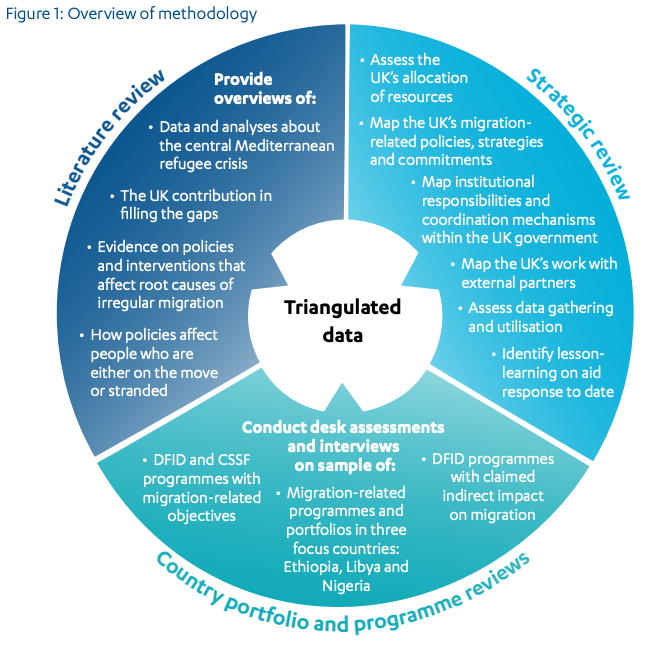
Component 1 – Literature review:
This will include a review of academic and other research reports on the effects of aid responses on irregular migration, and of a collation of real-time data and analysis on central Mediterranean migration flows. This review will help us understand: (i) the nature and scale of the migration flows; (ii) what is known about migration flows and how the UK has contributed to filling the data gaps; and (iii) evidence on which policies and interventions affect the root causes of irregular migration and can help support the people affected. This understanding will provide us with the benchmarks and initial insights we need when conducting the other two review components.
Component 2 – Strategic review:
We will map the migration-related content of relevant UK government policies, strategies and international commitments. Through document analysis and interviews,8 we will map the way different parts of the UK government: (i) use aid resources in response to the migration crisis in the central Mediterranean; (ii) invest in learning and adapt the UK’s engagement on the basis of data and evidence; (iii) coordinate their work internally and across government; and (iv) work with external partners. We will assess the relevance and proportionality of the overall response against the UK’s policy commitments and evidence on the scale and nature of the crisis. This strategic review will also provide the context for assessing the quality of individual interventions.
Component 3 – Country portfolio and programme reviews:
To address the review question on the likely effectiveness of the UK’s aid response, we will conduct desk reviews of all migration-related aid programmes in three countries: Libya, Ethiopia and Nigeria (see below for our sampling approach). In each case, we will review both the migration-related country portfolio as a whole and individual migration-related programmes (including those with explicit migration-related objectives and those that may indirectly affect levels of migration). We will review relevant analyses, strategies and programme documents and conduct telephone interviews with UK staff (in the UK and in country), implementing partners and, to the extent appropriate, national counterparts. We may decide to conduct additional desk reviews of migration-related programmes in other countries, if we judge that these three countries are not sufficiently representative of the portfolio as a whole.
In each component, interviews with a diverse group of external stakeholders will triangulate our findings, deepen our insights and reduce the potential bias that comes with this review’s reliance on UK government documents and interviews.
5. Sampling approach
There is no established definition of “migration-related” aid programmes. We are therefore sampling from programmes that the responsible departments have identified as “migration-related” so as to gauge the plausibility of their response. We are also interested in assessing migration-related portfolios in particular countries. We will therefore obtain our sample by focusing on three countries that are important for central Mediterranean migration, representing different sub-regions (Horn of Africa, West Africa and North Africa) and both source and transit countries. They also have a high density of migration-related programming.
- Libya: This is by far the most important transit country in the central Mediterranean (and has a long-standing history as a destination country). It is the main departure point for the sea voyage to Europe. It also presents unique challenges due to the ongoing conflict and the presence of large numbers of stranded migrant workers who provide a ready market for people smugglers. DFID is funding humanitarian support and protection activities. There is also UK programming on people smuggling and trafficking.
- Ethiopia: This is a country through which migrants from the Horn of Africa often transit (as well as a source country itself), but also a country where the national government and the UK are investing in local integration as a durable solution for refugees.9
- Nigeria: This is a country of origin with a range of push factors that cause irregular migration. The UK is implementing a range of related programming. Depending on the size and complexity of the UK’s programming, we may choose to limit ourselves to the UK’s work in a particular region or thematic area.
We will review all of the migration-related ODA programming in these countries. We will then make an assessment as to whether the sample we have reviewed is thematically representative of the portfolio as a whole. If any important programme types have been excluded, we will conduct additional programme desk reviews.
6. Limitations to the methodology
Migration is a sensitive area. As a consequence, some of the documentation on the UK aid response may be restricted and there may be limits on the extent to which the data we collect can be used in a public report. To manage this, we have agreed protocols with the responsible departments on the sharing and handling of restricted information.
It will be challenging to rigorously assess the effectiveness of UK programming at this early stage and given the complexity of the situation. Our findings will be limited to assessing the likelihood that UK objectives will be met and that UK aid will make a positive contribution.
7. Risk management
| Risk | Mitigation and management actions |
|---|---|
| Relevant UK departments' unfamiliarity with ICAI's way of working delays progress | Secretariat to agree protocols for collaborating with FCO and other departments and ensure communication channels are open at both senior and working levels. |
| Security issues prevent access to data | FCO and Secretariat to agree protocols on access and handling of restricted documents. Team members to sign supplementary agreement on information security. |
| Findings cannot be shared for security reasons | FCO and DFID to help identify public sources for data to be used in the report. |
8. Quality assurance
The review will be carried out under the guidance of the ICAI Chief Commissioner, Dr Alison Evans, with support from the ICAI Secretariat. The review will be subject to quality assurance by the Service Provider consortium.
Both the methodology and the final report will be peer reviewed by Dr Hein de Haas, a migration expert from the University of Amsterdam.
9. Timing and deliverables
This review will be executed within five months, starting from mid-September 2016.
| Phase | Timing and deliverables |
|---|---|
| Inception | Approach Paper: November 2016 |
| Data collection | Evidence Pack and Emerging Findings: December 2016 |
| Reporting | Final report: February 2017 |
Footnotes
- We use the term “irregular migration” to refer to refugee flows and other movements of people outside organised channels. The term does not imply any judgment about the motivations of the individuals involved, and we note that seeking asylum is a right recognised under international law. Whether or not migration is regular may depend on the availability of regular migration options. ↩
- Missing Migrants Project, IOM, September 2016, link. ↩
- Refugees/Migrants Emergency Response – Mediterranean, UNHCR, November 2016, link. ↩
- UK aid: tackling global challenges in the national interest, HM Treasury and DFID, November 2015, link. ↩
- New ministerial team, Government news, July 2016, link. ↩
- Oltmer, J., Connections between Migration and Development, Institute for Migration Research and Cross Cultural Studies, University of Osnabrück, 2015, link. ↩
- Based on the OECD DAC evaluation criteria. See Principles for Evaluation of Development Assistance, OECD DAC, 1991, link. ↩
- Our DFID counterpart has identified a number of individuals for key stakeholder interviews. Key respondents are likely to include DFID staff (from the Migration Department, the Research and Evidence Department, the Protracted Crisis Team and also any other teams we learn to be relevant) and other ODA-spending departments (such as the FCO migration unit and staff engaging in the Central Mediterranean Working Group). These interviews will become increasingly focused as the review progresses. We intend to interview key respondents more than once. ↩
- An additional consideration is that a learning review is most useful if it incorporates innovative programmes. DFID identified this local integration programme in Ethiopia as being its single most important example of innovative programming. ↩