The UK’s approach to funding the UN humanitarian system 2
1. Purpose, scope and rationale
The purpose of this performance review is to assess how well DFID uses its influence as a major funder of the United Nations (UN) humanitarian system to improve the effectiveness and value for money of multilateral humanitarian aid. It will review DFID’s approach to funding UN humanitarian agencies, how DFID uses its influence to improve their individual and collective humanitarian performance, and how DFID takes forward its humanitarian reform policy and international commitments.
The review will cover the evolution of DFID’s funding of UN humanitarian agencies since 2011. The focus will be on core funding mechanisms, linked to DFID’s Multilateral Development Review and its predecessors.1 It will also consider how core funding works alongside DFID funding to UN agencies in particular crises, and whether in-country funding practices are consistent with and supportive of DFID’s objectives and approach at the headquarters level.
In September 2016, the UK joined 30 other donors and aid providers as a signatory to the Grand Bargain – a set of commitments agreed at the World Humanitarian Summit in Istanbul for improving humanitarian funding practice.2 The review will not directly assess DFID’s implementation of its Grand Bargain commitments, but it will take account of the Grand Bargain and other World Humanitarian Summit outcomes as evidence of emerging good practice in humanitarian financing.
2. Background
In 2016, the UK spent £1.3 billion on humanitarian assistance (about 10% of the aid budget).3 In 2015-16, the majority of this funding (more than £0.9 billion) was directed through four UN humanitarian agencies – the World Food Programme (WFP), the Office of the UN High Commissioner for Refugees (UNHCR), the United Nations Children’s Fund (UNICEF) and the International Organization for Migration (IOM) – as well as the Office for the Coordination of Humanitarian Affairs (OCHA) and the Central Emergency Response Fund (CERF) through a range of mechanisms (see Table 1),4 including:
- core or unearmarked funding to agencies’ global budgets
- contributions to the UN’s Central Emergency Response Fund5
- funding in response to appeals for specific emergencies either directly to individual agencies or through country-based pooled funds.
UK humanitarian aid is also spent through the Red Cross movement, international non-governmental organisations, national governments and private contractors. Since 2011, DFID has been committed to increasing its core funding to the most effective humanitarian agencies, recognising that this improves the efficiency of humanitarian response.6 It is also committed to using its influence as a funder and partner to drive improvements to the international humanitarian system.
The UK government has been a long-standing champion of reforming the UN humanitarian system. It has been active in several waves of reform, including strengthening pooled funding mechanisms, the introduction of the ‘cluster’ system for humanitarian coordination and the Transformative Agenda.7 It was active in the lead-up to the 2016 World Humanitarian Summit, including through the Grand Bargain, which includes commitments on transparency, cash-based programming, reduction of overheads and more collaborative, flexible and multi-year funding arrangements.8
Through the Multilateral Development Review process, DFID assesses the performance of multilateral agencies based on their strategic fit to the UK aid programme and their organisational effectiveness. The 2016 Multilateral Development Review found that: “the multilateral system as a whole is falling short of its considerable potential because agencies, and the wider UN family, are not working together. The UK will work with partners to ensure there is less competition and duplication between organisations, and more collaboration and coordination instead.”9
Since 2015, DFID has provided core funding to the UN humanitarian agencies under a single business case, to give it more scope to address systemic challenges.10 A new business case for the period from 2017 to 2021 links 30% of the agencies’ core funding to the implementation of key Grand Bargain commitments by the group as a whole (called Payment by Results, although the conditionality relates to reforms, rather than results for beneficiaries).11 The remaining 70% of funding will be linked to reform commitments made by individual agencies and their progress in addressing areas for improvement identified in the Multilateral Development Review.
Table 1: DFID core and non-core funding to UN humanitarian agencies, 2015-1612
| Review title | Review type | Publication date | Score |
|---|---|---|---|
| How UK aid is spent | Strategic overview | February 2025 | Not scored |
| UK aid for sustainable cities | Full review | July 2024 | Green/Amber |
| The UK Department of Health and Social Care’s aidfunded global health research and innovation | Full review | July 2024 | Green/Amber |
| UK humanitarian aid to Afghanistan 2023-24 | Information note | July 2024 | Not scored |
| UK humanitarian aid to Gaza | Information note | May 2024 | Not scored |
| ICAI follow-up review of 2022-23 reports | Follow-up | May 2024 | 57% of responses scored as adequate |
| UK aid to Ukraine | Rapid review | April 2024 | Not scored |
Source: UN Humanitarian Single Business Case, DFID, December 2016, unpublished.
In October 2017, the UK government published a new Humanitarian Reform Policy.13 It contains a range of commitments related to humanitarian financing, including:
- building a coalition for reform of the global aid system, including better targeting of resources and improved transparency and accountability
- using UK funding to secure full delivery of the commitments made at the World Humanitarian Summit, including the Grand Bargain, and making UK contributions conditional on ‘radical system-wide reform’
- working with others to secure the reform of international governance and financing mechanisms for the global crisis response system, including more effective pooled funds and stronger leadership and coordination at the country level.
DFID’s core funding to the UN multilateral humanitarian agencies is managed by the Conflict, Humanitarian and Security department (CHASE) and, in the case of UNICEF, by the UN and Commonwealth Department, while its non-core funding is decentralised to country offices. Some of the innovations in humanitarian finance that DFID has championed internationally were first developed in the context of particular crises.
3. Review questions
This performance review is built around the three evaluation criteria of relevance, efficiency and effectiveness. It will address the questions and sub-questions listed in table 2.
Table 2: Review questions and criteria
[table “x702” not found /]4. Methodology
The review methodology will include three main components:
- Component 1 – Strategic review: This will examine the evolution of DFID’s strategy for funding and influencing UN humanitarian agencies between 2011 and 2018. It will examine how the strategic approach to UN humanitarian agencies has changed over time, how well strategic and policy objectives have been reflected in funding approaches and whether lessons from previous attempts at reform, by DFID and others, have informed the development of the current approach.
- Component 2 – UN organisation engagement reviews: Reviews will be undertaken of DFID’s engagement with four key agencies (OCHA, UNHCR, WFP and UNICEF), exploring changes in their management systems and response capacities at global and country levels and how DFID core funding has influenced these changes. A light touch review of IOM will also be carried out. The reviews will look at the influence of DFID’s funding, how funding approaches have related to other ways in which DFID seeks to influence the organisations (such as engagement at board level and secondments) and how DFID has monitored and evaluated progress on its reform objectives.
- Component 3 – Country and thematic case studies: The review will conduct four country case studies and two thematic case studies. Two of the country case studies, Iraq and South Sudan, will involve field visits for in-person interviews and data gathering, and two will be conducted remotely, Bangladesh and Yemen. The thematic studies on cash and accountability to affected populations will be based on phone interviews, visits to institution headquarters in Geneva, Rome and New York and documentation review.
These three components will enable us to assess from several perspectives how well DFID’s various UN reform objectives, as they have evolved over time, are reflected and advanced through its funding arrangements. We will explore changes in capacity and performance of both individual agencies and the UN humanitarian system as a whole, at the global level and in the context of specific emergencies. Through the country case studies, we will explore whether DFID’s humanitarian funding practices at the national level are consistent with the objectives of its core funding. We will collect feedback from a range of stakeholders, from the UN system, national officials, donor agencies and other informed observers, to test the relevance and effectiveness of DFID’s reform initiatives. There will be a particular focus on how well DFID has coordinated with other donors in attempting to influence individual UN agencies and collective performance. We are interested not only in understanding the influence that funding has, but its effectiveness alongside other forms of influence on performance.
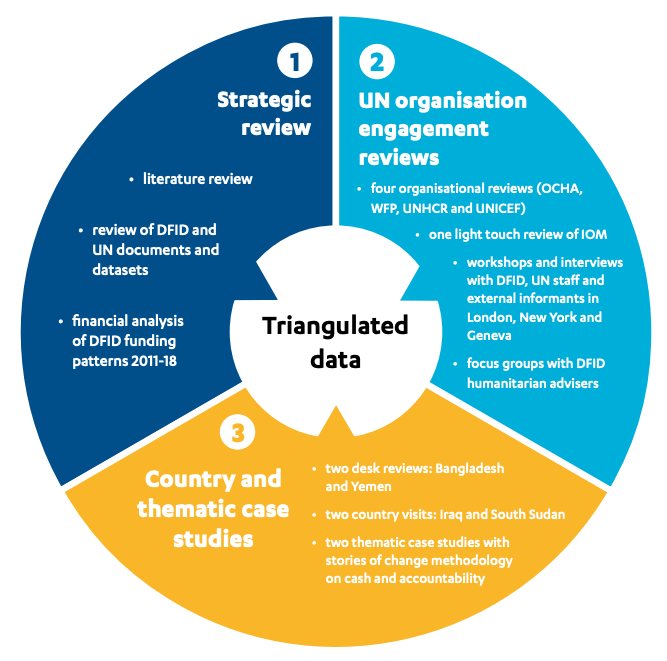
Research for the review will involve the methods outlined below:
- Literature review – We will prepare a literature review that synthesises findings from system-wide evaluations as well as evaluations of individual UN agencies.14 The literature review will assess the evidence base on progress against reform objectives and whether DFID’s stated reform objectives reflect key shortcomings in the performance and effectiveness of UN agencies and of the humanitarian system. The review will also look at literature around the use of performance-based mechanisms to achieve reform objectives in organisations. It will focus particularly on mechanisms for capturing the views of disaster-affected people on the performance of humanitarian work, including surveys, and the extent to which these are being acted on by UN humanitarian agencies.
- Financial analysis – Funding data for DFID and comparable donors will be downloaded from OCHA’s Financial Tracking Service for the years 2012-17 and triangulated with DFID and the Development Assistance Committee of the Organisation for Economic Cooperation and Development to ensure accuracy and comprehensiveness.15 The figures will be analysed to identify patterns and evolutions in DFID’s preferred funding channels by agency (and pooled funding mechanisms), countries and sectors. Analysis of how agencies have allocated core funding will be undertaken. The resulting detailed funding profiles will be compared against DFID’s effectiveness and efficiency objectives.
- Documentation review – We will examine relevant documents and datasets from DFID and the UN humanitarian agencies it is funding. These will include analyses and assessments of UN agencies (such as multilateral review background documentation), UN reporting to DFID, business cases, memoranda of understanding, performance agreements, annual reviews, due diligence documents, evaluations and DFID’s monitoring of progress against stated reform objectives.
- Key informant interviews – We will interview DFID CHASE staff responsible for managing the core funding to UN humanitarian agencies, and other key DFID humanitarian staff in the UK and in field offices. Interviews will be held with staff in the key UN humanitarian agencies funded by DFID at headquarters and field levels, including staff responsible for donor relations, senior managers and operations personnel. Other key informants will include informed observers in academia and think tanks, staff from other key donor and southern governments and staff from major international and national non-governmental organisations. Interviews will be carried out remotely and through in-person visits to agency headquarters in Geneva, Rome and New York. Interviews with other donors will be important for capturing views on how well DFID has coordinated with donors and used its funding in coherence with other forms of influence.
- Workshops and focus groups – Workshops will be held in Geneva, New York, Rome and London with UN and DFID staff and other key informants (academics, senior staff from major non-governmental organisations) to capture a wider range of views and allow debate on key issues. Where possible, virtual conference focus groups will be conducted with small groups of DFID humanitarian advisers working in humanitarian crises.
- Stories of change – Across two key themes (cash and accountability), we will use stories of change methodologies to document what progress has been made collectively and within organisations in shifting policy and practice.16 We propose focusing on promoting the use of cash, and accountability to affected populations. Cash represents a case study where significant progress has been made, allowing us to examine factors behind successful reform.17 Accountability represents a widely agreed priority for reform where progress has been slow, allowing us to examine barriers to collective progress.18
- Safeguarding – The protection of civilian populations from abuse and exploitation (commonly referred to as ‘safeguarding’) has become a subject of increased public concern since the revelation of sexual abuse allegations during the response to the 2010 Haiti earthquake. Although this is not a major focus of the review, we will explore the evolution of DFID’s approach to safeguarding in its funding of UN humanitarian agencies, including the expectations that DFID has set for its UN partners and whether these have led to changes in organisational practices. This will be based on key stakeholder interviews and document reviews. Assessing the effectiveness of UN safeguarding practices in our case study countries is outside the scope of the review.
5. Sampling approach
There are three sampling elements to our methodology:
- choice of UN humanitarian agencies for organisation review
- choice of country case study
- choice of thematic case studies.
UN organisation engagement reviews
There are four organisations which receive the bulk of DFID core and non-core funding to UN humanitarian multilaterals (OCHA, UNHCR, UNICEF and WFP). Each of these organisations has its own distinct mandate, challenges and role and is a critical part of the overall humanitarian system. We will conduct reviews of DFID’s engagement with all four organisations, in order to provide a full picture of its relationship with UN humanitarian multilaterals. There is much less core funding for IOM, which will be the subject of a lighter touch review.
CERF is a global humanitarian fund established by the UN General Assembly in 2005 to enable the provision of timely and reliable humanitarian assistance to those affected by natural disasters, armed conflict and complex emergencies. CERF channels resources to UN humanitarian agencies to support and promote a fast and effective response to rapid-onset emergencies, to enhance assistance in deteriorating contexts and to strengthen core elements of humanitarian action in under-funded protracted crises. We will assess through our country case studies the role that CERF plays in supporting collaborative action by the UN humanitarian system, and how it complements DFID’s country-specific humanitarian funding.
Country case studies
We will undertake two case studies through in-country visits and two as desk reviews. Through these case studies, we will explore the relationship between core funding at the headquarters level and programme funding, which is mainly allocated at the country level, the coherence between DFID’s funding approach at both levels, and whether and how reform efforts at the central level are integrated into country-level business plans and funding agreements. The case studies will also help us analyse whether there is evidence that reform objectives agreed at headquarters level are being taken forward at the country level, including in dialogue and programming with DFID country or regional offices.
We have made a purposive selection of four countries. We will undertake country visits to Iraq and South Sudan and desk-based reviews of Yemen and Bangladesh. The selected sample represents a range of causes of humanitarian crisis, UN coordination structures, and funding instruments. It includes countries where DFID provides significant support through both core and non-core funding to all of the UN humanitarian agencies that are the focus of this review.
The sample includes countries in which UNHCR leads the refugee response (for example Bangladesh), a different arrangement from OCHA-led cluster coordination. It also includes countries where CERF allocates funding, of which a proportion can be attributed to DFID, and where DFID programme funding is channelled through funding instruments with less or no earmarking, such as country-based pooled funds or resilience platforms. The sample also covers three different regions (one country from Africa, two from the Middle East and North Africa, and one from Asia), giving us a view on the respective roles of DFID’s regional divisions and decentralised country offices in influencing policy and practice.
Thematic case studies
We have selected two thematic case studies in order to explore the factors behind the effectiveness of particular reform initiatives. The two themes will be: (i) increasing the use of cash as a form of humanitarian assistance and (ii) accountability to affected populations. These have been purposively selected from DFID’s stated reform objectives, drawn from the current core funding business case, the Grand Bargain commitments and the Humanitarian Reform Policy. These two themes have been DFID objectives since the 2011 Humanitarian Emergency Response Review, and have been the subject of investment in institutional capabilities. Under the current business plan, they are included in the conditions in Payment by Results contracts. Cash represents a case study where significant progress has been made, allowing us to examine factors behind successful reform. Accountability represents a widely agreed priority for reform where progress appears from the literature to have been relatively limited, providing us with an opportunity to explore barriers to progress. In addition to these two detailed case studies, we will also conduct briefer reviews of progress in other reform areas.
6. Limitations to the methodology
Results coverage – DFID’s core humanitarian funding includes support to the World Health Organization (WHO) but this will not be covered in this review as WHO was covered in a recent ICAI review on global health threats and there were concerns about overburdening the organisation.19 This review will draw on the ICAI global health threats review and secondary literature where appropriate.
Attribution – Given the long causal chains between management reforms at the UN agency level and changes to in-country performance and the fact that multiple donors are involved in promoting UN reform, attributing any changes in performance to DFID’s influence and funding will be difficult. The review will not attempt to estimate the proportion of a given change that can be attributed to DFID, but will rather assess whether DFID has made a plausible contribution and whether there is evidence that DFID has played a distinctive role alongside others. The focus of the review will therefore be on whether or not there is evidence of changes in UN humanitarian agency performance in line with DFID’s stated objectives and whether DFID has successfully coordinated with other donors to contribute to change. Where DFID claims that it can attribute change to its approach to funding, the review will examine the evidence base for this.
Transparency – More transparent sharing of data is one of the goals of humanitarian reform, but over the period of the review there are limits to the level of detailed financial reporting that is available to make value for money or efficiency judgements. The review will assess the quality of evidence behind DFID funding choices and assess what progress it has made in pushing for greater transparency.
Openness – Particularly in the context of current scandals around sexual harassment and exploitation there may be reluctance on the part of people being interviewed to talk openly about some issues. There may also be a reluctance to talk openly about organisational shortcomings for fear that it could negatively affect future funding. The review will endeavour to deal with these issues by talking to as wide a range of stakeholders as possible and developing clear and transparent guidelines for dealing with sensitive issues.
7. Risk management
[table “x717” not found /]8. Quality assurance
The review will be carried out under the guidance of ICAI chief commissioner Dr Alison Evans with guidance from the ICAI secretariat. The review will be subject to quality assurance by ICAI’s service provider consortium.
The methodology and the final report will be peer reviewed by Bruce Jones, vice president and director of the Foreign Policy programme at the Brookings Institution, consulting professor at the Freeman Spogli Institute at Stanford University and chair of the advisory council of the Center on International Cooperation at New York University.
9. Timing and deliverables
The review will be conducted over a period of around nine months starting in March 2018 and it will adhere to the following timelines.
[table “x718” not found /]Footnotes
- Raising the standard: the Multilateral Development Review 2016, DFID, December 2016, link.
- The Grand Bargain – A Shared Commitment to Better Serve People in Need, 2016, link.
- Statistics on International Development 2017, DFID, November 2017, link.
- We sometimes refer to OCHA and CERF as agencies (such as in Table 1) for ease of reference to all organisations and instruments under review. However, OCHA and CERF are not agencies and they are part of the UN secretariat.
- CERF receives non-earmarked contributions from donors into a single fund set aside for immediate use at the onset of emergencies and in rapidly deteriorating situations (via the rapid response window) and protracted crises that fail to attract sufficient resources (via the underfunded emergencies window). It is managed by the CERF secretariat.
- Saving lives, preventing suffering and building resilience: The UK Government’s Humanitarian Policy, DFID, 2011, link.
- Agreed by the UN Inter-Agency Standing Committee in December 2011, the Transformative Agenda is a set of reform actions in the areas of leadership, coordination and accountability. See “IASC Transformative Agenda”, Inter-Agency Standing Committee website, link.
- The Grand Bargain – A Shared Commitment to Better Serve People in Need, 2016, link.
- Raising the standard: the Multilateral Development Review 2016, DFID, December 2016, p. 5, link.
- DFID provided £300 million in ‘lightly earmarked’ core funding to six humanitarian agencies for 2015-16 and 2016-17: Investing in the Humanitarian Capability of the United Nations, DFID Business Case, 2015, link.
- Year 1 funding and monitoring and evaluation costs are excluded from the Payment by Results arrangement.
- Excluding contributions via country-based pooled funding.
- Saving lives, building resilience, reforming the system: the UK Government’s Humanitarian Reform Policy, DFID, September 2017, link.
- The review will build on a synthesis of humanitarian evaluations including DFID’s Humanitarian Emergency Response Review, link, the Active Learning Network for Accountability and Performance (ALNAP)’s State of the Humanitarian System report, link, the UN’s High Level Panel on Humanitarian Financing Report to the Secretary General, link, and the Grand Bargain.
- The Financial Tracking Service is a centralised source of information and data on humanitarian funding flows managed by OCHA, link.
- Stories of change approaches involve generating and analysing personal accounts of change and deciding which of these accounts is the most significant and why. These can be very helpful in explaining how change comes about (processes and causal mechanisms) and when (in what situations and contexts).
- Cash transfer programming and the humanitarian system, Overseas Development Institute, March 2015, link.
- UN Humanitarian Single Business Case, DFID, December 2016, unpublished.
- The UK aid response to global health threats, ICAI, January 2018, link.