The UK’s International Climate Fund (ICF) – Terms of Reference
1. Introduction
1.1 The Independent Commission for Aid Impact (ICAI) is the independent body responsible for scrutinising UK aid. We focus on maximising the effectiveness of the UK aid budget for intended beneficiaries and on delivering value for money for UK taxpayers. We carry out independent reviews of aid programmes and of issues affecting the delivery of UK aid. We publish transparent, impartial and objective reports to provide evidence and clear recommendations to support UK Government decision-making and to strengthen the accountability of the aid programme. Our reports are written to be accessible to a general readership and we use a simple ‘traffic light’ system to report our judgement on each programme or topic we review.
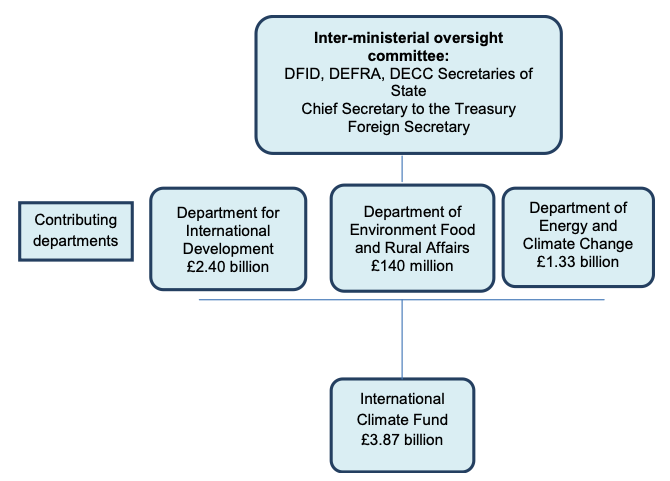
1.2 We have decided to carry out a review of the International Climate Fund (ICF). The ICF is a central part of the UK Government’s response to climate change. Poor people in developing countries are the most vulnerable to the effects of climate change, which threatens to undermine progress that has been made in reducing poverty the world over. As a result, development aid programmes and action to respond to climate change are inextricably linked. The ICF is a £3.87 billion joint initiative of the Department for International Development (DFID), the Department of Energy and Climate Change (DECC) and the Department for Environment, Food and Rural Affairs (DEFRA) to fund programmes that will help developing countries reduce their emissions and adapt to the impacts of climate change. Much of this money is spent through multilateral institutions focussed on climate change. Ministerial oversight of the ICF is provided by the Secretaries of State of these departments together with the Chief Secretary to the Treasury and is conducted in consultation with the Foreign Secretary. We will examine progress made by the ICF against its aim of having a transformational impact on efforts to tackle climate change and reduce poverty.
1.3 These Terms of Reference outline the purpose and nature of the review and identify its main themes. A detailed methodology will be developed during an inception phase.
2. Background
Overview of the International Climate Fund
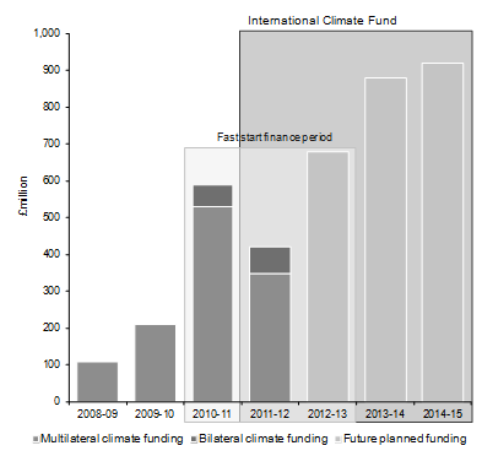
2.1 The ICF has its roots in the Environmental Transformation Fund – International Window (ETF), which was set up in 2007. Most of the ETF funding was channelled through Climate Investment Funds (CIFs), a set of funds administered by the World Bank group in partnership with the Asian Development Bank (ADB), the African Development Bank (AfDB), the European Bank for Reconstruction and Development (EBRD) and the Inter-American Development Bank (IDB). The UK, together with the US and Japan, was one of the founding members of CIF. A further boost to funding for climate change was made through the UK Government’s international commitment, alongside other developed countries, to mobilise approaching $30 billion of Fast Start Finance between 2010 and 2012 to help developing countries tackle climate change. This commitment subsequently led to the establishment of the ICF. Figure 4 on page 4 illustrates the growing commitment of funds for climate activities.
2.2 The ICF was set up in 2010, with funding allocated from 2011, and now runs to 2016. Many of its programmes are therefore in their early stages: only £1.49 billion has been spent as of February 2014. It is therefore still a work in progress. It operates at a much larger scale than the UK’s average aid programme or project, covering multiple and diverse objectives and using different delivery channels. It has three key priorities, framed around the overall purpose of UK development assistance, which is the reduction of poverty. These priorities are:
- to help poor people adapt to the effects of climate change;
- to reduce carbon emissions through promoting low carbon development and enabling poor countries to benefit from clean energy; and
- to reduce deforestation and protect the livelihoods of the 1.2 billion people who depend on forests.
The review will look at how these three priorities contribute to addressing the challenge of climate change and the coherence of the various approaches taken. Examples of the types of activities funded under each of these priorities are given in figure 2.
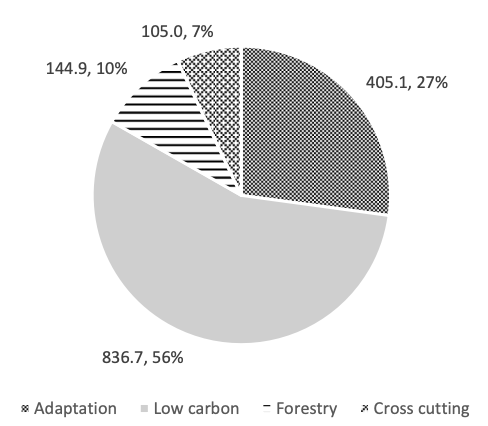
2.3 The ICF is providing £3.87 billion of climate finance over the period 2011-12 to 2015-16 to fund activities to meet these priorities.1 Over the period from 2011 to February 2014, 56% of the ICF has been directed to low carbon development, 27% to adaptation and 10% to forestry, with the remaining 7% being directed to cross-cutting areas (see Figure 1).
Adapting to climate change
- Helping smallholder farmers to continue to produce crops in a changing climate;
- protecting and managing scarce water resources; and
- adopting better technologies and systems to monitor weather and provide early warnings of extreme weather events.
Promoting low carbon development (LCD)
- Helping to transform energy systems, so that the technologies used are less carbon intensive;
- working with private investors and companies to increase the use of renewable energy and more energy-efficient technologies; and
- building knowledge and innovation through research and development.
Reducing deforestation
- Building a global partnership to protect forests;
- helping communities manage forests more sustainably; and
- supporting the global effort to reduce emissions from deforestation and forest degradation.
2.4 Figure 3 provides a schematic of the ICF, together with the breakdown of contributions to the ICF from the three funding departments.
Operation of the ICF
2.5 To help it to deliver its key priorities, the ICF has set out the following five objectives:3
- to build global knowledge and evidence that low carbon, climate resilient development supports growth and reduces poverty;
- to develop, pilot and scale up innovative low carbon, climate resilient programmes and approaches to reduce emissions, support adaptation and protect forests, including biodiversity;
- to support country-level action on low carbon, climate resilient development;
- to build an enabling environment for private sector investment and to engage the private sector to leverage finance and deliver action on the ground; and
- to make climate change an integral part of UK official development assistance (ODA), EU development assistance and lending by multilateral development banks.
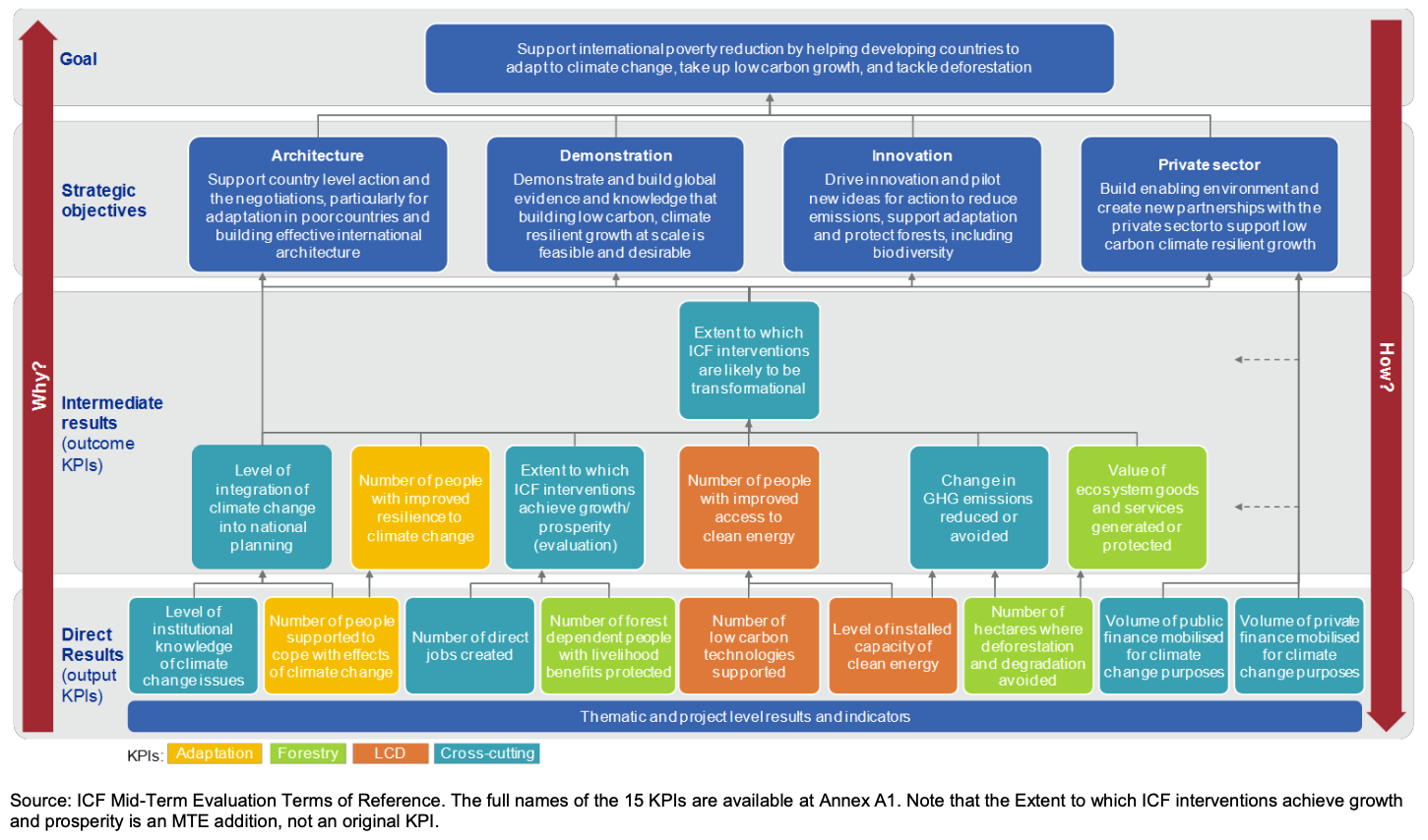
2.6 The ICF uses a set of high-level indicators to track progress against its overall priorities and objectives and to measure impact and value for money; these are at Annex A1. Figure 5 on page 5 presents the ICF results framework.
2.7 A substantial share of ICF funding is channelled through existing global institutions. Between 2011 and February 2014, over 60% of the ICF’s finance has been spent through dedicated multilateral climate funds, which include other donors, as well as developing countries in a collaborative process of programming funds for climate-related purposes.
2.8 The full list of ICF programmes is provided in Figure 6. This review will encompass all ICF-funded work, both multilateral and bilateral.
| Term | Explanation |
|---|---|
| Adaptation | Adjustment in natural or human systems in response to actual or expected climatic stimuli or their effects, which moderates harm or exploits beneficial opportunities. |
| Clean energy or renewable energy | Power generated from resources such as sunlight, wind, tides and geothermal heat which are naturally replenished. |
| Clean Technology Fund (CTF) | A fund set up alongside the Strategic Climate Fund 2009 to provide finance for low carbon energy projects or energy technologies in the South that reduce greenhouse gas emissions. |
| Climate change | Refers to any change in climate over an extended period of time, typically decades, whether due to natural variability or as a result of human activity. |
| Conference of the Parties (COP) | The supreme body of the United Nations Framework Convention on Climate Change. It currently meets once a year to review the Convention's progress. The word 'conference' is not used here in the sense of 'meeting' but rather of 'association'. The 'Conference' meets in sessional periods, for example, the 'fourth session of the Conference of the Parties'. |
| Dedicated multilateral climate fund | Multilateral institutions that channel funding from various donor institutions to developing countries specifically to finance activities aiming to limiting climate change. |
| Deforestation | Conversion of forest to non-forest. |
| Energy efficiency | The ratio of useful energy output of a system, conversion process or activity to its energy input. |
| Forestry | Activities to limit climate change via combating deforestation and promoting reforestation. |
| Fossil fuels | Carbon-based fuels from fossil hydrocarbon deposits, including coal, peat, oil and natural gas. |
| Global Environment Facility (GEF) | The GEF is an independent financial organisation that provides grants to developing countries for projects that benefit the global environment and promote sustainable livelihoods in local communities. The Parties to the Convention assigned operation of the financial mechanism to the GEF on an on-going basis, subject to review every four years. The financial mechanism is accountable to the COP. |
| Green Climate Fund (GCF) | At COP 16 in Cancun in 2010, governments established a Green Climate Fund as an operating entity of the financial mechanism of the Convention under Article 11. The GCF will support projects, programmes, policies and other activities in developing country Parties. The Fund will be governed by the GCF Board. |
| Greenhouse gases (GHGs) commonly referred as 'carbon emissions' | The atmospheric gases responsible for causing global warming and climate change. The major GHGs are carbon dioxide (CO2), methane (CH4) and nitrous oxide (N20). Less prevalent - but very powerful - greenhouse gases are hydrofluorocarbons (HFCs), perfluorocarbons (PFCs) and sulphur hexafluoride (SF6). |
| Intergovernmental Panel on Climate Change (IPCC) | A global scientific body for the assessment of climate change, established in 1988 by the United Nations Environment Programme (UNEP) and the World Meteorological Organization (WMO). Its purpose is to report on the current state of scientific knowledge about climate change and its potential environmental and socio-economic consequences. The preparation of the Assessment Reports on Climate Change is a key activity of the IPCC, reviewing and assessing the most recent scientific, technical and socio-economic information produced worldwide relevant to the understanding of climate change. There have been four of these to date, from the first in 1990 to the fourth in 2007. |
| Mitigation | In the context of climate change, a human intervention to reduce the sources or enhance the sinks of greenhouse gases. Examples include using fossil fuels more efficiently for industrial processes or electricity generation, switching to solar energy or wind power, improving the insulation of buildings and expanding forests and other 'sinks' to remove greater amounts of carbon dioxide from the atmosphere. |
| Multilateral | Multilateral programmes are executed in partnership with other governments and may be managed by multilateral institutions such as development banks or UN agencies. The distinction between multilateral and bilateral relates to the number of other donors. |
| Nationally Appropriate Mitigation Actions (NAMA) Facility | At COP 16 in Cancun in 2010, Governments decided to set up a registry to record nationally appropriate mitigation actions seeking international support, to facilitate the matching of finance, technology and capacity-building support with these actions and to recognise other NAMAs. |
| Reducing Emissions from Deforestation and Forest Degradation (REDD) | Set up by the UNDP, REDD is a multi-donor trust fund, pooling resources in an effort to create a financial value for the carbon stored in forests, offering incentives for developing countries to reduce emissions from deforestation and degradation of their lands. Advocates claim such a North–South flow of funds will support new, pro-poor development, help conserve biodiversity and ecosystem services and contribute to increased resilience to climate change renewable. |
| Reforestation | Replanting of forests on lands that have previously contained forests but that have been converted to some other use. |
| Stern Review | Shorthand for The Stern Review on the Economics of Climate Change published by the UK Treasury in 2007. led by the economist Lord Nicholas Stern. Its main messages were that there is still time to avoid the worst impacts of climate change, if we take strong action now; and that the costs of stabilising the climate are significant but manageable. |
| Strategic Climate Fund (SCF) | A fund set up by the World Bank in July 2008, together with the Clean Technology Fund, to provide financing to pilot new development approaches or to scale up activities aimed at specific climate change challenges through targeted programs. |
| United Nations Framework Convention on Climate Change (UNFCCC) | Signed at the Rio Summit in 1992 by over 150 countries, it sets an overall framework for intergovernmental efforts to tackle the challenge posed by climate change. Its ultimate objective is the 'stabilisation of greenhouse gas concentrations in the atmosphere at a level that would prevent dangerous anthropogenic interference with the climate system'. The Convention now enjoys near universal membership, with 192 countries having ratified it. |
Note: For a number of bilateral programmes, the ICF is using trusted delivery partners such as the Multilateral Development Banks (MDBs) to help deliver these.
3. Purpose of this review
3.1 This review will examine how well DFID, DECC and DEFRA systems are delivering on the transformational aspirations of the ICF and the emerging impacts that programmes are beginning to have in some of the countries to which finance has been directed. We will assess how likely it is that the work the ICF is funding will meet its objective of supporting international poverty reduction by helping developing countries to adapt to climate change, take up low-carbon growth and tackle deforestation. We will consider the catalytic role that the ICF is having in this context.
4. Relationship to other studies
4.1 This will be the first time that independent scrutiny on behalf of Parliament has been brought to bear on this area of high expenditure and high priority with public interest. It will complement the investment that DFID, DECC and DEFRA have already made in understanding the impact of the ICF. It will interrogate and build on insights from the DFID-commissioned mid-term evaluation (MTE) of the ICF. The MTE is reviewing the progress of the ICF in order to provide timely advice for action. This includes assessing the relevance and appropriateness of ICF implementation processes and value for money. It will also seek to inform future planning on UK climate finance.
4.2 This independent ICAI review will also examine the on-going independent evaluation of the CIFs, overseen by the Evaluation Oversight Committee of the Independent Evaluation Groups of the World Bank, AfDB, ADB, EBRD and IDB and an International Reference Group. The CIFs are the channel through which the largest share of ICF funding has been spent so far. They commenced in November 2012 and are in the process of completing ten country case studies. This ICAI review will examine these various outputs and further research and analysis will be carried out where necessary.
5. Analytical approach
5.1 The ICF seeks to be a transformative instrument by unlocking scale and replication potential through supporting programmes that seek to do this. The review will assess the progress of the ICF in this ambition. Annex A2 summarises the criteria that DFID has proposed to identify ‘transformative’ programmes. This review will consider progress to date in aggregate, considered across the breadth of ICF activities. It will focus on the following core questions:
- Is the ICF strategy coherent in support of the five core high-level objectives?
- Are the aggregate outcomes likely to achieve transformational impact?
- Are the early programmes funded by the ICF designed well, organised effectively and likely to meet intended beneficiary needs?
5.2 We will consider both the activities that are administered through multilateral partner institutions and international organisations, as well as programmes that are administered bilaterally by UK institutions. Country visits will place particular emphasis on UK bilateral programmes, which have been relatively less scrutinised so far, although they will also interrogate the impacts on the ground of multilaterally managed programmes. We will explore multiple country visits, in order to offer a more complete set of insights.
5.3 The review will include a number of elements:
- against the five core objectives, we will examine a subset of initiatives across the ICF’s four thematic areas (adaptation, mitigation, forests and cross-cutting) at three different levels (global, national and direct intervention level). We will consider how holistic the ICF approach has been and how well it sits with other donors’ efforts and priorities;
- at the global level, we will explore the degree to which the ICF is engaging knowledge brokers such as the World Bank and informing global policy processes, such as the UNFCCC and the Green Climate Fund (GCF) and the degree to which it is succeeding in mainstreaming climate change into development assistance. We will also consider how the UK approach is informing approaches taken by other donors;
- in order to understand impact on the ground, we will visit at least one chosen country. We will seek to select countries where programmes target all five of the ICF core objectives. This will include the degree to which the ICF has been able to develop, pilot and scale innovative programmes to support country-level action. This will also include the degree to which the ICF is building an enabling environment for the private sector and how ICF funding is prompting other development partners and multilateral institutions to address climate change, as part of national development finance. We will focus in particular on bilateral projects and interventions, recognising that these constitute a relatively small share of ICF programming so far; and
- at the intervention level, we will examine how far intended beneficiaries have been impacted by ICF interventions, for example the number of jobs created, the number of people supported to cope with the effects of climate change, the level of installed capacity of clean energy and the number of hectares where deforestation and degradation are avoided.
5.4 Figure 7 summarises the approach that we propose to take.
5.5 The review will include the three different levels identified above (i.e. global, national, intervention). We will draw on and generate different sources of information for each of these levels. Many of the sources of information will be useful at more than one level.
5.5.1 At the intervention level:
- internally commissioned reviews of ICF programmes and any reporting to date against the ICF’s Key Performance Indicators (KPIs);
- key informant interviews with local government, local civil society and the private sector, including with intended beneficiaries where possible;
- visits to project sites to see specific interventions on the ground and understand impacts;
- the ICF MTE and CIF Review findings where relevant; and
- further desk research and telephone interviews where required, including drawing on independent evidence.
5.5.2 At the national level:
- key informant interviews with national agencies and ministries and national-level civil society organisations (CSOs) and country-wide private sector companies;
- key informant interviews with other multilateral and bilateral donors, private sector and civil society representatives, including potentially on the margins of international meetings such as the upcoming GCF Board meeting in Indonesia in February 2014;
- national-level planning documents including Nationally Appropriate Mitigation Actions and National Adaptation Programme of Action;
- internally commissioned reviews of ICF programmes and any reporting to date against KPIs;
- the ICF MTE and CIF Review findings where relevant; and
- further desk research and telephone interviews where required.
5.5.3 At the global level:
- international climate finance literature and commentary to assess the degree to which the ICF is influencing global knowledge and contributing to building global evidence;
- international development finance programming documentation to assess the degree to which climate change is being mainstreamed;
- key informant interviews with other multilateral and bilateral donors, private sector and civil society representatives; including potentially on the margins of international meetings such as the upcoming GCF Board meeting in Indonesia in February 2014;
- further desk research, including independent evidence from international organisations, think tanks and civil society; and
- further key informant interviews in person and by phone as required.
6. Indicative questions
6.1 A detailed methodology will be developed during the inception phase, setting out the likely review questions and the methods to be used for answering them. The review is likely to consider the following questions at the global, national and intervention levels as appropriate:
6.2 Objectives
6.2.1 Are the objectives, priorities and proposed use of resources of the ICF appropriate?
6.2.2 Are the theories of change coherent at the three different levels of a) global, b) national and c) intervention?
6.3 Delivery
6.3.1 Do DFID, DECC and DEFRA, with the Foreign and Commonwealth Office (FCO) and Her Majesty’s Treasury, have adequate approaches for the governance and financial management of the ICF?
6.3.2 Are the frameworks for allocation of funding justified and appropriate? How adequate and appropriate is the due diligence that has gone into programme design?
6.3.3 Is the delivery of the ICF helping to mainstream climate issues into the strategic development priorities of DFID?
6.3.4 How well is the ICF engaging knowledge brokers such as the World Bank and informing global policy processes such as the UNFCCC and the GCF?
6.4 Impact
6.4.1 What impact is the ICF having working with countries at the national level on adaptation and mitigation (including forestry) to date? How well are programming priorities addressing poverty reduction and climate change linkages?
6.4.2 How likely are programmes to demonstrate that building low-carbon, climate resilient development at scale is feasible and desirable? What is the level of preparedness in countries now?
6.4.3 How coherent are interventions at programme, national and global levels? Given the breadth of ICF objectives, do the funded programmes seem poised to help realise them at sufficient depth?
6.4.4 How effective is ICF engagement with the private sector in enabling and leveraging private sector investment?
6.5 Learning
6.5.1 What are the monitoring and evaluation systems developed and used by the ICF? How do the ICF’s reporting practices compare with other climate funds?
6.5.2 What are priority countries learning and scaling up as a result of ICF-supported initiatives?
6.5.3 How are lessons from the ICF experience being disseminated to other institutions in the global climate finance architecture?
7. Timing and deliverables
7.1 The review will be overseen by Commissioners and implemented by a team from ICAI’s consortium, with the support of an Advisory Panel. The lead Commissioner will be Graham Ward. The review will take place from the first quarter of 2014 with the final report available in Autumn 2014.
Annex A1: ICF's Key Performance Indicators
| Dimension | KPI |
|---|---|
| People | 1. Number of people supported by ICF programmes to cope with the effects of climate change. |
| 2. Number of people with improved access to clean energy as a result of UK-ICF programmes. | |
| 3. Number of forest dependent people with livelihoods benefits protected or improved as a result of ICF support. | |
| 4. Number of people with improved resilience as a result of UK-ICF support. | |
| 5. Number of direct jobs created as a result of ICF support. | |
| Environment | 6. Change in Greenhouse Gas (GHG) emissions as a result of UK-ICF support. |
| 7. Level of installed capacity of clean energy as a result of ICF support. | |
| 8. Number of hectares where deforestation and degradation have been avoided through ICF support. | |
| 9. Number of low carbon technologies supported (units installed) through ICF support. | |
| 10. Value of ecosystem services generated or protected as a result of ICF support N.B. indicator is calculated centrally, based on KPI 8 and other input data. |
|
| Influence and Leverage | 11. Volume of public finance mobilised for climate change purposes as a result of ICF funding. |
| 12. Volume of private finance mobilised for climate change purposes as a result of ICF funding. | |
| 13. Level of integration of climate change in national planning as a result of ICF support. | |
| 14. Level of institutional knowledge of climate change issues as a result of ICF support. | |
| 15. Extent to which ICF intervention is likely to have a transformational impact Approach proposes supplementary evaluation work to strengthen the assessment. |
Annex A2: The criteria for a transformative programme
A number of criteria were submitted by DFID to ICAI in order to provide a guide on what could constitute a transformational programme. These criteria are a proxy for whether the intervention will bring about a change in incentives to shift from one state to another. For example, from conventional to: lower carbon or climate resilient patterns of development or to increase the pace of change or a much more rapid fall in the rate of deforestation. These include:
Scale: National, sectoral or economy-wide programmes including institutional and policy reform, for example energy sector reform, large-scale deployment of a technology so that it reaches critical deployment mass or provision of technical assistance to support a country to reduce national fossil fuel subsidies;
Replicable: Programmes which others can copy, leading to larger scale or faster roll out, for example, key policy change or helping to drive technology down the learning curve;
Innovative: Piloting new ways of achieving objectives that could lead to wider and sustained change. These programmes are often high risk but with corresponding high potential returns; and
Leverage: Programmes that leverage others to help increase the impact beyond the programme itself should increase the likelihood of this being transformational, by unlocking scale and replication potential. Examples of leverage include: domestic flows from recipient country, private sector or other aid flows. Leveraging should be considered an addition to existing sources whilst ensuring these sources are not crowded out.4
Annex A3: Glossary
| Term | Explanation |
|---|---|
| Adaptation | Adjustment in natural or human systems in response to actual or expected climatic stimuli or their effects, which moderates harm or exploits beneficial opportunities. |
| Clean energy or renewable energy | Power generated from resources such as sunlight, wind, tides and geothermal heat which are naturally replenished. |
| Clean Technology Fund (CTF) | A fund set up alongside the Strategic Climate Fund 2009 to provide finance for low carbon energy projects or energy technologies in the South that reduce greenhouse gas emissions. |
| Climate change | Refers to any change in climate over an extended period of time, typically decades, whether due to natural variability or as a result of human activity. |
| Conference of the Parties (COP) | The supreme body of the United Nations Framework Convention on Climate Change. It currently meets once a year to review the Convention's progress. The word 'conference' is not used here in the sense of 'meeting' but rather of 'association'. The 'Conference' meets in sessional periods, for example, the 'fourth session of the Conference of the Parties'. |
| Dedicated multilateral climate fund | Multilateral institutions that channel funding from various donor institutions to developing countries specifically to finance activities aiming to limiting climate change. |
| Deforestation | Conversion of forest to non-forest. |
| Energy efficiency | The ratio of useful energy output of a system, conversion process or activity to its energy input. |
| Forestry | Activities to limit climate change via combating deforestation and promoting reforestation. |
| Fossil fuels | Carbon-based fuels from fossil hydrocarbon deposits, including coal, peat, oil and natural gas. |
| Global Environment Facility (GEF) | The GEF is an independent financial organisation that provides grants to developing countries for projects that benefit the global environment and promote sustainable livelihoods in local communities. The Parties to the Convention assigned operation of the financial mechanism to the GEF on an on-going basis, subject to review every four years. The financial mechanism is accountable to the COP. |
| Green Climate Fund (GCF) | At COP 16 in Cancun in 2010, governments established a Green Climate Fund as an operating entity of the financial mechanism of the Convention under Article 11. The GCF will support projects, programmes, policies and other activities in developing country Parties. The Fund will be governed by the GCF Board. |
| Greenhouse gases (GHGs) commonly referred as 'carbon emissions' | The atmospheric gases responsible for causing global warming and climate change. The major GHGs are carbon dioxide (CO2), methane (CH4) and nitrous oxide (N20). Less prevalent - but very powerful - greenhouse gases are hydrofluorocarbons (HFCs), perfluorocarbons (PFCs) and sulphur hexafluoride (SF6). |
| Intergovernmental Panel on Climate Change (IPCC) | A global scientific body for the assessment of climate change, established in 1988 by the United Nations Environment Programme (UNEP) and the World Meteorological Organization (WMO). Its purpose is to report on the current state of scientific knowledge about climate change and its potential environmental and socio-economic consequences. The preparation of the Assessment Reports on Climate Change is a key activity of the IPCC, reviewing and assessing the most recent scientific, technical and socio-economic information produced worldwide relevant to the understanding of climate change. There have been four of these to date, from the first in 1990 to the fourth in 2007. |
| Mitigation | In the context of climate change, a human intervention to reduce the sources or enhance the sinks of greenhouse gases. Examples include using fossil fuels more efficiently for industrial processes or electricity generation, switching to solar energy or wind power, improving the insulation of buildings and expanding forests and other 'sinks' to remove greater amounts of carbon dioxide from the atmosphere. |
| Multilateral | Multilateral programmes are executed in partnership with other governments and may be managed by multilateral institutions such as development banks or UN agencies. The distinction between multilateral and bilateral relates to the number of other donors. |
| Nationally Appropriate Mitigation Actions (NAMA) Facility | At COP 16 in Cancun in 2010, Governments decided to set up a registry to record nationally appropriate mitigation actions seeking international support, to facilitate the matching of finance, technology and capacity-building support with these actions and to recognise other NAMAs. |
| Reducing Emissions from Deforestation and Forest Degradation (REDD) | Set up by the UNDP, REDD is a multi-donor trust fund, pooling resources in an effort to create a financial value for the carbon stored in forests, offering incentives for developing countries to reduce emissions from deforestation and degradation of their lands. Advocates claim such a North–South flow of funds will support new, pro-poor development, help conserve biodiversity and ecosystem services and contribute to increased resilience to climate change renewable. |
| Reforestation | Replanting of forests on lands that have previously contained forests but that have been converted to some other use. |
| Stern Review | Shorthand for The Stern Review on the Economics of Climate Change published by the UK Treasury in 2007. led by the economist Lord Nicholas Stern. Its main messages were that there is still time to avoid the worst impacts of climate change, if we take strong action now; and that the costs of stabilising the climate are significant but manageable. |
| Strategic Climate Fund (SCF) | A fund set up by the World Bank in July 2008, together with the Clean Technology Fund, to provide financing to pilot new development approaches or to scale up activities aimed at specific climate change challenges through targeted programs. |
| United Nations Framework Convention on Climate Change (UNFCCC) | Signed at the Rio Summit in 1992 by over 150 countries, it sets an overall framework for intergovernmental efforts to tackle the challenge posed by climate change. Its ultimate objective is the 'stabilisation of greenhouse gas concentrations in the atmosphere at a level that would prevent dangerous anthropogenic interference with the climate system'. The Convention now enjoys near universal membership, with 192 countries having ratified it. |
Footnotes
1 Supporting international action on climate change, UK Government, 2013, https://www.gov.uk/government/policies/taking-international-action-to-mitigate-climate-change/supporting-pages/international-climate-fund-icf.
2 The Secretaries of State and Foreign Secretary are represented by their respective director generals as per the following document: International Climate Fund (ICF) Implementation Plan 2011/12 – 2014/15, Technical Paper, ICF, https://www.gov.uk/government/uploads/system/uploads/attachment_data/file/67454/uk-International-Climate-Fund-techncial-working-paper.pdf.
3 These objectives are in the process of being updated.
4 What criteria must a programme follow to be transformational? DFID briefing pack of documentation.