UK aid for energy transition
Acronyms
| Acronyms | |
|---|---|
| BII | British International Investment |
| CCMM | Climate Investment Funds Capital Markets Mechanism |
| CETP | Clean Energy Transition Partnership |
| CIF | Climate Investment Funds |
| COP | Conference of the Parties |
| CPI | Climate Policy Initiative |
| CSP | Concentrated Solar Power |
| CTF | Clean Technology Fund |
| Defra | Department for Environment, Food and Rural Affairs |
| DESNZ | Department for Energy Security and Net Zero |
| DFI | Development Finance Institution |
| DSIT | Department for Science, Innovation and Technology |
| FCDO | Foreign, Commonwealth and Development Office |
| GCF | Green Climate Fund |
| GCPA | Global Clean Power Alliance |
| GW | Gigawatt |
| ICAI | Independent Commission for Aid Impact |
| ICF | International Climate Finance |
| IPG | International Partners Group |
| JETP | Just Energy Transition Partnership |
| KPI | Key Performance Indicator |
| MCF | Multilateral Climate Fund |
| MDB | Multilateral Development Bank |
| MEL | Monitoring, Evaluation and Learning |
| NDC | Nationally Determined Contribution |
| ODA | Official Development Assistance |
| OECD | Organisation for Economic Co-operation and Development |
| PIDG | Private Infrastructure Development Group |
| SDG | Sustainable Development Goal |
| UNFCCC | United Nations Framework Convention on Climate Change |
Executive summary
A shift of the world’s energy systems away from polluting and carbon-emitting fossil fuels and towards clean, affordable and renewable energy is essential to support economic growth and poverty reduction while keeping global warming below dangerous levels.
Domestically, the UK has already committed to this energy transition, cutting emissions by half compared to 1990 levels and pledging to reach net zero emissions by 2050. Internationally, recognising the global nature of the climate challenge, successive governments have also allocated a significant share of the UK’s aid budget to supporting developing countries to make the transition to low-carbon, climate-resilient and nature-positive development paths.
This Independent Commission for Aid Impact (ICAI) review assesses how well the UK’s support for energy transition in developing countries has worked over the past five years, focusing on relevant spending and activities from 2021-22 through to 2025-26 within the UK’s overall £11.6 billion international climate finance (ICF) pledge.
The review considers the relevance and effectiveness of the UK’s strategic approach to energy transition in developing countries; how well the UK has worked with international alliances and country partnerships, in particular the Just Energy Transition Partnerships (JETPs); and how effective the UK’s efforts have been at mobilising further public and private finance in support of energy transition.
The review scope is global, including the UK’s bilateral programmes and funding through British
International Investment (BII) and the Private Infrastructure Development Group (PIDG), as well as UK ICF funding for multilateral development banks (MDBs) and multilateral climate funds (MCFs), in particular the Climate Investment Funds (CIF) and the Green Climate Fund (GCF).
Energy transition is a multi-sector and system-focused endeavour that spans all the four priority pillars of the 2023 strategy governing the UK’s ICF spend (clean energy; sustainable cities, infrastructure and transport; adaptation and resilience; and nature for climate and people). The exercise to determine the UK’s portfolio of energy transition-relevant programming for ICAI to build its review around took place in two steps. Initially, the Foreign, Commonwealth and Development Office (FCDO) and the Department for Energy Security and Net Zero (DESNZ) shared the outcome of a recent mapping exercise they had conducted across energy transition-relevant programming. Building on this, we conducted an additional exercise in collaboration with the departments to identify the set of programmes and activities that were relevant to energy transition within our review period. In total, we identified 84 energy transition-relevant programmes and activities as constituting the UK’s energy transition portfolio. The findings in this review are centred around this portfolio.
Some of the programmes and activities in this portfolio have clean energy as their primary focus, some do not have an energy focus but are relevant to the wider energy transition, while others include clean energy alongside other ICF pillar priorities. Based on an analysis and estimates of this ICF pillar breakdown, as well as the delivery channels of the support, our best estimate is that the UK will spend around £3.6 billion of official development assistance (ODA) on supporting energy transition in developing countries over the five years 2021-22 to 2025-26 (within a total budget for the 84 relevant programmes and activities of £5.7 billion, and a total for ICF of £11.6 billion).
Findings
Relevance and effectiveness of the UK’s strategy
The review finds that the UK’s energy transition efforts in developing countries are highly relevant to addressing the climate crisis and benefit from long-standing and constant political commitment, substantial financial contributions, and strong technical expertise. Together these lie at the base of the UK’s leading role in international efforts to promote global energy transition.
The UK’s approach has largely evolved through a learn-by-doing, adaptive model shaped by a combination of international climate negotiations and reactive programme-level decisions. The result is a broad and diverse energy transition portfolio, which at its best allows adaptive decision-making, but also risks a lack of coherence. There is no single, shared definition of energy transition, nor a comprehensive operational strategy for achieving all of the UK’s energy transition objectives, and government departments do not have a clear framework for cross-departmental decision making. This makes identifying gaps, and strategic decision making on prioritisation and scaling up, difficult – an urgent challenge as the UK government reduces its ODA budget from 0.5% to 0.3% of gross national income over the next two years to 2027.
Programmes in the energy transition portfolio are reporting significant results in some areas, but accountability for ICF reporting is weak and reporting practice is not comprehensive. The UK’s ICF monitoring and learning system is recognised as stronger and more transparent than those of other donors, but the ICF key performance indicators (KPIs) only provide a partial results picture for the energy transition portfolio. It is also not possible to determine how many programmes should be reporting on a given ICF KPI, hampering accountability and strategic learning across the energy transition portfolio. The available data does not allow a complete and accurate breakdown of the UK’s spend on energy transition by KPIs, delivery channel, or country.
The UK vision is to enable systemic shifts to accelerate progress to deliver transformational change in the energy systems of developing countries. Some early progress has been made, but there is a lack of clarity on how the efforts across the UK’s broad range of programmes work together to achieve transformational change. There is a delicate balance to be managed between the energy transition portfolio’s strategic focus on higher-emitting, middle-income countries, albeit with sizeable poor populations, and the need to ensure adequate support for low-income countries that remain relatively underserved, despite their acute vulnerability and greater dependence on concessional finance, with potential implications for the UK’s longer-term poverty reduction and equity goals. The UK is a major contributor to MCFs and has used its role as the leading donor to influence the strategic direction of the CIF and the GCF in a positive direction. These climate funds are central to the UK’s energy transition objectives, but there has not been a clear strategic rationale underpinning the UK’s allocation decisions between multilateral and bilateral funding channels or on the proportion of funding allocated to each fund.
The review finds positive examples of cross-government coordination on the UK’s international energy transition portfolio, but a lack of high-level coordination structures risks undermining portfolio coherence and strategic delivery. In September 2025 the government announced an overhaul of the way its cross-government ODA board works to address this risk.
Finally, we noted the importance for energy transition of securing a stable and ethical supply of critical minerals and the persistent challenges posed by complex and opaque extraction and supply chains, despite UK and international commitment to strong environmental and social safeguards.
Working with partners and alliances
The UK played a central role in establishing JETPs, notably in Indonesia and South Africa, which are country-led agreements that aim to mobilise grants, concessional loans, guarantees and private finance to help middle-income countries shift from coal to clean energy.
The UK’s support for JETPs is valued by other donors and partner countries due to its responsive nature and focus on capacity support and consultation. While the JETPs have fostered financial commitments from national governments, donors and private financiers, the mobilisation of funds has been slower than intended, with actual project spend lagging behind expectations. Progress on the phase-down of coal-fired power capacity is also off track, and UK offers of guarantees on loans from MDBs – the primary means of UK financial support offered – have not yet been fully taken up.
While the UK’s influence on the outcomes of a country-led partnership is limited, some of the problems could have been anticipated in the original design and goals. However, the UK has used the lessons learned from the JETPs to inform its approach to subsequent country-led initiatives.
The UK has also been central to the creation of several different international alliances bringing developed and developing countries together to promote energy transition in the last five years. These range from the Clean Energy Transition Partnership launched at the Glasgow Climate Summit in 2021 to the Global Clean Power Alliance launched at the G20 in 2024. While the alliances themselves are not aid-funded, developing country members of alliances will often rely on aid funding to be able to commit to the alliances’ objectives.
Although there are some good examples of success, it is not possible to assess the effectiveness of these alliances robustly, since rigorous monitoring, evaluation and learning standards are only applied to direct use of aid money and not to the UK’s influence and wider impact of the alliance. The proliferation of alliances in the same space poses risks of fragmentation and duplication, especially for developing countries with limited capacity.
Mobilising finance
A central UK objective is to use its ICF to leverage and mobilise further public and private finance in support of energy transition. While global climate finance remains far below required levels, the review found evidence of UK leadership in supporting effective finance mobilisation. Looking at the results reported against the ICF KPIs on the mobilisation of public and private finance, the energy transition portfolio reported £5.2 billion of mobilised finance in the period from 2021-22 to 2023-24 (the last financial year for which we have KPI data). The UK-supported MCFs and development finance institutions all report significant mobilisation of public and private finance. However, their performance cannot be easily compared: they have different mandates, some operate in areas where attracting climate finance is easier, and they use different ways of measuring finance mobilisation, which may ultimately also affect the quality of the data fed into the ICF KPI data on mobilisation.
There is potential for the MCFs to increase their already considerable mobilisation of private capital, and the UK has been working with the funds to emphasise and operationalise this priority. There is evidence that in the past year the government has begun to engage with City of London institutions more intensively.
The UK takes a system-wide approach to finance mobilisation at all stages of the investment cycle, including for higher-risk innovations and for promoting an enabling investment environment in developing countries. This is a robust approach, but it is constrained in practice by the limited coherence between the many small and diverse activities and programmes that make up the energy transition portfolio, and insufficient coordination with other funders and between FCDO and DESNZ. The need for strengthened cross-departmental coherence on climate-related spending is recognised by the government, and there are intentions to strengthen the working of the cross-departmental ODA board, where all ODA-spending departments have a seat.
There is a risk of concessional funding crowding out private finance, linked to the UK’s focus on middle-income countries and emerging markets. Many middle-income countries, unlike low-income countries, have the capacity to access climate finance through non-ODA mechanisms and market-based instruments. The sample of business cases we reviewed in the UK’s energy transition portfolio all addressed the risk of crowding out private finance, but did so with the aim of justifying the proposed investment rather than providing a rigorous assessment of whether the programme’s goals could be secured without, or with less, concessional finance. Nevertheless, a few evaluations concluded that UK support had not crowded out private investors.
Conclusions and recommendations
Overall, there are many positive achievements to highlight in the UK’s ICF work on energy transition in developing countries. However, with difficult choices on the allocation of resources ahead, there is scope for improvement. This includes forming an overarching energy transition definition and strategy, addressing accountability and implementation gaps in data and reporting, and strengthening coordination across programmes and financial mobilisation efforts across the investment cycle, with sensitivity to the country context. While the UK’s influential role and adaptive decision making are clear strengths, further progress is needed on strategic direction, coherence, and transparency to fully maximise effectiveness and impact.
Work on energy transition through partnerships and alliances has the potential to empower developing countries to take the lead on this work. But in the absence of systems to evaluate the impact of some of these initiatives, there is no evidence that they are an effective replacement for more conventional bilateral aid programming or investments through multilateral funds and development banks.
With the aim of supporting the UK government in further strengthening its efforts on energy transition in developing countries, ICAI offers the following recommendations.
Recommendation 1: The UK should publish a comprehensive energy transition strategy with a clear definition and theory of change, which also reflects poverty reduction and inclusion goals
Recommendation 2: The UK should take a portfolio-level approach to identifying and allocating funding between different bilateral and multilateral channels, notably between the multilateral climate funds, based on comparative advantage and value for money
Recommendation 3: The UK should establish clear, publicly accountable departmental roles with joint accountability to strengthen decision making and coordination on energy transition
Recommendation 4: The UK should standardise and strengthen the implementation of monitoring and learning across its energy transition portfolio, particularly accountability for reporting and the use of data on transformational change, financial leverage, and the additionality of UK finance
Recommendation 5: The UK should clarify the role of its country partnerships and international alliances in supporting energy transition, introduce more realistic targets for the JETPs, and create robust performance frameworks for alliances
Recommendation 6: The UK should clearly articulate its objectives for mobilising additional finance, distinguishing between support for countries at different development stages and across the investment cycle
1. Introduction
1.1 Global energy transition from fossil fuels to renewable energy is key to reducing the rate of global warming and helping countries and communities become resilient to the impacts of climate change. It is at the centre of the global climate goals set out in the Paris Agreement of 2015 and subsequent accords (see Box 1). Despite record investments and strong policy support, the climate goals are off track, making energy transition more urgent than ever.1 The latest overview of the scientific evidence by the Intergovernmental Panel on Climate Change found that climate change is already affecting weather and climate extremes in every region of the world, including heatwaves, droughts, heavy precipitation, floods, and cyclones. Adverse impacts are already felt on food and water security, human health, and economies, with vulnerable communities disproportionately affected.2
Box 1: The Paris Agreement and the global climate goals
The United Nations Framework Convention on Climate Change (UNFCCC) is the main vehicle for driving global cooperation to reduce climate change and its negative impacts. The UNFCCC convenes an annual Conference of the Parties (COP) where states review the scientific evidence on climate change, assess progress against global goals and national targets, and negotiate further agreements. In 2015, at COP21 in Paris, almost all the world’s states adopted the Paris Agreement, committing to “strengthen the global response to the threat of climate change, in the context of sustainable development and efforts to eradicate poverty”. The Paris Agreement has three linked commitments:
- To keep the average global warming to well below 2 degrees Celsius above pre-industrial levels and as close to 1.5 degrees as possible.
- To increase the world’s ability to adapt to the adverse impacts of climate change and foster resilience. This includes “low greenhouse gas emissions development” – economic development that builds on low-emitting technologies (away from fossil fuels).
- To ensure there are sufficient finance flows (known as “climate finance”), both public and private, to enable countries to pursue the first two commitments.
Developing countries will be the worst affected by climate change. They have historically contributed less to the emissions causing global warming, although fast-growing emerging economies are now some of the largest emitters.3 The Paris Agreement establishes the principle of “common but differentiated responsibilities and respective capabilities”, with climate finance to support developing countries’ transition to low-emission and climate-resilient development.
In 2023, at COP28 in Dubai, the first global stocktake of the Paris Agreement was held. It found that important progress had been made, but the world was nevertheless on a dangerous path to a temperature increase of 2.5-2.9 degrees Celsius. In the United Arab Emirates Consensus, agreed at COP28, countries committed to:
- transition away from fossil fuels in energy systems – also known as ‘energy transition’ – in a just, orderly and equitable manner
- triple the global renewable energy capacity and double the rate of energy efficiency improvements by 2030
- strengthen adaptation and resilience, including national adaptation plans and support for vulnerable communities
- scale up climate finance, especially for developing countries. The mechanisms for delivering the collective finance goal, including mobilising private finance, will be a central topic at COP30 in Belém, Brazil, in November 2025.
1.2 At the same time, securing affordable and clean energy is also a core part of achieving broader development outcomes for sustainable economic growth. The World Bank report on progress towards Sustainable Development Goal 7 (SDG7) on Affordable and Clean Energy4 and the Organisation for Economic Co-operation and Development (OECD) report on climate finance flows show that there has been significant but uneven progress in this area:5
- Electricity access: almost 92% of the world’s population now have access to electricity. However, 666 million people remain without access, most of whom live in sub-Saharan Africa.6
- Clean cooking:1 billion people still lack access to clean cooking sources, with negative consequences for indoor air quality and human health, as well for as climate change. Progress in this area remains slow.7
- Renewable energy: in 2022, renewables made up 17.9% of the world’s total energy consumption. This is an improvement, but it is not on track for the UAE Consensus commitment to triple the global renewables-based power capacity by 2030.8
- Energy efficiency: this is mainly measured as energy intensity – the ratio of energy supply to gross domestic product, where a decrease in the ratio means that a country produces more with less energy. There are moderate improvements, but not at the pace needed to meet 2030 targets.9
- Financial flows: in 2022, developed countries mobilised $115.9 billion (£86.2 billion) in climate finance for developing countries. This was the first year that countries achieved the goal of mobilising $100 billion (£74.4 billion) towards climate finance.10 However, this is still far below the amount required, based on estimated need. The World Bank found that in 2023, $21.6 billion (£16.1 billion) of climate finance went towards clean energy research and development and renewable energy production, a 29% increase from the year before.11 According to the OECD, the overall volumes of investments going to least developed and low-income countries remain modest in both absolute and relative terms, accounting for less than 10% of global climate flows.12 The World Bank found a similar disparity in climate finance for energy, where the flow to least developed countries dropped by 0.5% in 2023.13
- Rising demand: although the least developed countries currently have some of the lowest energy consumption levels globally, their demand is expected to grow rapidly, underscoring the urgent need for sustainable energy solutions to support inclusive and resilient development.
The purpose and scope of this review
1.3 Successive UK governments have made clear their long-standing commitment to energy transition both domestically and globally. The International Climate Finance (ICF) Strategy, which governs the use of the UK’s £11.6 billion pledge for climate-related aid, has clean energy (a key dimension of energy transition see Box 22) as one of its key pillars.
1.4 This review looks at UK-supported activities and interventions to promote energy transition in developing countries, assessing their effectiveness and their relevance to UK policy objectives. It assesses UK activities to date and provides recommendations to support the development of future UK strategies. This is timely, since the government is currently updating its strategy for the next period of ICF spending and deciding its approach to future replenishments for multilateral climate funds. The review provides the first ICAI assessment of how the UK supports energy transition in developing countries.
1.5 The review focuses on the UK’s ICF spending and its activities in support of energy transition in developing countries from 2021-22 through to 2025-26. Its scope is global, reflecting the UK’s funding through multilateral initiatives, in particular the Climate Investment Funds (CIF) and the Green Climate Fund (GCF), and its work with international alliances with worldwide reach, such as, most recently, the Global Clean Power Alliance launched at the G20 in 2024. In addition, the UK has entered into country-specific partnerships, and the review looks at the most important of these, the Just Energy Transition Partnerships (JETPs).
1.6 We selected the GCF and the CIF, and the JETPs, because they are the largest-value and most significant multilateral initiatives and country partnerships in the UK’s energy transition portfolio. We also identified, together with government departments, a list of 84 programmes and activities that were relevant to energy transition objectives during the review period. The list includes 74 ICF-funded programmes plus ten additional activities, some of which are funded through official development assistance (ODA) and some that are non-ODA. We refer to these programmes and activities (84 in total) as the UK’s energy transition portfolio. Among these, we selected a sample of 12 programmes for more in-depth analysis. When selecting our sample, we kept a thematic focus on energy supply, keeping in mind that this does not cover all of the broad range of activities and sectors that are relevant to energy transition. This was done for the practical reason of ensuring a more focused scope for the programme reviews. (See paras 2.1 to 2.3 for the energy transition definition and Annex 1 on the methodology, limitations and sampling approach.)
1.7 The three questions and sub questions guiding the review are set out in Table 1. They focus on the UK’s strategic objectives, its partnerships and alliances, and its mobilisation and leveraging of funding for energy transition in developing countries.
Table 1: Review questions
| Review question | Sub-questions |
|---|---|
| 1. How relevant and effective is the UK’s strategy for the use of development aid to support its objectives for the global transition to clean energy? | • How well is the UK articulating its energy transition aims, including in relation to other actors? • Are the UK’s priorities focused in the most impactful areas to effect transformational change and systemic shifts and guided by what works? • In what ways has the UK been operationalising its priorities in supporting energy transitions? • What is the added value of the UK’s energy transition approach as part of the overall landscape of support for energy transition? |
| 2. How well is the UK working with its partners and alliances to support developing countries’ energy policies and practices? | • How is the UK’s work with partners and alliances supporting effective delivery of developing countries’ energy transition aims? • How does the UK ensure that its engagement with initiatives and alliances remains coherent and effective? • Does the UK promote inclusive partnerships and alliances to help achieve its energy transition aims? |
| 3. How effective are UK efforts at leveraging and mobilising public and private finance for the global energy transition in developing countries? | • How effective and coherent is the UK’s approach to leveraging and mobilising finance for energy transition, including private climate finance? • How effective are the UK-supported multilateral development banks and multilateral climate funds in mobilising private finance for the energy transition? • How effectively is the UK addressing the barriers to attracting climate finance? • To what extent is the UK harnessing its leadership in financial services to deliver its energy transition objectives? |
1.9 We designed our methodology to assess how well the energy transition portfolio and other activities by the UK government are supporting energy transition in developing countries. Set out in more detail in Annex 1, the design consists of five key components: a strategic review to understand the policy context and structure of UK support for energy transition in developing countries; portfolio mapping to capture the scale and diversity of UK efforts in this area; a multilateral case study, which examined the UK’s influence and investments through two major climate funds, the CIF and the GCF; a country partnership case study focusing on high-profile JETPs, particularly in South Africa and Indonesia; and four thematic deep dives into critical areas such as finance mobilisation, alliance support, transformational change, and just transition barriers. These elements collectively cover both financial and diplomatic UK activities, ensuring a comprehensive review of bilateral and multilateral engagements, with programme selection based on spending size, strategic importance, and relevance to review questions.
2. Background
What is energy transition?
2.1 The term ‘energy transition’ is shorthand for all the elements needed for a global shift away from energy systems based on fossil fuels and traditional biomass, towards systems based on clean and renewable energy sources and modern technologies at the point of use. It includes changing power sources, such as closing down coal mines, eliminating charcoal reliance for cooking, or building wind farms. It is a systemic effort, including constructing more efficient grids to distribute power, creating more efficient and less wasteful energy storage, transforming market and regulatory frameworks, and ensuring that energy systems are resilient in the face of future climate change. Energy transition objectives cover all the sectors of the economy related to energy, including for example urban planning measures to electrify public transport systems or building energy-efficient buildings that are resilient to global warming and climate shocks. Because of this broad remit, various definitions of energy transition are in use, including within different departments and teams in the UK government.
Box 2: Defining energy transition
A common definition of energy transition is provided by the International Renewable Energy Agency. It describes energy transition as the fundamental shift from fossil fuel-based energy systems to those dominated by renewable sources such as wind, solar, and hydropower, with the aim of achieving a net zero carbon energy system by 2050. This transition encompasses decarbonising energy production, modernising grids and energy markets for greater efficiency and resilience, reforming regulatory and financing systems, electrifying end-uses across transport and industry, improving energy efficiency at scale, and integrating system-wide technologies like green hydrogen – going well beyond investments in individual clean energy projects. Achieving global energy transition requires coordinated policy, investment, and infrastructure changes, ensuring system resilience, as well as social behaviour changes, to secure a sustainable, affordable and inclusive energy future that supports economic and social wellbeing.14
ICAI’s review of the UK’s support for energy transition in developing countries also uses this definition, and we have worked with relevant departments in the UK government to identify relevant programming and activities in a range of sectors that fall under this definition.
Energy transition versus clean energy: Clean energy typically refers to specific renewable energy technologies and projects, while energy transition is a broader systemic shift. The latter extends beyond power generation to include the transformation of energy systems, markets, and end-uses, requiring regulatory, financial and technological change that is resilient and sustainable, at scale. In other words, clean energy is one component of energy transition, but the transition itself involves a much wider reorganisation of entire energy systems.
2.2 Energy transition entails a system-wide shift. It involves decarbonising energy systems, switching to ultra-low- or zero-carbon energy sources – often referred to as ‘clean energy’. But it goes far beyond clean energy, as described in Box 2.15 Achieving energy transition globally will require coordinated policy, investment, and behavioural changes to ensure a sustainable, affordable and inclusive energy future.
2.3 If plotted on a graph, the energy transition pathway to achieve this system-wide shift would typically follow the shape of an S-curve,16 illustrating how clean energy sources and energy-efficient technologies – like solar, wind or batteries – move from slow early adoption to rapid growth once they hit a tipping point (around 5-10% market share), driven by falling costs and learning-by-doing. Countries advance their energy transition from ‘emergence’ through to ‘maturity’ along the S-curve, as their technology absorption and use, renewable markets, and ability to attract and manage finance evolve (see Box 3).17 Middle-income countries often accelerate faster along this curve because they have the market size, policy frameworks, and credit capacity to attract both public and private finance. Low-income countries, by contrast, tend to lag on the S-curve, as higher perceived risks, weaker financial systems, and limited infrastructure make it harder to mobilise the capital needed for large-scale, rapid deployment.
Box 3: Different phases of the S-curve for energy transition in developing countries
The energy transition pathway is often described as an S-curve, with slow rates of technological and market absorption at the early ‘emergence’ stage of the transition, followed by a period of rapid ‘diffusion’ in the middle stage, before reaching a slower rate of change again at the final ‘maturity’ stage.
In the early ‘emergence’ phase, seen in many low-income countries, transition is slow as countries build the basic conditions for absorbing new technologies and attracting related investments. Priorities centre on developing the enabling environment: crafting policy frameworks, strengthening institutions, providing technical assistance, and mobilising concessional finance (loans on more favourable terms than what is available at market rates)18 to de-risk investments and expand energy access. These countries require context-sensitive regulation and capacity building to support foundational infrastructure and local skills, with energy transition plans adapted to urgent development needs.19 Getting this enabling environment in place to absorb technological innovation and attract related finance is slow and painstaking.
As countries progress into the ‘diffusion’ phase, progress accelerates as they adopt new technologies and attract diverse financial instruments. Needs shift towards scaling technology deployment and strengthening energy markets. This means attracting diverse investment – such as concessional loans, blended finance (using grants to attract private investment), competitive auctions, and public-private partnerships. Efforts focus on grid modernisation, research, innovation, and creation of a domestic renewable industry.
In the ‘maturity’ phase, policy shifts towards energy system optimisation and integration. Here, the emphasis is on sophisticated financial instruments such as green bonds (regular bonds or loans to specifically finance environmental projects) and demand-side management. Higher-income countries can therefore focus on system flexibility and resilience, and on attracting private finance.20
International organisations, including the United Nations Framework Convention on Climate Change, the International Renewable Energy Agency, the World Bank and the International Energy Agency, highlight the importance of tailored, phased approaches aligned with national context and each country’s stage on the S-curve of transition. Achieving global energy transition requires flexible support – targeted technical assistance, robust policy tools, and innovative finance – matched to individual country priorities and developmental and market realities.
The UK’s energy transition portfolio in support of developing countries
2.4 The UK’s aid spending on energy transition is organised under the umbrella of the International Climate Finance (ICF) Strategy. In 2019 the government pledged to spend a total of £11.6 billion in climate finance over the five-year period from 2021-22 to 2025-26, covering all aspects of support for climate action, both mitigation and adaptation. This commitment was reaffirmed by the new government in 2024.
2.5 The ICF Strategy is structured around four thematic priority pillars: clean energy; sustainable cities, infrastructure and transport; adaptation and resilience; and nature for climate and people. Each pillar sets out a number of objectives, and there is a framework for measuring and assessing results. (See Box 4 on how these pillars relate to the UK’s energy transition goals.)
2.6 Spending under ICF is primarily administered and managed by the Foreign, Commonwealth and Development Office (FCDO) and the Department for Energy Security and Net Zero (DESNZ),21 with a smaller proportion delivered through the Department for Environment, Food and Rural Affairs (Defra) and the Department for Science, Innovation and Technology (DSIT).
2.7 ICF includes a wide range of programmes and instruments including:
- conventional bilateral programmes administered mainly by FCDO, whether grants or technical assistance
- finance for investment in infrastructure through the development finance institutions British International Investment (BII) and the Private Infrastructure Development Group (PIDG)
- contributions to multilateral climate funds (MCFs), most notably the Green Climate Fund (GCF) and the World Bank-administered Climate Investment Funds (CIF) (see Box 7 for more information on these MCFs)
- the climate finance-related share of the UK’s core contributions to multilateral development banks (the World Bank and regional development banks) during this period.22
What the UK’s energy transition portfolio looks like
2.8 The core of the UK’s support for energy transition falls within the ‘clean energy’ pillar of the ICF Strategy. However, energy transition is a multi-dimensional endeavour, with many programmes designed to deliver a range of energy, development, and wider climate-related outcomes. Box 4 sets out how the four priority pillars all involve objectives that are relevant to energy transition.
Box 4: The priority pillars of the International Climate Finance Strategy and their links to energy transition
The UK’s International Climate Finance Strategy (ICF3) is built on four priority pillars:
- clean energy
- sustainable cities, infrastructure and transport
- adaptation and resilience
- nature for climate and people.
Clean energy is the most prominent pillar, directly driving the clean energy shift and wider energy transition through decarbonisation, system reform, and just transition support. Investments in sustainable cities and infrastructure complement this by strengthening grids, storage, transport and efficiency, while adaptation and resilience ensure that energy systems are climate-proofed and able to withstand shocks. Even the nature pillar, although least directly linked, contributes by protecting ecosystems (for example watersheds for hydro, coastal protection for assets) that underpin sustainable and resilient energy systems. The resilience and nature pillars ensure that energy systems endure shocks and stay on track with transition goals, reducing losses and safeguarding gains. Together, these pillars create a platform that supports systemic progress towards a low-carbon, climate-resilient energy future.
2.9 We worked with the relevant government departments to map and delineate the UK’s energy transition portfolio. Together we identified 74 ICF-funded programmes and ten non-ICF-funded activities that were relevant to energy transition and active during the review period from 2021-22 to 2025-26.23 This group of programmes and activities, referred to in the review as the UK’s energy transition portfolio, includes:
- 28 ICF-funded programmes that fall solely under the ICF ‘clean energy’ pillar. These include, for example, Transforming Energy Access, the Mitigation Action Facility, and the Energy Sector Management Assistance Programme.
- 24 ICF-funded programmes that contribute to both ‘clean energy’ and one of the other thematic pillars in the ICF Strategy. These include, for example, UK Partnering for Accelerated Climate Transitions, Climate Compatible Growth, and Supporting Structural Reform in the Indian Power Sector.
- 22 ICF-funded programmes that are not tagged by government as contributing to the ‘clean energy’ pillar, but which ICAI and government departments have identified as contributing to energy transition outcomes. These include, for example, the Market Accelerator for Green Construction, classified under the ‘sustainable cities, infrastructure and transport’ pillar.
- The UK also reports a share of its core contributions to the multilateral development banks (MDBs) as climate finance, and tags this under the ‘adaptation and resilience’ pillar of the ICF Strategy. We have included this in the energy transition portfolio since many MDB investments are relevant to energy transition.
- Ten activities, with small budgets, that are not ICF-funded but contribute to the UK’s energy transition objectives in developing countries. These activities are not eligible to be reported as official development assistance (ODA) and are mainly related to the UK government’s support for international alliances to promote global energy transition. They include, for instance, the Accelerate to Zero Coalition, the Breakthrough Agenda Secretariat, the Global Alliance for Buildings and Construction, and the Global Clean Power Alliance.
- Finally, the UK is a major donor to MCFs, in particular the GCF and the CIF. The funding for these is tagged across all the ICF priority pillars. Since they are key investors in energy transition activities, the UK’s ICF funding of these funds is included in the energy transition portfolio.
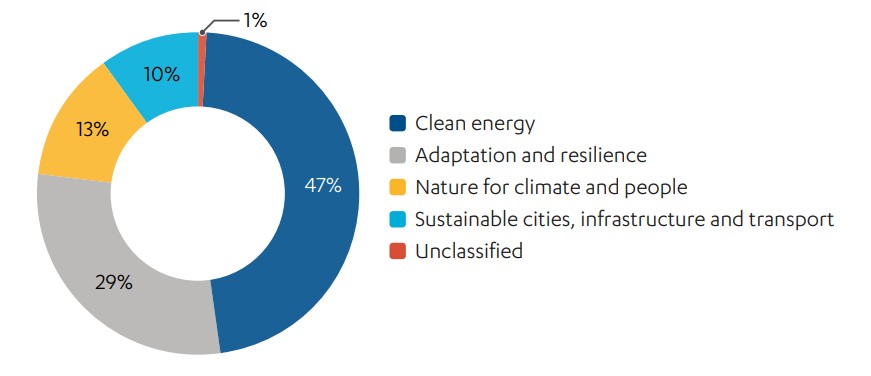
2.10 Figure 1 shows how the full value of the energy transition portfolio is distributed across the four priority pillars of the ICF Strategy. Almost half the portfolio is tagged as clean energy, with adaptation and resilience, at 28%, the second largest category (including the core funding for the MDBs). Nature for climate and people is 13%, while sustainable cities, infrastructure and transport accounts for 10%. The MCFs are tagged across all the pillars, as appropriate.
Figure 1: The UK’s energy transition portfolio is distributed across the international finance climate finance thematic pillars
The total value of the programmes and activities tagged under the ICF pillars identified by the government as its energy transition portfolio, split across the four thematic pillars of the UK’s ICF Strategy from 2021–22 to 2025–26
Source: International climate finance (ICF), ‘ICF Management Information data’, December 2024, unpublished
Description: The pie chart shows the UK’s energy transition portfolio spend and projected spend for the period from 2021–22 to 2025–26, classified according to the four pillars of the UK’s ICF Strategy. ‘Clean energy’ has the largest percentage at 47%, and ‘Adaptation and resilience’ is the second largest segment at 29%. There is a 1% portion for ‘unclassified’ programming that is contributing to energy transition but is not categorised under any of the pillars.
Estimating the value of the UK’s energy transition portfolio
2.11 In total, the UK expects to spend £5.7 billion in ODA on this portfolio of 84 energy transition-relevant programmes and activities over the five-year period from 2021-22 to 2025-26, although final spend figures for 2025-26 are not yet known. However, this is an overestimate of the UK’s true spending on energy transition: while some of those programmes have clean energy and other ICF pillars contributing to energy transition as their primary focus, others include clean energy alongside other climate objectives, or are estimates of the core climate finance-related contributions to MDBs, which are recorded wholly as adaptation and resilience, although they also have various activities that contribute to energy transition.
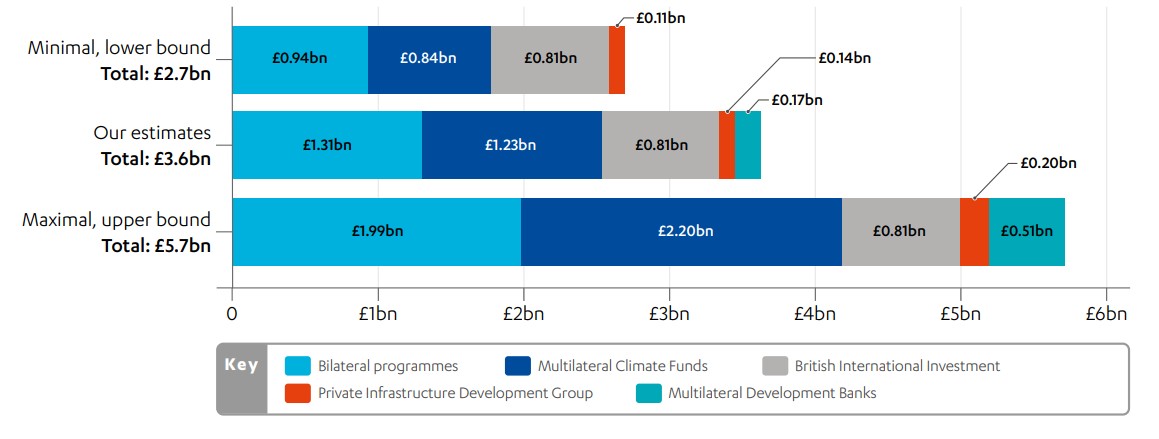
2.12 We therefore sought to make a more accurate estimate of the UK’s energy-only spend. Looking at programming tagged under the ICF clean energy pillar, we identified a total of £2.7 billion in ODA spending over the five-year review period. This is, however, an underestimate: energy transition goes wider than just clean energy to include other ICF pillars and system-wide support. Additionally, there are important clean energy elements of existing ICF programmes that are not tagged under the ICF clean energy pillar.
2.13 We then employed two different methods to refine our estimate within the range of £2.7 billion to £5.7 billion by using first the ICF pillar tags and second an analysis of delivery channels, which both arrived at a similar conclusion (see Box 5 for a more detailed technical account of how we did this). Our best estimate is that the UK will spend around £3.6 billion in ODA on energy transition over the five-year review period, although there is considerable uncertainty around this figure.
Box 5: The technical explanation of the two estimation methods for the total value of the UK’s energy transition portfolio
Determining the size of the UK’s energy transition portfolio is a challenge due to the inherent limitations of the ICF dataset and the challenges of isolating the impact of programmes with multiple objectives. We used two different methodological approaches to triangulate our results and strengthen the robustness of our estimates. The two approaches are described in this box.
The pillar methodology:
The energy transition portfolio comprises three distinct groups of programmes, defined by how they are tagged against the priority pillars of the ICF Strategy:
- Group 1: This group consists of cross-sector programmes that are not tagged to the clean energy pillar at all. This means it has no energy-tagged budget lines. The total value of Group 1 programmes is £1.25 billion.
- Group 2: This group has cross-sector programmes that have both clean energy and other sector tags. This means that the programmes have some budget lines that are relevant to clean energy and others that are relevant to one or more of the three other priority pillars. The total value of Group 2 is £2.65 billion. Within that overall value, the elements that are tagged as clean energy within Group 2 amount to £0.9 billion, while the rest is tagged to one of the other three priority pillars.
- Group 3: This group consists of energy-only programmes, that is the programmes that have all their budget lines tagged as clean energy. (This group has a total value of £1.8 billion.)
The combined value of all budget lines of the programmes in Groups 1 to 3 constitute the ‘maximalist’, upper bound value of the energy transition portfolio, as shown in Figure 2. This is the total value of all the programmes that the government identified to ICAI as relevant to energy transition.
The ‘minimalist’ scenario, or lower bound (also depicted in Figure 2), includes only the budget lines that were tagged as clean energy. This included all the energy-only programmes in Group 3 and the £0.9 billion tagged as clean energy in the cross-sector programmes in Group 2. In total, this adds up to £2.7 billion, representing the sum of energy-only programmes and the energy-tagged share of cross-sector programmes.
To estimate the proportion of energy transition-related spend in Group 1, which was also identified by the government as relevant for the review, we 1) observed the energy share in cross-sector programmes that had been energy-tagged (Group 2), and noted that the energy-tagged budget lines in this group (£0.9 billion out of a total of £2.65 billion) amounted to 34% of the value. We also 2) reviewed a small sample of individual programme annual reviews from Group 1 and found that approximately 35% of the activities and budget of these programmes were energy-related (despite not being tagged as such).
Applying a 35% pro-rata assumption of the energy pillar spend across Groups 1 and 2 confirmed our best estimate of a total of £3.6 billion for the energy transition portfolio.
The channel estimation methodology:
The energy transition portfolio is delivered through different delivery channels:
- bilateral programmes
- bilateral investment through development finance institutions (DFIs), notably British International
Investment (BII) and the Private Infrastructure Development Group (PIDG)
- multilateral development banks (MDBs)
- multilateral climate funds (MCFs), notably the Climate Investment Funds (CIF) and the Green Climate Fund (GCF).
We looked at the UK’s ICF funding through these different delivery channels including bilateral programmes, bilateral funding to DFIs (BII and PIDG), MDBs (which the government tags as adaptation and mitigation) and the MCFs (which are tagged across the four ICF pillars as appropriate). Based on 2023 annual reports and other relevant reporting,24 we estimate that around 33% (one-third) of ICF core funding to MDBs is relevant to energy transition objectives. And, based on the MCFs’ own reporting,25 we estimate that 50% of funding to the GCF and 70% of funding to the CIF are relevant to energy transition. Adding the 35% coefficient from the pillar analysis to the remainder of the bilateral programmes, separating out the DFIs, MDBs and MCFs and the 100% actual energy tagging of the DFIs, the analysis confirms the best estimate figure of around £3.6 billion for the total energy transition portfolio.
Conclusion
By arriving at a similar total figure of £3.6 billion for the energy transition portfolio using both the pillar methodology and the delivery channel methodology, we have greater confidence that this is the best possible total budget estimate for the portfolio. While this approach is supported by different data sources and methods, it nevertheless rests on the assumption of uniform energy transition relevance across bilateral programming beyond the DFIs, MDBs and MCFs. This assumption may not hold in all cases, particularly for sectors with inherently lower energy linkages, and cannot be validated without project-level financial attribution.
The analysis in this review is, unless otherwise stated, conducted on the full portfolio value, without attempting to break down the programmes into individual budget lines relevant to energy transition, since the dataset does not permit this. Using the full envelope of the portfolio ensures that the analysis is based on an unaltered, reproducible dataset and avoids selective adjustments that cannot be applied uniformly across the portfolio. It also allows us to compare spend data over time (see Figure 3).
2.14 The bar chart in Figure 2 gives a breakdown of the portfolio, showing the lower bound, minimum value of identified clean energy programmes of £2.7 billion, the upper bound, full maximum value of all energy transition-relevant programmes of £5.7 billion, and our best estimate of energy transition spending of around £3.6 billon.
2.15 Given the challenges of isolating spending on energy transition, the analysis underpinning the findings of this review (see Section 3) is conducted on the full portfolio of 84 programmes and activities. The government is currently working to refine and disaggregate its data to better identify the energy transition-specific contributions within broader programmes.
Figure 2: Estimated value of the UK energy transition portfolio by funding source and inclusion criteria, financial years 2021–22 to 2025–26
A stacked bar chart showing the value of the UK’s energy transition portfolio based on different estimates
Source: International climate finance (ICF), ‘ICF Management Information data’, ’, December 2024, unpublished; Climate funds update database, link; GCF Open data library, link; GCF 2024 Annual progress report, link; GCF unpublished report; CIF 2024 Annual report, link; CIF unpublished dataset; BII website database, link; BII unpublished report; PIDG unpublished report
Description: The stacked bar chart sequence illustrates the energy transition portfolio estimate values based on different inclusion criteria, disaggregated by funding source. The lowest bar represents the maximal, upper bound view, including the total value of all relevant programmes (£5.7 billion). The middle bar represents our estimates (£3.6 billion). And the top bar represents the minimal, lower bound, which includes only the value of programmes with clean energy tagging (£2.7 billion).
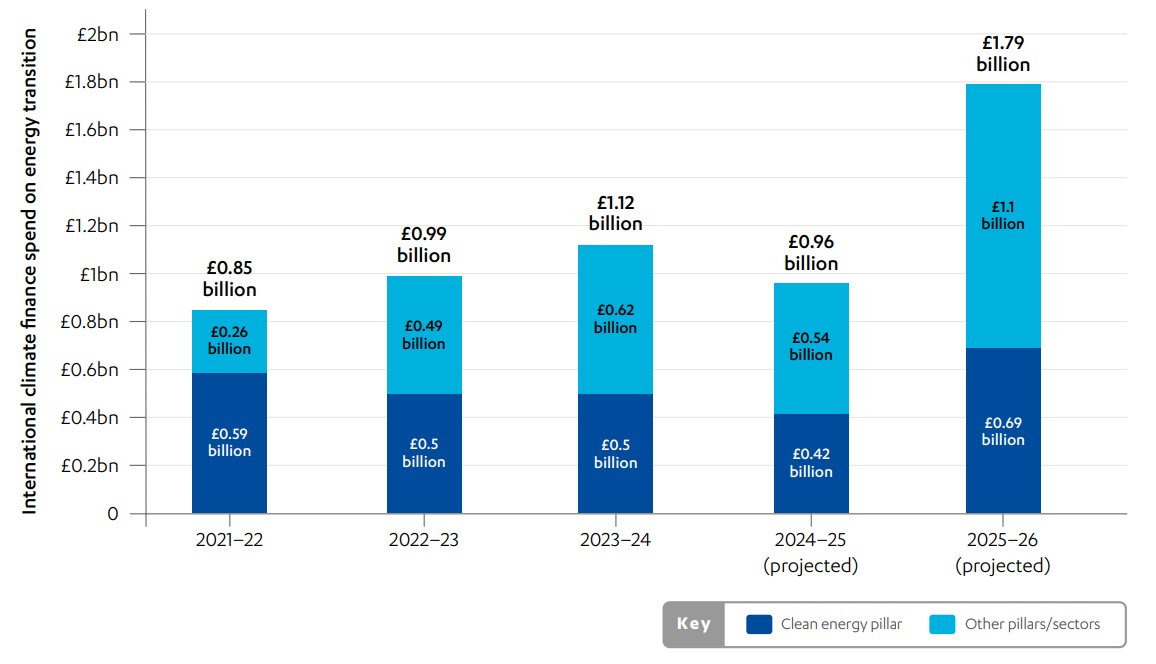
2.16 Figure 3 shows UK ICF spend on the entire energy transition portfolio for the review period, with actual spend to the end of the 2023-24 financial year and projected financial commitments for the next two financial years. The columns show the total value of the portfolio in each year, as well as how much of this spend is tagged as clean energy (thus reflecting the upper and lower bounds of the data analysis in paras 2.11 to 2.15).
Figure 3: The value of the UK energy transition portfolio
Estimated UK international climate finance spending on energy transition from 2021–22 to 2025–26
Source: The figures are derived from ICF unpublished management information data provided by the UK government, December 2024, with estimates for the share of funding relevant to energy transition derived by the ICAI review team
Description: The column chart shows estimated UK ICF spend on energy transition. The total value of the energy transition portfolio rises from £0.85 billion in 2021–22 to £1.1 billion by 2023–24. The projected estimated spend on energy transition drops in 2024–25, before rising to £1.8 billion in 2025–26. The columns also show how much of the energy transition portfolio spend each year is tagged as ‘clean energy’ only in the UK’s ICF reporting. The rest of the spend is tagged against the other three ICF pillars (sustainable cities, infrastructure and transport; adaptation and resilience; and nature for climate and people), sometimes in combination with clean energy.
Alliances and partnerships are central to the UK energy transition work
2.17 The approach set out in the ICF Strategy also includes a range of partnerships, alliances and initiatives. These include:
- Country partnerships, particularly the Just Energy Transition Partnerships (JETPs), which were launched during the UK’s Conference of the Parties (COP) presidency in 2021.26 The JETPs aim to raise ambition, coordinate donor action, and mobilise additional financing, all with strong country ownership. The UK is actively involved in three of the four JETPs: it leads the International Partners Group (IPG)27 in South Africa’s JETP, co-leads the IPG with the EU in Viet Nam’s JETP, and is an active partner in Indonesia’s JETP. (The UK also participates in the Senegal JETP, but on a much smaller scale.) More recently, the UK-Brazil Hubs represent a newer model of country partnership, supporting Brazil’s goals for industrial decarbonisation and green hydrogen.28
- International alliances, such as the Clean Energy Transition Partnership (CETP), which are aimed at different aspects of promoting energy transition in developing countries. Many of these alliances, including CETP, were established under the UK’s COP presidency in 2021. Not all are funded by ICF, but they are central to the 2023 ICF Strategy for advancing climate action, including energy transition, in developing countries.
Guarantees are not scored upfront as aid but may incur future liabilities to the aid budget
2.18 The UK has offered loan guarantees to multilateral lenders (the World Bank and the African Development Bank) to Indonesia (up to £750 million) and South Africa (up to £975 million), as well as commercial debt and equity via PIDG and BII (£371 million in South Africa and £111 million in Indonesia) as the main financial component of UK support for these two countries’ JETPs. Across all four JETPs, the UK has committed £2.3 billion in guarantees, including over £730 million through PIDG and BII, and £28 million in grants and technical assistance.29 Guarantees are a secondary liability, where the UK agrees to take on debt if the debtor cannot fulfil their commitment to the lender. Guarantees do not have any upfront cost to the aid budget, but if the primary debtors are unable to fulfil their commitments, the UK would become responsible for servicing the debt, which would be drawn from the aid budget in future years. In this case, neither South Africa nor Indonesia has taken up the offer of UK-guaranteed loans, so any secondary liability for the UK has not at this point been incurred (on why, see para 3.58).
3. Findings
3.1 This section is divided into three parts, presenting the main findings for each of the three review questions set out in the introduction to this report (see Table 1).
3.2 We first look at the relevance and effectiveness of the UK’s use of development assistance in support of energy transition. We then address how well the UK is working with partner countries and in international alliances to support developing countries’ energy transition, before turning to the UK’s efforts to leverage and mobilise public and private finance for energy transition.
How relevant and effective is the UK’s strategy for the use of development aid to support its objectives for the global transition to clean energy?
3.3 This section examines how effectively the UK uses its international climate finance (ICF) to support energy transition in developing countries. It explores whether the UK’s approach is clearly defined, well targeted, and aligned with its climate and development goals. This includes the extent to which the UK’s approach addresses systemic barriers to energy transition and contributes to transformational change.
The UK’s energy transition efforts in developing countries are highly relevant to addressing the climate crisis and benefit from long-standing political and financial commitment
3.4 A range of strategic frameworks guide the UK’s approach to supporting energy transition in developing countries, setting a stable and committed course for UK efforts over time. The most recent strategy documents include the 2030 Strategic Framework for International Climate and Nature Action (2023), the International Climate Finance Strategy “Together for People and Planet” (2023), and the International Development Strategy (2022, refreshed in 2023). All three present global energy transition as central to UK development assistance objectives and see it as aligned with both climate and poverty reduction goals. UK commitment to the promotion of energy transition has remained stable through changes in ministers and governments. Confirming climate action as central to global prosperity and security, the then Foreign Secretary, speaking in Kew Gardens in September 2024, announced the appointment of a Special Representative for Climate Change with responsibility for driving the global transition to clean energy, and launched the Global Clean Power Alliance.
3.5 This long-standing policy commitment to energy transition can also be seen in the UK’s financial contributions to ICF. The UK’s ICF spend started in 2011 and accelerated for the period covered by this review, as shown in Figure 3 in the previous section.
While overall commitment is strong, the UK’s energy transition portfolio is broad and diverse, which risks a lack of coherence and presents challenges in prioritisation as the UK reduces its aid budget
3.6 The UK’s approach to supporting energy transition in developing countries has largely evolved through a learn-by-doing, adaptive model shaped by international climate negotiations and reactive, programme-level decisions. While the adaptive approach has enabled flexibility, government stakeholders almost unanimously emphasised the need to consolidate learning and shift towards a more strategic and coherent direction. This was also reflected in a June 2023 ICF Management Board review, which flagged risks of incoherence in the energy/mitigation portfolio.
3.7 There is a lack of clarity on how energy transition is defined and operationalised in ICF. As the discussion of the portfolio in paras 2.4 to 2.18 shows, energy transition cuts across all four pillars in the 2023 ICF Strategy, but the strategy does not set out how to pursue this cross-cutting ambition. There is no specific and unified energy transition strategy with a related theory of change setting out key objectives, and timelines and approaches for achieving these across different departments. The Department for Energy Security and Net Zero (DESNZ) developed an overall, umbrella business case for ICF in 2020, but this was focused on ICF overall, not on energy transition, and it only covered the approach of a single department. The lack of a cross-cutting portfolio approach – understood as the strategic management of a diverse mix of delivery channels, programmes, financial instruments, and partnerships – creates a risk to coherence, both at a strategic level and at a programme level. One such area of risk to coherence is when the UK’s bilateral spend and its core support to multilateral bodies provide finance through different channels to the same project. This is, for instance, the case for the Mission 300 initiative for energy access in Africa, which receives UK aid through direct bilateral funding as well as through UK core contributions to the World Bank and the African Development Bank.
3.8 Most government interviewees agreed that a strategic approach to achieving energy transition must address persistent barriers, and recognised that these are consistent across sectors and geographies. Commonly cited barriers include investment risk management, political will, policy stability and identifying bankable project pipelines. Interviewees emphasised that barriers must be addressed through targeted programmes designed to tackle specific constraints at different phases of the transition and across the S-curve, addressing different country circumstances, degrees of technological absorption, and financial readiness (see Box 3 for an explanation of the S-curve in energy transition). Interventions needed to address these obstacles range from early-stage support to improve the enabling environment, notably in low-income countries, to mobilising capital at scale for innovative pilots to lead to commercially viable investments in higher-income contexts. However, although the portfolio is broad and diverse, it is not explicitly structured to address these challenges systematically.
3.9 The lack of a clear strategy will make evidence-based decision making on prioritisation difficult as the UK reduces its official development assistance (ODA) budget from 0.5% to 0.3% of gross national income over a three-year period to 2027. Government stakeholders broadly recognised the need for a clearer energy transition definition and greater strategic coherence, with some advocating for stronger prioritisation and scaling up of proven solutions. The government told us that the next iteration of the ICF Strategy, which is currently under development, will include a theory of change for energy transition.
Programmes in the energy transition portfolio report substantial results in some areas, but accountability for the selection and application of ICF key performance indicators (KPIs) remains limited, which constrains the comprehensiveness of reporting
3.10 Table 2 shows the reported results for the UK’s energy transition portfolio for the three-year period from 2021-22 to 2023-24 (the last year for which we have data) for three ICF KPIs central to the UK’s energy transition goals: the amount of greenhouse gas emissions reduced or avoided; the number of gigawatts (GW) of clean energy capacity that has been installed; and how many people have improved access to clean energy. We recognise that these three KPIs do not cover all relevant dimensions of energy transition.30
3.11 Table 2 shows substantial results: between 2021-22 and 2023-24, 35 million people improved their access to clean energy; the carbon dioxide equivalent of 26 million tonnes of greenhouse gas emissions were reduced or avoided; and 2.1 GW of clean energy were installed. However, only around a third of the programmes in the portfolio report results against any one of these three KPIs, which suggests that the results picture may be incomplete. There are some programmes, notably some of the support to multilateral development banks (MDBs), which do not appear to report to ICF KPIs at all. Accountability for results and reporting is weakened by the fact that individual programmes self-select ICF KPIs, and are only required to select one KPI at a minimum. There is little visibility at portfolio level as to which programmes have selected a given indicator and whether data is actually being collected and reported on selected ICF KPIs.
Table 2: Efforts to support energy transition in developing countries have led to substantial impacts
Reported results for the energy transition portfolio for three key performance indicators: the volume of greenhouse gas emissions reduced or avoided; the installed capacity of clean energy; and the number of people with improved access to clean energy, from 2021 to 2024
| Key performance indicator (KPI) | Programme results for 2021-22 to 2023-24 |
|---|---|
| KPI 2.1: People with improved access to clean energy | 35 million people |
| KPI 6: Tonnes of greenhouse gas emissions reduced or avoided | 26 million tonnes of carbon dioxide equivalent |
| KPI 7: Installed capacity of clean energy | 2.1 gigawatts |
Source: This table is derived from unpublished KPI results reporting provided by the UK government, December 2024. It includes reporting by the selected energy transition programmes only and therefore cannot be compared with the cumulative ICF results reporting for the review period. It also does not include the latest ICF KPI data for 2024-25, as we had not received the underlying programme-by-programme dataset for the latest year of reporting by the time of publication. Energy access programmes are best aligned with KPI 2, while renewable energy programmes correspond more directly to KPIs 6 and 7. Programmes would therefore not be expected to report against all three KPIs. They are included for illustrative purposes only.
3.12 Both of the multilateral climate funds (MCFs) reviewed, the Climate Investment Funds (CIF) and the Green Climate Fund (GCF), demonstrate progress on similar metrics. For example, since its establishment in 2008, the CIF has supported 65 million people to cope with the effects of climate change overall, added a cumulative total of 25.9 GW of renewable energy capacity, brought energy access to 3.9 million people, demonstrated the commercial viability of energy access investments, and generated tens of billions of dollars of economic value in local economies.31 About two-thirds of CIF programmes report across the KPIs listed above, and the CIF provides a transparent account of the number of programmes reporting on each indicator on the summary dashboard on its webpage.
The UK has made some early progress in its aim to support transformational change of energy systems in developing countries, but the concept of transformational change is not consistently understood and applied across the energy transition portfolio
3.13 There is broad recognition within the Department for Energy Security and Net Zero (DESNZ) and the Foreign, Commonwealth and Development Office (FCDO) of the need for a systemic approach to energy transition. The UK vision is to provide the catalytic change that enables systemic shifts or accelerates climate progress to deliver transformational change in developing countries.32 But while the UK’s vision is clear, it is not yet consistently understood or applied across departments and teams. There is also a lack of clarity on how the efforts across the UK’s broad portfolio of programmes, which covers every aspect of the energy system, can work together and amplify the total impact of the portfolio to achieve transformational change. We heard that work is currently underway to better align programmes and partnerships towards a systemic approach across geographies and sectors.
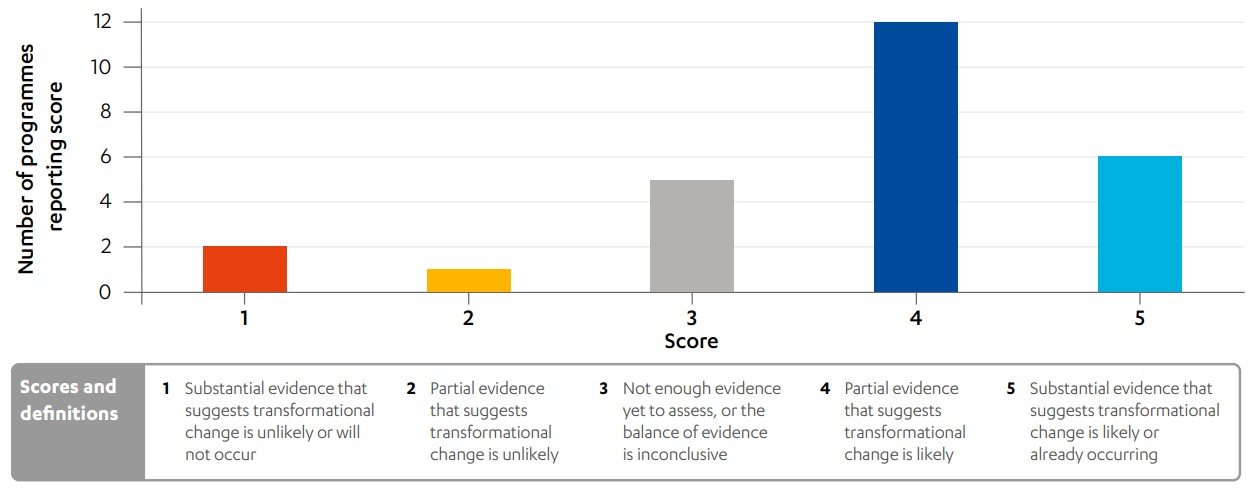
3.14 ICF KPI 15 assesses the likelihood that specific programmes or interventions will lead to transformational change. KPI 15 is a forward-looking, qualitative indicator aligned with the broader ICF Strategy to promote transformational outcomes. Some programmes in the energy transition portfolio are explicitly expected to deliver transformational impact in their business cases and to report to KPI 15.
3.15 However, transformational change takes time and is challenging to measure, and the overall reporting towards KPI 15 is limited. Figure 4 shows the results for KPI 15 for the 26 programmes within the energy transition portfolio that report against this indicator. It shows that 12 programmes reported a score of 4, which signifies that there is partial evidence that transformational change is likely. Another six programmes reported a score of 5, meaning that there is substantial evidence that transformational change is likely or already occurring. Three programmes scored 1 or 2 – indicating that there was evidence that transformational change was unlikely.
Figure 4: The majority of energy transition programmes show partial or substantial evidence of transformational change
Column chart showing the likelihood that specific energy transition programmes will lead to transformational change (key performance indicator 15) for financial year 2023–24
Source: This chart is derived from unpublished KPI results reporting provided by the UK government, December 2024
Description: The column chart lists the number of energy transition programmes reporting against KPI 15 on the y-axis, and their distribution of KPI 15 scores, from 1 to 5, on the x-axis. The chart shows that about half of the 26 programmes scored 4 for KPI 15, demonstrating partial evidence of transformational change; six programmes scored 5, indicating substantial evidence; and three programmes scored below 3, suggesting that transformational change is unlikely.
3.16 The best evidenced examples of contribution to transformational change come from the CIF, which has reported substantial evidence that transformational change is likely or already occurring in three programmes. An example of transformational change that the UK’s energy transition portfolio has contributed to is provided in Box 6, on a vast concentrated solar power installation in Morocco financed by the CIF Clean Technology Fund (CTF).
Box 6: Concentrated solar power in Morocco: transformational change in action
The 500-megawatt Noor Ouarzazate Concentrated Solar Power (CSP) complex in Morocco, which supplies clean energy to over one million people and has helped to reduce Morocco’s dependence on imported fossil fuels, was supported by the Clean Technology Fund (CTF) with UK co-financing. It exemplifies transformational change in action. As one of the world’s largest CSP installations, the project added significant renewable energy capacity while catalysing follow-on investments in Morocco and the wider Middle East and North Africa region.
By absorbing early-stage technology and market risks, the CTF played a pivotal role in mobilising private and multilateral finance and demonstrating the commercial viability of solar power in emerging markets. The project also contributed to national energy security, created local employment, strengthened domestic supply chains, and helped embed renewable energy as a central pillar of Morocco’s long-term energy strategy. Its sheer scale has driven down the costs of this technology by 40% and has enabled the Moroccan government to meet its renewable energy target of 42% in 2020, and raise its 2030 target to 53%. The Noor example illustrates how targeted concessional finance can drive systemic, scalable and inclusive energy transitions.
3.17 The GCF does not currently report against KPI 15 but applies the concept of ‘paradigm shift’ to ensure that projects are transformational by design and implementation. Nevertheless, the Independent Evaluation of the GCF’s Energy Sector Portfolio and Approach found that the GCF’s goals and intended pathways in catalysing a paradigm shift in the global energy sector seem less clearly articulated.33 A financing package provided by the GCF and the European Bank for Reconstruction and Development in Egypt is cited as an example. The package included support for tariff reform, technical assistance, and reverse auctions (with one buyer and many sellers), which helped establish a more predictable market environment and enabled private investment in large-scale renewable energy.
3.18 Several of the programmes supported by UK funding beyond the MCFs can demonstrate partial or substantial evidence that transformational change is likely. The challenges in catalysing transformational change were nevertheless raised in numerous interviews. We found that the approach to assessing the evidence for transformational change was not consistent across programmes.
The energy transition portfolio is directed towards higher-emitting, middle-income countries, which can leave lower-income countries underserved, with potential implications for the UK’s overall poverty reduction objective
3.19 The UK’s energy transition portfolio has a strong focus on high-emitting middle-income countries, based on the sound rationale that these countries contribute significantly to global emissions. The rationale is reflected in the UK’s ICF Strategy, its ICF spend, and its choices of multilateral and country partnerships. UK engagement in high-emitting middle-income countries has focused on targeted technical support to advance low-carbon transitions, with potential to serve their large populations living below the poverty threshold, while also promoting green finance and broader UK diplomatic and commercial interests.
3.20 Recent evidence from the Organisation for Economic Co-operation and Development (OECD) and the Climate Policy Initiative (CPI) highlights a persistent geographic imbalance in global climate finance flows, which is also evident in the UK energy transition portfolio.34 In 2022, about 70% of all global climate finance was channelled to support middle-income countries, of which 40% went to lower-middle-income countries and 30% to upper-middle-income countries35 Low-income countries received approximately a 10% share of flows, although in absolute terms the volume of financing to low-income countries as well as small island developing states has increased substantially over time.36 Of the remaining amount, 18% is geographically unallocated while 2% goes to high-income countries. MDBs and MCFs struggle to channel support to the poorest countries, with both allocating less than 10% of their climate finance to low-income countries (30% of MCF financing remains geographically unallocated), according to the OECD analysis.37 As of July 2025, the GCF reported that 29% of its funding was targeted towards least developed countries, and 12% towards small island developing states,38 which is a substantially higher proportion than the prevailing 10% average allocation to low-income countries. The CPI’s Global Landscape of Climate Finance 2025 report found that 79% of global climate finance was mobilised in three regions: East Asia and the Pacific, Western Europe, and the US and Canada, with a trend towards a further concentration of finance in these regions and China dominating the first region.39 If looking only at private finance, middle-income countries benefited from more than 50% of total private finance mobilised in the period 2020-2023, in part because they are in general perceived as lower-risk investment environments than low-income countries.40 Most private climate finance flows to larger, creditworthy economies, notably China, leaving lower-middle-income and low-income countries with increasingly constrained fiscal space reliant on grants and a diminishing pool of concessional finance.
3.21 In our analysis of data from the GCF, the CIF, British International Investment (BII) and the Private Infrastructure Development Group (PIDG) on their geographic financial allocations to single countries during the review period, there is a strong representation of upper-middle-income countries such as South Africa (£208 million) and Indonesia (£184 million), and lower-middle-income countries such as India (£876 million) and Egypt (£164 million), and inclusion even of high-income countries, notably Barbados (£71 million), where high-income countries are eligible through MCFs such as the GCF. Aggregating from the data on single-country funding provided by the GCF, the CIF, BII and PIDG, country allocations are distributed as follows: 75% is directed to lower-middle-income countries, 12% to upper-middle-income countries, and 3% to high-income countries, with only 10% allocated to low-income countries during the review period.
3.22 The available ICF data does not allow us to determine exactly the geographic spread of all the UK’s energy transition activities. Of the programmes in the energy transition portfolio, more than 90% were geographically unspecified in the ICF data. For instance, multi-country programmes (of which there are many) are excluded from the overall geographic breakdown by individual countries. The same is the case with the allocations by MCFs and development finance institutions (DFIs) to multi-country programmes. In addition, the data analysed does not include pre-2021 project approvals from the MCF and DFI data. The figures reported separately by the GCF are above the averages noted across the ICF data. However, the trend towards predominantly supporting middle-income countries is clear.
3.23 While support to high-emitting middle-income countries can lead to more immediate gains in reduced emissions, there is also a longer-term imperative to support low-income countries through sustained investment in early-stage, low-carbon development. The UK’s 2023 ICF Strategy acknowledges the disproportionate impacts of climate change on vulnerable groups and emphasises poverty reduction, access to clean energy (notably clean cooking), and adaptation, all of which are central to the needs of low-income countries, particularly in sub-Saharan Africa. Looking to the near future, many of these countries face fast-rising energy demand. Without support to transform their energy systems and overcome infrastructure barriers, which entails large upfront costs, they are likely to continue meeting their rising energy demand with fossil fuels. At the same time, low-income countries are less able to raise private finance for energy transition projects compared to middle-income countries and rely more on concessional ODA finance.
3.24 Although this is a smaller part of its energy transition portfolio, the UK is already supporting activities by the GCF and the CIF to strengthen the enabling environment for energy transition in low-income as well as in middle-income countries. The GCF’s Readiness Programme has committed £530 million since its inception, of which £237 million is in the period covered by this review, to assist low-income countries to secure finance for their low-carbon development. It does this through support for country-driven initiatives to overcome institutional capacity and governance barriers to pursue the full range of adaptation and mitigation efforts. The CIF Technical Assistance Facility also supports countries’ capacity for policy reform and raising finance, but with a modest budget of £30 million.
With UK aid reductions, gender equality and social inclusion efforts are at risk of being reduced, since newer country partnerships and alliances do not always give these priorities the same consistent attention as aid-funded programmes
3.25 The UK government has a long-standing commitment to promoting development assistance that supports gender equality and the inclusion of marginalised and vulnerable groups. The International Development Act (Gender Equality) of 2014 requires ministers to “have regard to the desirability of providing development assistance that is likely to contribute to reducing poverty in a way which is likely to contribute to reducing inequality between persons of different gender”. 41 The programmes in the energy transition portfolio sampled for this review demonstrate meaningful engagement on gender equality and social inclusion, and gender equality considerations are integrated into project design, policy advocacy, and KPIs. The UK has also used its influence on multilateral institutions like the CIF to promote social inclusion and gender equality. The GCF is updating its gender policy, but it appears that the process has been postponed while awaiting guidance from the upcoming Conference of the Parties (COP) in November 2025. The UK should continue to insist on this priority, especially due to differing cultural and political contexts that are also represented on the Board, and the shifting global landscape on gender equality and social inclusion.
3.26 In its country partnerships, the UK has made efforts, albeit limited, to emphasise the ‘just’ aspect of energy transition. It has funded initiatives that embed social benefits into energy transition programmes, such as the Growth Gateway grant-funded programme that supports small business schemes in Mpumalanga, South Africa. The programme has gender equality and social inclusion targets, such as ensuring that 30% of jobs go to women, and requiring infrastructure projects to integrate community engagement and social safeguards. In Indonesia, UK-supported renewable energy demonstrations are expected to improve rural livelihoods through allowing off-grid access.
3.27 However, while commitment to equality and inclusion goals remains strongly expressed in strategic documents and in interviews with government stakeholders, the risk remains that they may be diluted in practice. Government documentation suggests that a growing proportion of the ICF programmes that report against the OECD’s ‘gender equality marker’42 have gender equality objectives as a significant or primary goal, increasing over the ICF3 period from 67% in 2021-22 to 82% in 2025-26. However, many ICF programmes do not report against this marker at all. As discussed in para 3.42, the gender disaggregation of ICF KPI data also continues to face implementation challenges. Geopolitical shifts, and growing hostility to the gender equality and social inclusion agenda in many parts of the world, have added to the challenge of pursuing inclusion goals. Such challenges are evident in the UK’s country partnerships. The level and nature of engagement with workers, communities and civil society – especially organisations representing marginalised groups – are often shaped by host government preferences, which may not always align with UK gender equality and social inclusion objectives. As a result, the UK has faced criticism from some stakeholders for the limited inclusivity of Just Energy Transition Partnership (JETP) processes. Beyond the JETPs, the latest country partnership model, the UK-Brazil Hubs, do not have ‘just transition’ as an explicit aim. The hubs do not have representation from vulnerable and marginalised groups in governance or implementation, although individual projects are expected to engage stakeholder groups.
3.28 Similar challenges are present for the UK’s work with international alliances. These often operate through multi-stakeholder dialogues – convening ministers, MDBs and civil society organisations to identify systemic barriers to energy transition. However, many of these processes have not been able to ensure that a broader range of stakeholders at country level, and in particular marginalised groups, are included in a meaningful way, according to interviews.
The UK’s role as a major contributor to the multilateral climate funds is central to its energy transition objectives
3.29 The UK is a leading contributor to the Climate Investment Funds (CIF) and the Green Climate Fund (GCF). It has committed £2.2 billion across the two funds during the review period. Looking further back, the UK has provided a total of £2.7 billion since 2008 to the CIF and £2.8 billion since 2015 to the GCF, placing it comfortably among the top three largest donors to each fund. While it was not possible to provide an exact number for how much of the UK’s contribution is spent by the funds on energy transition objectives, our estimate based on the funds’ reporting is that around 70% of the CIF’s portfolio and 50% of the GCF’s goes towards energy transition investments.43
3.30 In broad terms, the CIF and the GCF play complementary roles in promoting energy transition (see Box 7 on how the two funds operate). They both follow a country-led approach to support the global energy transition, aligning with national priorities and fostering country ownership. They differ primarily in delivery models: the CIF works through the MDBs, leveraging their capacity to mobilise large-scale finance and implement programmes – which is particularly relevant in middle-income countries. In contrast, the GCF operates a direct access model, allowing accredited national and regional institutions, such as government agencies and non-governmental organisations, to access funding directly, providing flexibility across different contexts, including in least developed countries.
3.31 The CIF’s MDB-led model is well suited to mobilising finance and enabling transformational, system-level change, while the GCF offers a more inclusive approach with broad regional reach. The GCF is critical for fulfilling the UN Framework Convention on Climate Change (UNFCCC) treaty commitments on providing broad, flexible access to climate finance for the most vulnerable countries. UK officials view the GCF as a central results delivery mechanism under the UNFCCC and a key test of developed countries’ climate finance commitments.
The UK has used its role as a major donor to influence the strategic direction of the CIF and the GCF in a positive direction
3.32 The UK exercises strategic leadership across both the CIF and the GCF and is widely recognised by stakeholders as a consistent and influential voice in both funds. Together, the funds enable the UK to deliver climate finance at scale, promote systemic change, and support developing countries in advancing clean energy pathways. Stakeholders in the two funds highlighted the UK’s technical expertise and diplomatic engagement, demonstrated through roles such as co-chairing CIF governance bodies and shaping the GCF’s 20242027 Strategic Plan.
3.33 The UK has encouraged both funds to increase their ambition. For example:
- The CIF, spurred on by the UK, is driving the MDBs to have a greater ambition on transformational climate action. The UK has played a leading role in designing the CIF’s approach to transformational change. It provided seed funding for the Evaluation and Learning Initiative when this was first set up, and pushed for it to be made a core part of the CIF Secretariat to ensure sustainability and integration of the initiative. This included the Transformational Change Learning Partnership, a multi-stakeholder learning community facilitating research and evidence-based analysis to understand what constitutes transformational change and how best to pursue it.44
- The GCF has recently turned its attention to the obstacles to accessing concessional ICF faced by fragile and conflict-affected countries, a move supported by the UK. While it is early days, the fund’s executive director has, for instance, recently visited Somalia and South Sudan to identify opportunities for support.
3.34 The UK government has been a strong supporter of GCF reform, after it and other stakeholders identified weaknesses in the fund. For example, developing countries – least developed countries and fragile and conflict-affected countries in particular – found it hard to navigate the GCF’s processes to access finance. The GCF appointed a new executive director who, with the encouragement and support of the UK, is driving significant changes to the organisation. The aims of the reform include improving access to GCF funding, strengthening the fund’s operating model, mobilising private finance, targeting the most vulnerable for support, and strengthening the leadership team. A recent internal FCDO value for money review of the GCF found strong reform progress underway, notably in improving leadership and process efficiency.
There is no clear strategic rationale for deciding between multilateral and bilateral channels or among contributions to different multilateral funds
3.35 The ICF dataset does not allow us to accurately determine the overall or annual split between multilateral and bilateral delivery channels for the UK’s energy transition spend. Nor is it clear that the split between multilateral and bilateral channels is the result of a deliberate strategy. Strategic documents pull in somewhat different directions. The 2022 International Development Strategy marked a shift away from multilateral aid, favouring more bilateral partnerships and control, while the 2023 ICF Strategy suggests renewed confidence in multilateral channels, particularly for tackling a global challenge such as energy transition. Mentioning the importance of both bilateral and multilateral channels, the ICF Strategy notes that multilateral banks and funds are the ones that can deliver finance and impact at scale. Meanwhile, the umbrella business case for ICF3 has a stronger emphasis on “country-focused bilateral programming” than in previous phases. It includes a “relative increase in more targeted bilateral geographic and sectoral spend”, including through country partnerships.
3.36 We were not able to find clear evidence of a strategic rationale for how the UK government allocates its energy transition funding between multilateral and bilateral programmes, including the significant allocations made to the two MCFs. For example, the rationale was not evident from a review of the April 2023 concept note and December 2024 business case for the second replenishment of the GCF, where the UK committed a further £1.62 billion contribution, the largest single ICF commitment made during our review period.
3.37 The 2024 GCF business case did judge that a further UK contribution offered good value for money, with a strong benefit-cost ratio of 9:1 for mitigation projects (adaptation benefits being harder to quantify), and was aligned with global climate goals. A subsequent 2025 internal FCDO value for money assessment of the GCF provided retrospective evidence of emerging cost effectiveness and value for money. The business case also noted that there were no multilateral options other than the GCF with the same treaty-bound link to the UNFCCC and the same level of representation for developing countries. However, at the time the decision was made, results were based on a relatively small number of projects given the young age of the GCF’s portfolio, and challenges persisted around access to funding and efficiency of the financial allocation and project development process. It was recognised that continued institutional reforms and strengthened evidence on results would be important to fully realise and sustain the GCF’s strategic value, but despite this, the option of a performance-based tranche to incentivise GCF reform, proposed in the 2023 concept note, was not taken up in the business case. There was little explicit consideration of alternative uses of the funding, with options primarily limited to weighing the merits of different financial sums for the replenishment.
3.38 Finally, the public announcement of the £1.6 billion commitment to the GCF was made in September 2023, more than a year before the full business case was considered. While the time lag was driven by the change of government, there are clearly risks to value for money where public political commitments are made well in advance of full consideration of options.
Box 7: How the multilateral climate funds operate
The Climate Investment Funds (CIF) and the Green Climate Fund (GCF) are the UK’s largest multilateral partners for supporting energy transition in developing countries. The UK is one of the top three contributors to the CIF and the GCF.
The funds’ distinct roles enable the UK to diversify risk and maximise impact – driving energy transition outcomes aligned with its ICF objectives.
- The CIF, established in 2008, delivers large-scale, programmatic investments through MDBs, focusing on middle-income countries and higher-risk sectors such as coal transition, green hydrogen, and industrial decarbonisation.
- The GCF, created under the UN Framework Convention on Climate Change in 2015, takes a broad, country-driven approach. It has supported over 100 energy transition projects.
The funds measure their performance in different ways, so their achievements are not directly comparable. However:
- The CIF reports 25.9 gigawatts of renewable energy installed and 211 million tonnes of CO₂
- The GCF has delivered 5.6 gigawatts of clean energy and expects to reduce greenhouse gas emissions by 2.9 billion tonnes of CO₂ over project lifetimes.
Both funds attract investments from governments and private investors. The CIF works mainly through development banks to deliver large, ready-to-finance projects, attracting about $10 in co-financing for every $1 it invests. The GCF is more flexible, backing earlier-stage projects through its 200 partner organisations (29 of them in the private sector), with about $2.80 in co-financing for every $1 invested; 37% of its projects also involve development banks.
The funds operate in different countries: the CIF focuses more on middle-income countries while the GCF has around 50% of its energy transition projects in least developed countries, small island developing states, and fragile and conflict-affected states – compared to 30% of CIF projects. Of the 117 countries in which the GCF has invested, 70 are considered vulnerable.
Until 2023, the GCF was organised centrally from its headquarters in the Republic of Korea while the CIF worked through the network of MDBs. To become more responsive to local needs, the GCF has now reorganised its operations on a regional basis.
See Annex 1 for more information on the MCFs.
The ICF has a well-defined system for monitoring, evaluation and learning at the programme level, but persistent challenges in accountability, measurement and reporting limit strategic learning across the portfolio
3.39 The monitoring, evaluation and learning (MEL) system for the UK’s ICF is exceptional in the climate finance landscape and broadly recognised for its strong design. The UK is one of very few providers of ICF that aspires to report results at an aggregate level, although the accountability and transparency of how programmes contribute to this reporting could be improved. The MEL system tracks the impact of UK ICF funding using the same core set of standard KPIs to report results across all programmes. This enables consistent measurement of results over time and across programmes, on outcomes such as emissions reductions, clean energy access and capacity, and transformational change. The MEL system aims to support evidence-based decision making and learning through annual reporting, cross-programme evaluations, and knowledge sharing.
3.40 The UK has also championed improvements in MEL in key partners such as the CIF and the GCF. This has included increasing the focus on transformational change, supporting initiatives to align reporting and measurement, and encouraging the GCF to improve its systems to increase confidence in the data it provides.
3.41 We found good examples of programme-level learning in our sample of energy transition programmes, but few that span the full energy transition portfolio. Strategic use of MEL data remains limited. Evidence from cross-departmental programmes is often siloed, with limited use of thematic synthesis or structured learning to inform strategic decisions across the portfolio. An exception is the Ayrton Fund, which has a Joint Delivery Team of FCDO, DESNZ and Department for Science, Innovation and Technology (DSIT) leads providing coordination, tracking and reporting, including to the joint Ayrton Board. It also has expert steering groups for the 12 priority Ayrton Challenges it seeks to address (such as Cooling, Clean Hydrogen, Next Generation Solar, and Energy Storage).
3.42 FCDO has produced a ‘best buy’ document which draws on evidence from several donors to identify the value for money of interventions to mitigate climate change. The most recent version of this document is from 2019 and is becoming outdated. The DESNZ counterpart to FCDO’s best buy document is the September 2024 ICF Assessment of Mitigation Options report, produced to inform DESNZ’s strategic approach to deploying ICF for climate mitigation. However, we could not find evidence that the FCDO best buy document or the DESNZ mitigation options report were being systematically used and understood by staff working on the energy transition portfolio.
3.43 While the ICF MEL system stands out in comparison to other donors, KPI methodological and measurement challenges remain. For example:
- Evaluating systemic change is complex and many programmes resort to the easier task of just measuring immediate outputs.
- Accountability for programme reporting on ICF KPIs relevant to energy transition is limited. UK ICF rules require that programmes counted as ICF must report on progress on at least one of the ICF KPIs.45 For this review, only a third of the identified programmes were reporting on any given ICF KPI, suggesting that actual data gathering and reporting is not comprehensive. This is in line with UK results reporting, which notes that relevant KPIs are omitted due to data constraints, capacity, or the principle of proportionality. There has not been an independent, systematic, portfolio-wide review of ICF KPI reporting since 2018.
- KPI limitations constrain disaggregated reporting on geography (urban versus rural), gender and disability. The International Development Act requires development assistance to have a regard to how the activity contributes to gender equality and poverty reduction. However, it is hard to assess the extent to which the energy transition portfolio meets this requirement because of weaknesses in disaggregation in ICF reporting.
- The available data does not allow the construction of a complete and accurate breakdown by country of the UK’s energy transition ODA spend. While ICAI recognises the challenges involved in producing such data, it is a concern that departments do not have the data to clearly identify where UK energy transition investments are being spent.
There are positive examples of cross-government coordination on the UK’s international energy transition portfolio, but a lack of high-level coordination structures undermines portfolio coherence and strategic delivery
3.44 We found positive examples of cross-government coordination, including the establishment of a dedicated, interdepartmental ICF Management Board, but the division of labour between the two main delivery departments, DESNZ and FCDO, is a challenge. The lack of clear strategic leadership, defined roles, and coordinated governance between DESNZ and FCDO in delivering the UK’s energy transition agenda contributes to fragmented implementation and blurred responsibilities. This has resulted in overlapping programming and weakened portfolio coherence due to limited coordination. The government has noted that departments do not have “clear sight of each other’s programming” when it comes to UK climate spending, and has announced that this will be addressed through changes in how the cross-government ODA board works. 46 The board has representation across all ODA-spending departments.
3.45 The split of responsibilities between FCDO and DESNZ is unclear, creating institutional tension and uncertainty, particularly after a significant portfolio shift from DESNZ to FCDO over the course of the review period. Figure 5 shows that, if we count the full value of the energy transition portfolio (the ‘maximalist approach’), in the first two years of the review period DESNZ was responsible for 38% of spending on the energy transition portfolio. If we look only at programmes tagged as clean energy (the ‘minimalist approach’), DESNZ was responsible for 43% in this period. However, in the final three years, this reduced to 15% of spending for the whole portfolio, and 24% if we look at energy-only spend.
Figure 5: The Foreign, Commonwealth and Development Office (FCDO) has been spending progressively more on energy transition finance compared to the Department for Energy Security and Net Zero (DESNZ) and its predecessor department
Column chart showing energy transition portfolio spend and projected spend from financial year 2021–22 to financial year 2025–26, split by department*
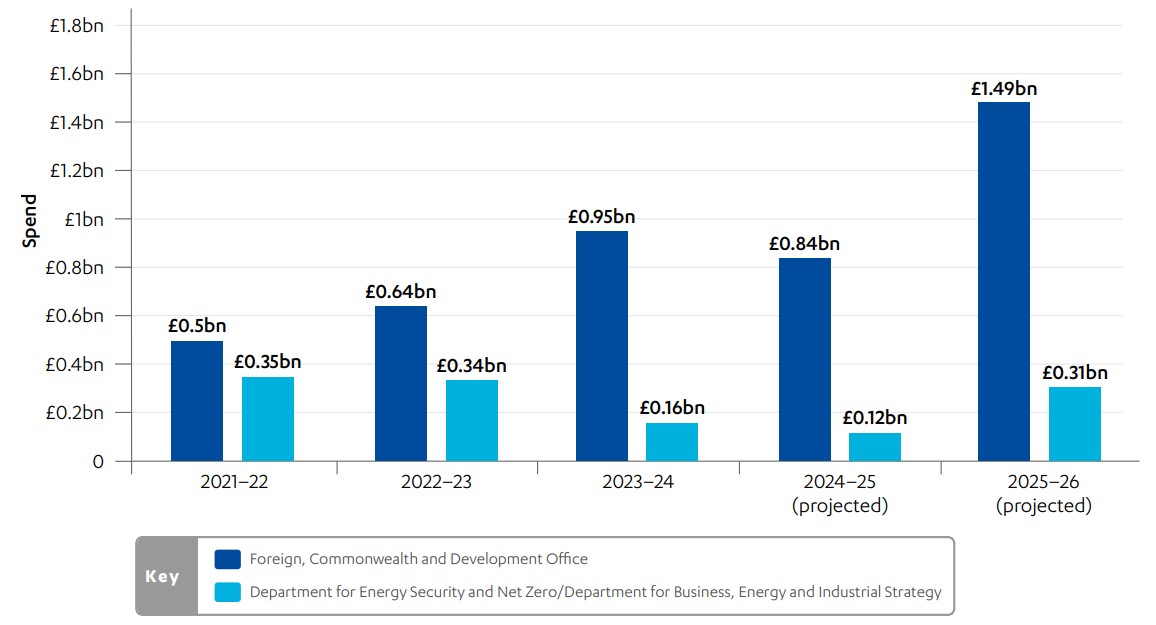
Source: The figures are derived from unpublished ICF management information data provided by the UK government, December 2024
*DESNZ was created in February 2023, as one of the successors to the then Department for Business, Energy and Industrial Strategy (BEIS). The DESNZ share of the energy portfolio fell under BEIS before February 2023.
Description: The column chart illustrates the ICF spending on energy transition across two departments: FCDO and DESNZ/BEIS. FCDO’s expenditure has increased significantly, going from £499 million in 2021–22 to £953 million in 2023–24, with a projected increase to £1,485 million in 2025–26. In contrast, DESNZ/BEIS spending decreased year on year from £349 million in 2021–22 to £115 million in 2024–25, but is projected to increase again to £307 million in 2025–26. This chart does not include energy transition spend by the Department for Environment, Food and Rural Affairs or the Department for Science, Innovation and Technology (DSIT), as this makes up a very small proportion of total spend.
3.46 In principle, the two departments operate within different geographies and focus on different thematic areas: FCDO emphasises energy access and support for low-income countries, while DESNZ focuses on industrial decarbonisation and high-emitting middle-income countries. In practice, this distinction is not as clear-cut, and the two departments have overlapping geographic and thematic mandates.
3.47 Cross-government structures like the ICF Management Board aim to improve alignment, but joint decision making does not always take place when it is needed and lines of authority on cross-departmental issues can be unclear. Some coordination has improved through joint delivery teams and expert steering groups, such as for the 12 Ayrton Challenges (see para 3.40), and biannual portfolio reviews now help identify strategic gaps and duplication. While these positive examples of coordination exist, cross-government dialogue is not yet translated into an integrated, strategically aligned pipeline, especially at the country level. Stakeholders widely agree that achieving a coherent, synergistic UK-wide portfolio remains aspirational and requires stronger governance, clearer roles, and more deliberate collaboration across departments. This has been recognised, and the government’s intention to strengthen coherence through improving the way in which the cross-government ODA board works is a positive development.
While there are environmental and social safeguards in place, securing ethical critical minerals for a sustainable energy transition poses persistent challenges
3.48 The UK recognises that securing a stable supply of critical minerals – such as lithium, cobalt, and rare earth elements – is essential for achieving its own net zero emissions targets as well as advancing energy transition in developing countries (see Box 8). At the same time, the government is conscious of the use of forced labour and other human rights violations documented in this sector. Civil society organisations, such as Anti-Slavery International, have drawn attention to such human rights violations, although the issue is much broader than a single sector, geography or vulnerable group.47
3.49 The UK’s approach to human rights screening in supply chains, particularly for sectors like critical minerals, is based on standards set out in the UK International Development Strategy and the UK Modern Slavery Act 2015, as well as international standards such as the UN Guiding Principles on Business and Human Rights. The need for environmental and social safeguards is also set out in relevant clauses of the Procurement Act 2023 and amendments to the Great British Energy Bill. FCDO requires due diligence processes through its guidance on responsible business conduct and development programming, including risk assessments, stakeholder consultations, and monitoring mechanisms to identify and mitigate abuses such as forced labour and human trafficking. Standard guidance is also proved through FCDO’s Programme Operating Framework.48
3.50 British International Investment (BII), the UK’s development finance institution, follows its Policy on Responsible Investing which sets out BII’s approach to environmental and social governance. The policy draws on international frameworks such as the International Finance Corporation Performance Standards and International Labour Organisation Core Labour Standards, to embed environmental and social risk management throughout the life of its investments.49 Taking a risk-based approach, BII’s approach includes supply chain mapping, contractual human rights clauses, sector-specific assessments (notably in mining and renewables), grievance mechanisms, and ongoing supervision tailored for high-risk sectors, including critical minerals. BII also manages a best practice Environmental, Social and Governance toolkit, which supports the wider industry on these matters.
3.51 However, a persistent challenge lies in the inherent complexity and opacity of global supply chains involved in the extraction and trade of critical minerals. Materials are difficult to trace, with limited data visibility. Geopolitical pressures (see Box 8) and the global competition for critical minerals compound risks posed by weak local enforcement of human rights standards.50 There is a recent recognition among international alliances for energy transition that work on critical minerals and sustainable supply chains is an urgent gap that needs filling. Going forward, sustained due diligence and adaptive risk management strategies will be essential for both direct UK ODA-funded programmes and wider development finance.
Box 8: Critical minerals and the energy transition
Geopolitical tension around critical minerals has become more prominent in recent years. The International Energy Agency defines critical minerals as “mineral resources that are essential for the energy transition but whose supply is vulnerable to disruption”, such as lithium, cobalt, and rare earth elements. As outlined in the UK’s Critical Minerals Strategy (2022, refreshed 2023),51 these minerals are essential for the technologies needed for energy transition, such as batteries, solar panels, wind turbines, hydrogen fuel cells, and grid infrastructure.
With the world expected to require four times as many critical minerals by 2040, and factors such as market concentration and geopolitical risk threatening supply security, the UK aims to enhance resilience through an ‘A-C-E’ framework: accelerating domestic capabilities, collaborating with international partners, and enhancing global markets through transparency and responsible standards.52 The UK also uses ODA, through its ICF funding, in its aim to ensure ethical critical mineral supply chains and promote sustainable and responsible resource management globally. The Ayrton Fund53 exemplifies this approach: with a budget of £1 billion targeting critical minerals, clean hydrogen, industrial decarbonisation, and smart energy, it finances clean energy research, development, and demonstration to scale innovation in developing countries.
Complementing this, the Ensuring Minerals Enable Responsible Growth and Economic Development initiative (September 2024 to September 2026, £3 million)54 supports equitable mineral governance in four African countries through collaboration with the Natural Resource Governance Institute. The programme promotes the sustainable scaling up of critical minerals production and the development of clean energy technologies.
Conclusions on the relevance and effectiveness of the UK’s energy transition strategy
3.52 The UK is regarded by stakeholders as playing a leading global role in promoting energy transition in developing countries, leveraging its long-standing diplomatic engagement, financial support and technical expertise to pursue an ambitious energy transition agenda. However, there is not a clear and shared cross-departmental definition of energy transition, with a related operational strategy and theory of change, that would provide a clearer framework for cross-departmental decision making.
3.53 The UK’s diverse range of programmes and activities is the result of a flexible and adaptive approach, which has its strengths but also poses a challenge to overall coherence. The portfolio has spread widely into too many small programmes, but beyond that, it is difficult to assess which sectors, through different delivery channels, in various geographic locations, are supported. This again makes it difficult to assess where and how energy transition support is most impactful. This challenge is becoming more urgent in light of the prioritisations that will be needed as part of the UK’s planned aid budget reductions over the next years. In a tighter funding environment, the need to strengthen collaboration between FCDO and DESNZ will become more urgent, as they work together on tough prioritisation decisions. The ICF MEL framework is well designed, but there are methodological challenges in accountability for and gathering data across its KPIs, along with weaknesses in strategic, cross-portfolio and cross-departmental learning.
3.54 The UK’s energy transition portfolio is highly relevant to UK net zero objectives and the global climate goal of keeping global warming below dangerous levels. It could nevertheless provide stronger strategic direction and improve cross-programme alignment, to maximise results and ensure that the UK’s energy transition efforts consistently tackle key barriers and benefit those countries and groups that are most vulnerable and have the greatest needs.
How well is the UK working with its partners and alliances to support developing countries’ energy policies and practices?
3.55 This section draws on programme data, strategic documents, and stakeholder views to examine how effectively the UK is working with country partners and international alliances to support developing countries’ energy transition. The analysis focuses on:
- Country partnerships (paras 3.55 to 3.62): We look at the effectiveness of UK support to the Just Energy Transition Partnerships (JETPs), the country-led agreements that mobilise grants, concessional loans, guarantees, and private finance to help middle-income countries shift from coal to clean energy. The partnerships emphasise both decarbonisation and the need for transition to be just – supporting workers and communities and providing equitable access to renewables while modernising energy systems. The findings focus in particular on the Indonesia and South Africa JETPs. We also look at a more recent partnership model, the UK-Brazil Hubs.
- International alliances (paras 3.63 to 3.71): We assess the effectiveness and coherence of a sample of the UK’s alliances. These are international coalitions of governments, private sector actors, and civil society that the UK backs – financially, diplomatically, or through its convening power – to accelerate energy transition in developing countries.
Country partnerships
The JETPs were intended to galvanise national and donor support around ambitious targets in the partner countries, but progress in many areas has been slow
3.56 The goals for each of the four JETPs are set out in publicly available political declarations, around which host countries (the owner of the strategy) and the donors in the JETPs’ International Partners Group (IPG) can galvanise action. The JETP declarations are highly ambitious. They commit, for example, Indonesia and South Africa, two coal-dependent, fast-growing emerging economies, to peak and reduce their power sector emissions earlier than business as usual, while rapidly scaling up the generation of renewable energy and managing the profound economic and social adjustments that this entails. UK government interviewees emphasised that these ambitions – and the targets within the investment and implementation plans that have been developed under each partnership – are set and owned by the host countries. They are nevertheless jointly committed to by IPG members and host countries. The JETPs form an important part of the UK’s overall approach to energy transition in developing countries and are the centrepiece of the UK’s support for energy transition in emerging economies.
3.57 Progress under the JETPs has been slow relative to the target timeframes, which typically envisaged improvements to the policy environment and the mobilisation of finance at scale to happen within three to five years. As the decarbonisation and energy transition ambitions set out in the original declarations have been translated into specific plans and policy instruments, both South Africa and Indonesia have taken steps that indicate a reduction in original level of ambition. Meanwhile in Viet Nam, implementation is progressing but the ambition in the original JETP declaration remains only partially reflected in national plans and policies, resulting in ongoing misalignment between the declared goals and the measures being enacted. Mobilisation of public and private finance has not reached the targeted sums, and the phase-down of coal-fired power capacity, which is fundamental to the JETPs, is not on track, with continued investment in fossil fuels taking place to keep up with energy needs.
3.58 There are, however, some promising outcomes:
- In South Africa: The South African government has introduced primary legislation to reform the domestic electricity market. It is reforming the state-owned electricity company Eskom and projects improving the institutional governance of energy transmission (the bulk movement of electricity from generation sites to substations), which should help remove barriers to attracting investment and the wider deployment of renewable energy. UK experts have worked with the South African government to facilitate options for concessional financing to reach municipalities for energy and water projects.
- In Indonesia: The UK’s Mentari programme directly supported a temporary reform to regulations on local content requirements, relating to the share of manufactured parts sourced from local suppliers. This change reduces the cost of renewable energy projects, while retaining some incentives to develop domestic supply chains in Indonesia. This will also make energy transition-related investments in Indonesia more attractive to foreign investors.
Structural and design-related factors have hindered progress and continue to affect the future outlook for JETPs
3.59 There are a range of structural barriers and design-related factors that hinder progress on the JETPs’ objectives, many of which could have been anticipated before the JETP declarations were drafted. These include:
- Barriers to the uptake of loans: The largest financial component of the UK’s support for the JETPs in South Africa and Indonesia is a UK offer to guarantee loans from MDBs, as well as separate investments from UK DFIs. However, these loans have not been taken up. In Indonesia, the authorities do not see the World Bank financing that the UK has offered to guarantee as competitive. In South Africa, the borrowing powers of the state-owned electricity company, Eskom, were limited by the National Treasury in 2023 due to its high levels of debt, and it is unable to take advantage of loans, regardless of UK guarantee facilities to the African Development Bank.
- Capacity of sub-state actors: State-owned electricity suppliers and sub-national governments in South Africa and Indonesia have limited organisational and financial capacity to implement change and face conflicting incentives which pose barriers to a faster transition to clean energy. Some progress has nevertheless been made, such as the review of the local content requirements in Indonesia and the restructuring of Eskom in South Africa (see para 3.58).
- Tensions around ownership of the JETPs: Despite the principle of country ownership, some stakeholders in host countries and expert observers feel that donor countries and international organisations had too much sway over JETP design, setting of objectives, and choices in implementation. For example, they highlighted the fact that using external rather than local data and analysis to determine decarbonisation pathways and options to meet financing needs undermined the principles of country ownership and made the achievement of the declared goals less likely. At the same time, domestic politics and the need to carefully manage relationships with various interest groups in partner countries remain key constraints for the impact the UK can have as a partner.
- Insufficient involvement of multilateral finance institutions: The JETPs were designed to bring together donors and institutional actors for overall coherence, yet key multilateral finance institutions were not consistently integrated into the central structure and design of these partnerships. This gap has been widely noted as a weakness, since successful implementation of JETP plans relies significantly on coordinated multilateral finance institutions’ financing and technical support.
3.60 These barriers were known and understood by the UK government before the JETPs were agreed. It is reasonable to argue that the challenges they pose to energy transition objectives could have been better addressed in the design of the partnerships and through engagement with host countries. This is not something the UK could have done on its own, but in interaction with other donors and the host countries. The UK was only one among the driving forces determining how the JETPs were shaped.
Box 9: South Africa’s Just Energy Transition Partnership
The UK played a key role in launching the JETP model in 2021 during its presidency of COP26, signing an initial agreement with South Africa and other donor countries in the IPG, which the UK leads. South Africa committed to achieve the most ambitious target possible within its 2030 Nationally Determined Contribution (NDC) range,55 through accelerating the decarbonisation of its electricity system. Key issues in South Africa’s energy transition include chronic power shortages, debt burdens (especially at the state-owned utility Eskom), high unemployment, and vulnerable communities in areas where coal power plants and supply chains are concentrated.
The IPG committed to mobilise an initial $8.5 billion (approximately £6.3 billion) over three to five years from a variety of sources. The UK’s share consists of two guarantee facilities to the African Development Bank to increase its sovereign lending to the amount of $1.3 billion (£970 million), while BII and PIDG have made investments and agreed guarantees totalling $179 million (£134 million). Grant commitments exceed the original plans, amounting to $64.6 million (£48 million) for projects that are either completed or still active. The African Development Bank loans with UK guarantees provided under two facilities have mostly not been taken up, although one $86 million (£63.6 million) project has been supported under the Room to Run guarantee, covering the electricity distribution components of the African Development Bank’s loan to the City of Johannesburg.
However, decarbonisation and financial mobilisation have not advanced as quickly as intended. Following acute energy shortages, South Africa delayed coal plant closures and is not on track to meet the high end of its 2030 NDC ambition. The delay has posed challenges to raising additional finance, including through the CIF’s investment plan, a key element of the $8.5 billion (approximately £6.3 billion) committed by the IPG.
The UK has responded to these challenges by continuing its support for pipeline development and strengthening the enabling environment.
The UK’s support for JETPs is resource-intensive but responsive and valued by stakeholders. Lessons learned from the JETPs have informed recent country-led initiatives
3.61 Effective delivery of UK support for JETP implementation relies on dedicated FCDO staff in the UK and partner countries, tasked with coordinating support options to meet host country priorities, negotiating complex instruments like guarantees, and pushing for policy change and other aspects of improving the enabling environment. Stakeholders with official responsibility for JETP implementation in South Africa and Indonesia described the UK as agile and responsive, while representatives of the energy industry and civil society appreciated the UK’s openness and pragmatism. The UK was valued for its sharing of ideas and plans for funding, its requests for feedback, and its engagement with domestic stakeholders on behalf of the IPG. UK technical support to host country governments was also appreciated. Even where the UK does not have a leadership role, as in Indonesia’s JETP, it has been actively engaged and has refocused existing programmes to support the priorities of the JETP Secretariat towards the goals of the JETP.56
3.62 The UK has actively adapted its approach to a shifting geopolitical context, strengthening its collaboration with like-minded allies. The UK was proactive in attempting to contain the repercussions of the US withdrawing from the JETPs (alongside multilateral climate action in general) in early 2025. It engaged, for example, directly with German participants in Indonesia’s JETP to bring them up to speed on coal subsidies and related regulations which, until then, the UK had focused on together with the US.
3.63 Drawing on its JETP experiences, the UK has facilitated international discussions to develop a new generation of country-level partnerships, involving multiple actors and forms of support. The recently established UK-Brazil Hubs have explicitly integrated learning from the JETPs, for example by focusing on plans that have already been adopted by Brazil and explicitly involving the multilateral financial institutions. This suggests that while the transformational promise of JETPs has not to date been realised, the UK’s engagement has been strategically important also in shaping more workable models for future energy transition cooperation.
International alliances
Alliances are central to the UK’s influencing objectives, and while most alliances do not receive development assistance funding, they play an important role in facilitating the work of programmes that do
3.64 International alliances for the promotion of energy transition are usually established to capitalise on specific sectoral opportunities or address specific barriers and challenges. As such, they provide channels for the UK’s influencing work in this area. The UK government sees alliance work as central to coordinating action around shared global commitments. It supports a range of alliances, which address different sectors, barriers and challenges (see Table 3). Many of the current UK-supported alliances were established at COP26 in 2021, during the UK’s presidency. The UK’s work through alliances is generally viewed favourably by partners and alliance members, who in interviews described the UK government as a steady, constructive and trusted alliance member.
3.65 The UK does not generally use ODA to fund its engagement with international alliances for energy transition. In the few cases where it provides ODA funding to an alliance, it is usually focused on technical assistance and capacity building. In other cases, the UK has used its ODA programmes to support not the alliance itself, but ODA-eligible alliance member countries, sometimes on an ad hoc basis. Such country-level projects in support of alliance objectives were often delivered through larger multilateral funds or organisations, such as the CIF, the GCF, the International Energy Agency, the NDC Partnership, and the Energy Sector Management Assistance Programme, a multi-donor trust fund managed by the World Bank. Government stakeholders told ICAI that various alliance teams within the UK government have been mapping their ‘energy transition offer’, with the aim of consolidating and strengthening the connections and coherence between alliance activities and ODA-funded ICF programmes, to better support member countries.
Table 3: Alliances and initiatives where the UK plays a leading role
| Initiative | Description |
|---|---|
| Powering Past Coal Alliance | The Powering Past Coal Alliance seeks to accelerate clean growth and climate protection through rapid phase-out of unabated coal power. Launched at COP23 in 2017, it has over 180 members including national and sub-national governments, businesses and civil society organisations. |
| Climate Compatible Growth | Established in 2021, Climate Compatible Growth brings together some of the UK's leading research organisations and partners them with local researchers, governments and banks to help countries develop economic strategies, plans, and policies to attract investment into low-carbon growth opportunities. The programme is funded by UK official development assistance. |
| Clean Energy Transition Programme | Launched at COP26 in 2021, the Clean Energy Transition Programme brings together 36 countries (including nine developing countries) and five public finance institutions with the potential to shift up to $28 billion per year (approximately £21 billion) from investment in unabated fossil fuels to investment in clean energy. |
| Green Grids Initiative | The Green Grids Initiative, which was also established at COP26 in 2021, facilitates investment and assistance to accelerate the deployment of green grids globally, such as by publishing climate finance principles to unlock green grids financing. |
| Energy Transition Council | The Energy Transition Council provides high-level leadership in the power sector to facilitate an effective dialogue between countries with energy transition needs and the international actors who can support them. It was launched ahead of COP26 in 2021. Its Rapid Response Facility also provides technical assistance to countries with specific transition barriers. |
| Global Clean Power Alliance | The Global Clean Power Alliance comprises countries with high ambition for clean power who want to work together to accelerate energy transitions globally. It was launched in 2024 at the G20 summit, and aims to support the Global Stocktake Commitments to triple renewable energy capacity and double energy efficiency by 2030. |
| Breakthrough Agenda | Launched by the UK at COP26 in 2021, the Breakthrough Agenda is a global framework designed to accelerate international collaboration across seven high-emitting sectors: power, road transport, steel, hydrogen, agriculture, building, and cement. Its aim is to achieve net zero emissions by mid-century. Supported by 61 countries, the Breakthrough Agenda establishes an annual cycle to prioritise, coordinate, and enhance collective action, ensuring that clean technologies become affordable and accessible worldwide. |
Although there are some good examples of success, it is not possible to assess the effectiveness of alliances robustly, since most are not required to meet the MEL standards of ODA programmes
3.66 Because most alliances do not receive ODA funding, they are not required to adhere to the reporting standards required of development assistance programmes. Despite being highly relevant to ICF objectives, most alliances do not report progress against the ICF KPIs, although some do produce reports on their results.
3.67 There are nevertheless some examples of alliance success. For example, members of the Clean Energy Transition Partnership have reduced the funding they provide for fossil fuel projects by two-thirds and increased funding for clean energy projects by $5 billion (approximately £3.7 billion) annually. However, no rigorous assessments exist that measure the contribution the alliances themselves have played in such successes.
3.68 In interviews, UK government stakeholders told us that they expect alliances to play a more important role as the UK and other donors reduce their development assistance funding. However, the ambitions of alliances and the ODA-funded support received by alliance members are often closely linked, and developing countries are often incentivised to participate in alliances by the potential for accessing grant financing. This raises questions whether alliances without the support of ODA-funded programming can achieve the desired results.
A proliferation of international alliances and initiatives poses challenges to coordination and coherence, evident both at international and country level
3.69 Alliances and initiatives tend to proliferate. Each COP leads to new alliances to implement decisions, while it is hard to wind down existing alliances. Over time, this can increase the risk to coherence and coordination, dilute scarce resources, and confuse and over-burden partner countries.
3.70 Developing countries face an overwhelming number of offers from various alliances and initiatives. UK government interviewees believe that many developing countries struggle because limited staff have to manage multiple initiatives simultaneously. This weakens their engagement and the effectiveness of the support they are able to provide to developing country partners, for instance through targeted technical assistance in support of the alliance objectives. The UK is working to improve alliance coordination at the country level. One example of this is the initiation of a dialogue with Pakistan about the country’s energy transition that will include representation from the Energy Transition Council, the Powering Past Coal Alliance, and the Green Grids Initiative.
3.71 The UK is working to strengthen its own internal coordination of its various alliance activities within and between departments. It is also attempting to do the same internationally: the UK established the Breakthrough Agenda at COP26 in 2021, which conducts an annual process to identify common priorities and foster alignment among government, industry and investors involved in the various alliances worldwide.
3.72 The latest of the UK-supported alliances, the Global Clean Power Alliance (GCPA), launched at the 2024 G20 summit, aims to avoid duplication by acting as a political coordinating body. It has a two-year, mission-focused mandate. It emphasises South-South dialogue, balanced membership, and hybrid financing – combining ODA, specialised secondments, and philanthropic funds – to address immediate project bottlenecks and gaps in private investment and capacity building. However, the GCPA has to navigate a crowded climate alliance landscape, with stakeholders noting the need for sharper unique selling points and clearer roles as earlier initiatives mature.
Conclusions on the UK’s work with partnerships and alliances
Country partnerships:
3.73 JETPs have so far delivered limited outcomes relative to ambition. Structural barriers such as the weak borrowing capacity of state-owned utilities, conflicting domestic incentives, and political resistance could have been better addressed in partnership design and donor engagement. Despite these shortcomings, there are signs of progress in enabling environments, showing that targeted technical assistance can unlock incremental change even when headline goals stall.
3.74 The UK has been a pragmatic and responsive JETP partner and has used lessons from the challenges faced by the JETPs to inform newer country partnerships such as the UK-Brazil Hubs, which adopt a more realistic design anchored in national plans and stronger engagement with multilateral institutions.
International alliances:
3.75 Alliances are a central influencing tool for the UK government, which is widely seen as a trusted and constructive alliance member. Alliances provide platforms to convene diverse actors, broker technical assistance, and shape global commitments, but there is no robust evidence available to assess their effectiveness in achieving energy transition objectives. Alliances create entry points for linking ODA-funded programmes with wider international initiatives – underscoring that alliances alone are unlikely to deliver results in developing countries without complementary finance and structured support.
3.76 The proliferation of alliances poses risks of fragmentation, duplication, and overburdening partner governments with overlapping offers. While the UK has taken steps to improve coherence, the alliance landscape remains crowded and difficult to navigate.
How effective are UK efforts at leveraging and mobilising public and private finance for the global energy transition in developing countries?
3.77 This section examines the effectiveness of the UK’s efforts to mobilise public and private finance for energy transition in developing countries. It explores the approaches taken to mobilise finance through bilateral programmes, the UK’s development finance institutions (DFIs) and multilateral channels, including the multilateral climate funds (MCFs). It also considers how the government works with the UK financial services sector.
The UK has effectively mobilised public and private finance across its energy transition portfolio
3.78 The UK mobilises finance for energy transition through bilateral, multi-bi57 and multilateral programmes, such as through its investments in multilateral development banks (MDBs), MCFs and the UK’s DFIs, such as British International Investment (BII) and the Private Infrastructure Development Group (PIDG).
- BII leverages finance for energy transition by anchoring equity and debt investments that draw in institutional co-investors, with a focus on commercially scalable clean energy projects in emerging markets. In 2024, BII established a £100 million Mobilisation Facility to boost the flow of private capital into emerging economies considered too risky by global investors. BII has announced a shortlist of finalists in its call for proposals. Organisations shortlisted include Amundi, BlueOrchard, Finance in Motion, Standard Chartered and a climate-focused fund manager.
- PIDG mobilises private capital for energy transition by de-risking early-stage and frontier infrastructure through facilities like InfraCo and GuarantCo, using layered finance and guarantees to crowd in investors where market appetite is weak.
- The UK uses its influence with MDBs and climate funds to encourage and support them in mobilising climate finance for energy transitions. MDBs and climate funds mobilise additional climate finance by using their capital base, credit ratings, and risk-sharing instruments (like guarantees, concessional blending, and co-financing structures) to attract far larger volumes of private and public investment into climate projects than they could provide alone.
3.79 Looking across the entire UK energy transition portfolio, the two ICF KPIs measuring public or private finance mobilisation report good progress. Out of the 74 programmes in the portfolio (not including the 10 alliances which do not report against ICF KPIs), 32 programmes, both multilateral and bilateral, report against one or both of these KPIs: about 30% report on KPI 11, the volume of public finance mobilised for climate change purposes, and more than 40% report on KPI 12, the mobilisation of private finance. In total, the UK energy transition portfolio reports the mobilisation of £5.2 billion in public and private finance in the period from 2021-22 to 2023-24 (see Table 4).
Table 4: The UK’s reported results on mobilising public and private finance for energy transition
Table showing results for key performance indicators 11 and 12: public and private finance mobilised through the ICF energy transition portfolio from 2021-22 to 2023-24
| Key performance indicators (KPIs) | Programme results for 2021-22 to 2023-24 |
|---|---|
| KPI 11: Volume of public finance mobilised for climate change purposes | £2.1 billion |
| KPI 12: Volume of private finance mobilised for climate change purposes | £3.1 billion |
Source: This table is derived from unpublished KPI results reporting provided by the UK government, December 2024
3.80 Over the course of our review timeframe, BII reported approximately £850 million and PIDG £407 million of private finance mobilised. The CIF reported £315 million of public and £302 million of private finance mobilised in the same period. The GCF does not report on either ICF KPI 11 or 12.
The UK-supported multilateral climate funds and development finance institutions all show successful mobilisation of public and private finance, but measure this in different and not directly comparable ways
3.81 The UK-supported MCFs and DFIs have effectively mobilised substantial amounts of both public and private finance (albeit still below what will be required for system-wide energy transition).
3.82 The MCFs (the CIF and the GCF) report substantial co-financing – the additional public and private funds that flow alongside the fund’s own financial resources. Since 2008, the CIF’s financial resources were £9.3 billion, of which £5.7 billion has already been approved for projects. These projects are expected to include about £54 billion of co-financing from other sources, of which 72% is expected to come from public sources like beneficiary governments, MDBs, and bilateral donors, and 28% from the private sector.58
3.83 The Clean Technology Fund (CTF), which is the largest of the CIF funds, has £6.7 billion in overall resources. Projects are planned with £47.8 billion in co-financing – about two-thirds from public sources and one-third from private investors. So far, CTF projects have achieved £26.8 billion in co-financing.59
3.84 From 2015 to 2024, the total GCF financial resources were £12.3 billion. The GCF has reported co-financing of £33.5 billion, of which 57% was from public and 43% from private sources. As of March 2025, the GCF had committed a total of £6.1 billion in the energy sector across 103 projects, with £24.7 billion in co-financing, of which 58% came from public and 42% from private sources.60
3.85 The climate funds are working to harmonise the monitoring of their financial mobilisation data, but comparison will remain challenging due to their different mandates. Even if data were produced on the same basis, any comparison would need to take account of the two funds’ different purposes and risk profiles. While the GCF often navigates the economic volatility, limited fiscal space, capacity gaps, and political and economic instability in lower-income and fragile states, the CIF tackles risks tied to pioneering innovative technologies, financial innovation and market creation, as well as the replicability of demonstration projects. The CIF invests more in middle-income countries and technologies that are closer to commercial viability, which makes it more attractive to public and private investors.
3.86 Turning to the UK’s DFIs, in the period 2020-2024, BII reports that it committed £7.4 billion in new investments. Climate finance accounts for £2.3 billion of these investments, of which £1.4 billion is relevant to energy transition. Using the accounting method established by the OECD on the leveraging of private finance through ODA, BII reports a total of £9.1 billion private finance mobilised in the period 2012-2023 (the period covered by OECD’s dataset), of which around £1.1 billion was identified as related to climate action.61 We do not have OECD data for 2024, but BII self-reports for this year that it has mobilised an additional circa £1.2 billion of private finance,62 of which about £344 million was mobilised for climate action.63
3.87 In the same period, 2020-2024, PIDG reported committing around £1.9 billion to new projects.64 OECD data covering the period 2012-2023 shows that PIDG mobilised about £6 billion in private finance, of which around £1.3 billion went to climate action. For 2024, PIDG self-reports an additional £1.5 billion of private finance leveraged for 2024, but we do not have data on how much of this supports climate action.65
3.88 Figure 6 shows the total private finance mobilised by BII and PIDG, according to the OECD dataset on the mobilisation of private finance from ODA sources. Note that the mobilisation data covers all private finance leveraged relative to climate action, not specifically energy transition.
Figure 6: Private finance mobilised by British International Investment (BII) and the Private Infrastructure Development Group (PIDG), split by climate action and other purposes, 2012–2023
Bar chart showing an overview of private finance for climate action mobilised by PIDG and BII, as well as the other private finance mobilised by these institutions, from 2012 to 2023, as reported to the Organisation for Economic Cooperation and Development
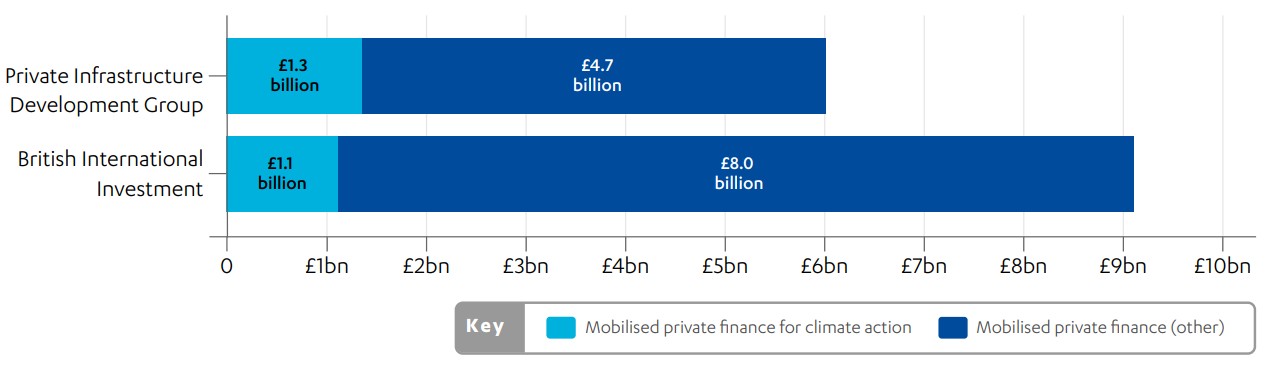
Source: Organisation for Economic Co operation and Development, ‘Mobilisation of private finance for development’, 2025 (accessed 9 October 2025)
Description: Bar chart illustrating private finance mobilised by BII and PIDG, split into finance mobilised for climate action and finance mobilised for other purposes. Between 2012 and 2023, PIDG mobilised £1.3 billion for climate action and £4.7 billion for other purposes. In the same period, BII mobilised £1.1 billion for climate action and £8 billion for other purposes.
3.89 Without private capital, the climate finance needs for energy transition in developing countries cannot be met. In recognition of this, the mobilisation of private finance underpins the strategies of both the CIF and the GCF. Both the CIF and the GCF have already mobilised significant sums (see para 3.82), but with higher rates of public finance mobilisation than private finance. Both funds have dedicated mechanisms for raising private finance, through the CIF Clean Technology Fund Private Sector Programme and the GCF Private Sector Facility. The GCF has accredited 39 private sector partners while the CIF works through the MDBs to mobilise private finance.
3.90 The CIF Capital Markets Mechanism (CCMM) is a significant innovation that has the potential to mobilise private finance at scale (see Box 10). The move was actively supported by the UK government, underscoring its commitment to financial innovation in climate finance. The government used its influence with the CIF and the World Bank to ensure that the CCMM was listed on the London Stock Exchange rather than in Luxembourg, which is standard World Bank practice.
Box 10: The Climate Investment Funds Capital Market Mechanism (CCMM)
Launched in September 2023, the CCMM is a ground-breaking initiative to leverage institutional investment for climate action. It allows the CIF to issue green bonds, a type of debt instrument used to raise money specifically for projects with environmental or climate benefits, on international capital markets, backed by the donor-funded assets of the CIF’s trust funds. The first issuance, which was kept intentionally modest to test the model, raised $500 million (approximately £370 million). This was well received by the market and is expected to lead to further funds raised.
The novelty of the CCMM lies in its ability to mobilise private capital at scale and speed, reducing the cost of climate finance by drawing on the strong creditworthiness of the MDBs and donors. As a next-generation blended finance instrument, the aim of the CCMM is to channel market financing into the CTF while adhering to rigorous green bond standards to ensure impact and transparency.
Stakeholders in the CIF and the UK government believe that the CCMM has the potential to unlock billions of pounds in additional capital. The CCMM offers a replicable model for other climate finance institutions and MDBs seeking to expand the toolbox for climate investment beyond traditional grants and concessional loans.
3.91 The GCF has made increased mobilisation of private finance a strategic priority and has dedicated resources to doing so. To achieve this, it has simplified its processes for private sector partners and established a new department with a wide brief to bring additional private finance to GCF projects. It is too soon to tell what impact these efforts will have on the amount of private finance mobilised.
The UK has taken a robust system-wide approach to finance mobilisation, allocating funding at different stages of the S-curve, including to address barriers to investment in countries at different stages of development
3.92 The UK’s approach to mobilising public and private finance, as described by government officials, is robust and systems-focused, consisting of four elements:
- supporting partner country governments to improve the enabling environment through technical assistance and capacity building
- providing pre-commercial support for research and development, and pilot projects to demonstrate the technical and commercial viability of energy transition investments
- building a pipeline of bankable projects
- mobilising investment at scale through project support and the use of concessional capital to de-risk investments.
3.93 There is an unavoidable strategic tension between, on the one hand, the need for patient, longer-term support to developing countries to establish or strengthen the policies and institutions needed to attract large-scale private investment in their energy transition; and, on the other hand, the shorter-term pursuit of commercially viable interventions that provide more immediate climate gains. The Climate Policy Initiative and the OECD emphasise that private finance is much harder to mobilise in low-income countries. 66 Private investors avoid low-income countries because projects there are seen as too risky, too small, or too complex. Weak financial systems, unstable regulations, and limited infrastructure make it hard to develop reliable, profitable energy projects. As a result, most clean energy and climate finance flows to larger, more creditworthy middle-income countries, leaving low-income countries dependent on grants and concessional funding. Low-income countries need to be supported by concessional funding, while middle-income countries, especially upper-middle-income countries, have great potential for mobilising private finance. In the review period, the UK has demonstrated willingness to extend support also to technologies and countries in the emergent stage of the S-curve, although its focus has been predominantly on middle-income countries. In interviews, external stakeholders and co-funders reported that the UK has a reputation for being more willing than other donors to support innovation, research and development, pilot projects, capacity building, and enabling environment work also in lower-income environments.
3.94 UK-supported initiatives have had some success in improving the enabling environment. Of the 74 programmes in the energy transition portfolio, 11 report against the technical assistance KPI 3 (climate policies influenced by ICF programming). Together these programmes report having influenced 130 policies, but the KPI reporting does not allow extrapolations on how those policy changes have affected the mobilisation of public and private finance. Some of the UK initiatives to address barriers to investment in energy transition include:
- The Climate Compatible Growth Programme, led by Loughborough University, which supports countries’ project management from conception to implementation and provides energy planning and modelling tools.
- The Global Clean Power Alliance, which works with local financial institutions to build their capacity in funding energy transition projects and to develop locally owned, investor-friendly energy plans. It emphasises South-South dialogue, balanced membership, and hybrid financing.
- The Energy Transition Council’s Rapid Response Facility, which provides technical assistance at the request of partner countries to address specific barriers to the energy transition that may help unlock finance at scale.
- The GCF’s $500 million (approximately £372 million) Readiness Programme, which provides technical assistance and project support to enable countries to access climate finance.
3.95 This strategic tension between early-stage versus late-stage support may, however, increase as the UK’s ODA envelope is reduced, making the need to prioritise between different geographies and forms of investment more acute and increasing the incentive to favour easier commercial ‘wins’. Since the more difficult early-stage and enabling work in low-income country contexts does not attract private finance, there is a risk that the foundational reforms needed for long-term impact, especially in low-income countries, will be neglected if the primary focus is on the mobilisation of private finance.
The UK’s large spread of small programmes, combined with insufficient coordination between departments and with other funders, reduces the effectiveness of its system-wide approach to finance mobilisation
396 The UK’s system-wide approach to mobilising finance is appropriate, but weakened by limited coherence across programmes and across the S-curve (see Box 3 for an explanation of the S-curve). While government interviewees found small programmes to be helpful to pilot innovations or fill gaps left by other initiatives, there are too many such small programmes, with 74% of all programmes in the energy transition portfolio worth less than £50 million. While it is not relevant or feasible to establish a benchmark of the ideal number of programmes, in a lower ODA and resource environment, the coordination required for maintaining coherence and the administrative cost of a large number of individual programmes is too high. Government and external stakeholders noted that initiatives operate independently, with separate administrative structures and eligibility rules, rather than forming a joined-up approach across the S-curve. As a result, pipeline-building efforts do not consistently build on earlier pilots, and opportunities for programmes to reinforce one another are often missed. Some stakeholders saw the reduction in UK development funding over the next two years as an opportunity to consolidate and focus the portfolio to improve the coherence of UK-supported efforts to mobilise finance.
3.97 Government staff reported that coherence and coordination opportunities can be missed between FCDO and DESNZ. Efforts are underway to remedy this through improving the way in which the cross-government ODA board works.67 The same is the case between the UK and other funders, such as the MDBs and the MCFs. More can be done, for instance, to attract funders with different risk appetites to build on the foundational UK-funded efforts to improve the enabling environment or build the capacity of lower-income countries.
There is a risk of concessional climate finance crowding out private finance in middle-income countries
3.98 Financial additionality is a key principle of development aid-funded investments. It means that grants and concessional finance (soft loans provided on better terms than commercial rates) should only be used to mobilise an investment that would not have materialised otherwise and should not crowd out private finance.68 We reviewed the business case assessments of financial additionality in our sample of UK energy transition programmes. Each business case includes a commercial case and value for money assessments that specifically address the question of additionality and assess what finance can be leveraged to support the programme itself, as well as addressing the ways in which the programme activities will directly or indirectly support finance mobilisation. However, the arguments made in business cases generally seek to justify the proposed investment and do not provide a rigorous assessment of whether the goals of the programme could be secured without, or with less, concessional finance. The strict methodologies for calculating ICF KPIs 11 and 12, notably on establishing a counterfactual, business as usual case, further reinforce the rigour of this assessment and monitoring process.
3.99 Such assessments need to strike the right balance: strict rules on proving additionality can make it harder to get valuable projects off the ground. However, concessional finance support to middle-income countries, as opposed to low-income countries, warrants closer scrutiny, given that many have the capacity to access climate finance through non-ODA mechanisms and market-based instruments. Based on three evaluation reports shared by government with ICAI for the Climate Public-Private Partnership, Global Climate Partnership Fund, and Renewable Energy Performance Platform, UK grant and concessional financing was found to be clearly additional, providing the early-stage capital and technical assistance needed to de-risk investments in new low-carbon technologies and business models that private investors would not have supported independently. By absorbing first-loss risks and anchoring funds in more challenging or higher-risk emerging markets, UK financing catalysed private participation and enabled projects and pipelines that would not have proceeded under normal, business as usual, market conditions. A more thorough analysis of a representative sample of programmes would be required, but was beyond the remit of this review.
The UK financial sector is regarded as a strength, and over the past year the government has begun to engage with City of London institutions more strategically
3.100 UK government interviewees reported that the UK financial sector has strengthened its ability to develop and deliver initiatives to support energy transition in developing countries. External stakeholders also saw the UK financial sector as enhancing the UK’s energy transition capabilities. Ministers have expressed a desire for the UK financial sector to increase its engagement in energy transition efforts. Innovative initiatives such as the CCMM and the GCF’s Green Guarantee Company have been established in the London market with support from the UK government.
3.101 A recent report from the Institutional Investors Group on Climate Change led to the establishment of a task force involving City institutions, HM Treasury and FCDO ministers.69 The task force has four workstreams; research, decision-making, data and MDB reform and regulation.
Box 11: The City of London
The UK has long positioned itself as a global leader in climate finance, but recent developments mark a step change in how the government and the financial sector promote international energy transition together. A key vehicle for this is the Transition Finance Council, co-convened by the UK government and the City of London Corporation, and chaired by former COP26 President Alok Sharma. Launched in 2024, the Council aims to establish London as the premier global centre for energy transition finance, catalysing private capital for climate mitigation and adaptation in emerging and developing economies.
This agenda is intensifying. In public statements, former Foreign Secretary David Lammy and Energy Secretary Ed Miliband have underscored the UK’s ambition to be a “force multiplier” in global climate action, using its financial system, diplomatic networks, and development institutions to crowd in private finance for energy transition abroad. Secretary of State for Energy Security and Net Zero, Ed Miliband, has specifically highlighted the role of blended finance in lowering the risk profile for investors in Global South energy projects.
The City of London, meanwhile, plays a convening and standard-setting role, hosting platforms such as the Green Finance Institute, promoting credible energy transition plans, and supporting the issuance of green and transition-labelled bonds that align with net zero pathways. UK Export Finance and BII have stepped up their coordination with the private sector to de-risk and invest in large-scale renewables and grid projects across Africa, Asia and Latin America. The Brazil Industrial Decarbonisation Hub illustrates a promising step in this direction: the Green Finance Institute was contracted to support project preparation, culminating in a UK-hosted workshop that connected Brazilian project proponents with 25 UK-based investment houses.
Conclusions on UK efforts at leveraging and mobilising public and private finance for energy transition
3.102 UK-supported institutions and activities have been effective in mobilising public and private finance, with £5.2 billion reported as mobilised through the UK’s bilateral and, particularly, multilateral programmes in the energy transition portfolio. The UK takes a system-wide approach, addressing finance mobilisation at all stages of the S-curve, notably also for higher-risk innovations, and promoting the enabling environment. This is a robust approach, but it is constrained in practice by the limited coherence between the many small and diverse activities and programmes that make up the portfolio, and insufficient coordination with other funders and between FCDO and DESNZ.
3.103 There is a risk of concessional funding crowding out private finance in middle-income countries, and related assessment procedures are insufficiently directed to this end. The relationship between the UK government and the City of London is recognised as a significant strength in supporting the UK’s work on the energy transition.
4. Conclusions and recommendations
4.1 The UK’s energy transition support to developing countries is highly relevant to UK net zero objectives and the global climate goal of keeping temperature rises below dangerous levels, while also contributing to poverty reduction by expanding access to clean, affordable and reliable energy. The UK has leveraged its long-standing diplomatic engagement, technical expertise and substantial official development assistance (ODA) through its international climate finance (ICF) to play a leading global role in promoting energy transition in developing countries. Its engagement through multilateral climate funds (MCFs), international alliances and national partnerships has positioned it as a respected convener and norm-setter.
4.2 The UK takes a system-wide approach to promoting and financing energy transition in developing countries. It supports a diverse range of activities and a wide and growing network of international alliances and country partnerships. At its best, this is a flexible and adaptive approach. However, there is not a clear and shared cross-departmental definition of energy transition, with a related operational strategy and theory of change. The portfolio is spread thinly into too many small programmes and ICF data does not allow a clear understanding of how energy transition-relevant spend within these programmes is spread across different sectors, delivery channels and geographical locations. This again makes it difficult to assess where and how the UK’s energy transition support is most impactful. There is also insufficient cross-portfolio and cross-departmental monitoring, coordination and learning. Although officials work well together, for example on the ICF Management Board, the split governance of the energy transition portfolio between the Foreign, Commonwealth and Development Office (FCDO) and the Department for Energy Security and Net Zero (DESNZ) contributes to the lack of clear strategic leadership and has created operational difficulties and blurred responsibilities.
4.3 This weakens overall coherence and the ability to identify gaps, as well as to prioritise and scale up transformational, impactful interventions. The absence of a clear strategy and priorities will be more urgent as the UK is reducing its ODA budget over the next years. Currently, there is no clear framework for decision making on priorities and where to strike appropriate balances, for instance between: support via multilateral versus bilateral channels; support to high emitting middle-income countries versus low-income countries in more need of concessional finance; attention to early-stage enabling environments versus commercial deployment; and cost effectiveness versus inclusivity. The government is aware of the greater need for coordination and coherence across the climate-related spending of its departments, and has announced that it will improve how the cross-government ODA board works.70
4.4 The UK’s strong multilateral engagement and recognised leadership in major climate funds such as the Green Climate Fund (GCF) and the Climate Investment Funds (CIF) has been valuable, and the UK has used its role as donor to improve the performance of the two funds. However, the strategic rationale for the UK’s allocation of resources across multilateral and bilateral channels, and between different multilateral actors, including multilateral development banks and MCFs, is unclear.
4.5 Strategic country partnerships like the Just Energy Transition Partnerships (JETPs) are an important element of the UK’s energy transition diplomacy. The JETPs have not delivered on their ambition, but the UK has been a pragmatic and responsive partner and has used lessons from the challenges faced by the JETPs to inform a more realistic design for newer country partnerships such as the UK-Brazil Hubs. The UK also pursues its influencing work through a range of international alliances. While this is also valuable work, there is a clear risk of over-proliferation of alliances with overlapping objectives.
4.6 The UK’s ICF has a well-defined system for monitoring, evaluation and learning at the programme level, and the UK is a global leader among donors on its portfolio-wide results reporting on climate goals, through its set of ICF key performance indicators (KPIs). Nevertheless, persistent challenges in accountability for ICF measurement and related reporting challenges limit strategic learning across the portfolio, and there are no robust measurements of the impact of the international alliances that the UK supports.
4.7 The UK has been a leader in supporting the effective mobilisation of both public and private finance and is working well with the City of London to innovate, also through mechanisms such as the CIF Capital Markets Mechanism. Such successes aside, a large increase in both public funding and, particularly, private finance is needed to achieve a transformational shift in global energy systems. Most public and private finance is mobilised for investment in technologies that are near to commercial viability in middle-income countries. Grant financing will continue to be needed for early-stage projects and the promotion of a welcoming investment environment in lower-income countries.
4.8 These positive efforts and achievements are, however, balanced by shortcomings, including the lack of a cohesive overarching energy transition definition and strategy, and accountability and implementation gaps in data and reporting – especially on transformational change, financial mobilisation, geography, and gender equality and social inclusion. There are challenges in coordination across programmes and financial mobilisation efforts across the S-curve in different country contexts. While the UK’s influential role and adaptive decision making are clear strengths, further progress is needed on strategic direction, coherence, and transparency to fully maximise effectiveness and impact.
4.9 ICAI intends to follow up on the government’s progress in responding to the findings and recommendations of this report, first in May 2026 and then again in May 2027. In May 2026 we intend to assess actions taken in the short term by the government, returning for a more detailed assessment of the impact of these and other actions in May 2027.
Recommendations
Recommendation 1: The UK should publish a comprehensive energy transition strategy with a clear definition and theory of change, which also reflects poverty reduction and inclusion goals
Problem statements:
- While overall commitment is strong, the UK’s energy transition portfolio is broad and diverse without a clearly defined energy transition strategy. This risks a lack of coherence and presents challenges in prioritisation as the UK reduces its aid budget.
- There is a delicate balance to be managed between the energy transition portfolio’s strategic focus on higher-emitting, middle-income countries, albeit with sizeable poor populations, and low-income countries that remain relatively underserved, despite their acute vulnerability and greater dependence on concessional finance, with potential implications for the UK’s longer-term poverty reduction and equity goals.
- With UK aid reductions, an overarching strategy is needed to ensure that political and diplomatic initiatives on energy transition give the same priority to gender equality and social inclusion efforts as current aid-funded programmes do.
Recommendation 2: The UK should take a portfolio-level approach to identifying and allocating funding between different bilateral and multilateral channels, notably between the multilateral climate funds, based on comparative advantage and value for money
Problem statements:
- ICF data does not allow a clear understanding of how energy transition-relevant spend is spread across different sectors, delivery channels and geographical locations, making it difficult to judge where and how the government’s energy transition work has the greatest impact.
- The portfolio has spread widely into many small programmes without a clear rationale for this fragmentation.
- There is no strategic rationale which underpins how the UK decides the balance of its investments between multilateral and bilateral channels, and among different MCFs.
- A full options and value for money analysis was only conducted more than a year after the public announcement of the UK’s commitment at the GCF’s second replenishment.
Recommendation 3: The UK should establish clear, publicly accountable departmental roles with joint accountability to strengthen decision making and coordination on energy transition
Problem statements:
- There is a lack of clear strategic leadership and coherent division of roles and responsibilities between departments.
- The shift in programming focus and budget levels between DESNZ and FCDO has created operational challenges and blurred responsibilities.
- While there are positive examples of cross‑government coordination in the UK’s international energy transition portfolio, the lack of high‑level governance and coordination structures weakens its coherence and strategic delivery.
Recommendation 4: The UK should standardise and strengthen accountability for the implementation of monitoring and learning across its energy transition portfolio, particularly the reporting and use of data on transformational change, financial leverage, and the additionality of UK finance
Problem statements:
- Programmes in the UK energy transition portfolio report substantial results in some areas, but accountability is weakened by the fact that individual programmes self-select ICF KPIs, and are only required to select one relevant KPI. There is little visibility at portfolio level as to which indicators have been chosen and whether data is actually being collected and reported.
- The UK has made some early progress in its aim to support transformational change of energy systems in developing countries, but the concept of transformational change is not consistently understood and applied across the energy transition portfolio.
- The ICF has a well-defined system for monitoring, evaluation and learning at the programme level, but persistent challenges to measurement, including the identified challenges in disaggregation by geography, delivery channel, programme, gender equality and social inclusion, as well as the inability to track KPI reporting to individual programmes more transparently, limit strategic learning across the portfolio.
- ICF data does not allow a clear understanding of how energy transition-relevant spend is spread across different sectors, delivery channels and geographical locations, making it difficult to judge where and how the government’s energy transition work has the greatest impact.
- There is insufficient evidence that learning structures and processes are operating effectively across departments.
- The ICF KPI monitoring, evaluation and learning system has made significant efforts to standardise the ICF KPIs and harmonise the related concepts and data collection methods, notably for ICF KPIs 11 and 12, which are also among the most frequently reported indicators. However, the actual reporting requires scrutiny considering how diverse the methods are for measuring finance mobilisation across delivery mechanisms, including by the MCFs and development finance institutions themselves. This is likely to have an impact on the quality of the data feeding into ICF KPIs 11 and 12, despite the standardised definitions and harmonised methodology.
Recommendation 5: The UK should clarify the role of its country partnerships and international alliances in supporting energy transition, introduce more realistic targets for the JETPs, and create robust performance frameworks for alliances
Problem statements:
- The JETPs were intended to galvanise national and donor support for ambitious energy transition targets in the partner countries, but progress in many areas has been slow.
- Structural and design-related factors have hindered progress and continue to affect the future outlook for JETPs. The choice of financial instrument offered, in the form of guarantees, was not perceived as appropriate to the context by country stakeholders.
- Although there are some good examples of success, it is not possible to assess the effectiveness of alliances robustly, since most are not required to meet the monitoring, evaluation and learning standards of ODA programmes.
- A proliferation of international alliances and initiatives takes up significant political capital, and poses challenges to coordination and coherence, especially where capacity to manage the growing number of alliance engagements is limited.
Recommendation 6: The UK should clearly articulate its objectives for mobilising additional finance, distinguishing between support for countries at different development stages and across the investment cycle
Problem statements:
- Business cases for energy transition programmes address the question of additionality. However, they generally seek to justify the proposed investment and do not provide a rigorous assessment of whether the goals of the programme could be secured without, or with less, concessional finance.
- There is no explicit agreement in the UK government on the right balance between supporting commercially viable projects and higher-risk, innovative investments.
- Investment is skewed towards near-commercial projects in middle-income, lower-risk countries, rather than building enabling environments in lower-income countries.
- Reductions in ODA risk narrowing focus to commercial-ready projects, at the expense of early-stage research and development and capacity building.
Annex 1: Methodology
Our methodology was designed to assess how well the international climate finance (ICF) portfolio and other activities by the UK government are supporting the transition of low- and middle-income countries towards clean energy. We focused on the UK’s strategic objectives for energy transition and how they sit within its ICF architecture, its support to alliances and partnerships, and its role in mobilising finance for energy transition in developing countries.
The methodology consisted of five main components (see also Box 13 for limitations):
- Strategic review: The strategic review was used to understand the landscape of UK aid for energy transition. This provided insights into the context, policies, programme design, and implementation frameworks. Desk reviews of key policies, strategies and guidance and consultations with key stakeholders covered all three review questions.
- Portfolio mapping: The portfolio mapping was used to develop a clear understanding of the breadth and range of the UK’s energy transition portfolio, in collaboration with the relevant government departments. This had not been attempted before, given the cross-cutting nature of energy transition. The exercise helps strengthen public knowledge of UK spending and achievements to support and further the energy transition in developing countries.
- Multilateral investments case study: We conducted a case study to assess UK investments in energy transition through large multilateral channels. This case study of the Climate Investment Funds (CIF) and the Green Climate Fund (GCF) assessed how effectively the UK is pursuing its energy transition objectives through the support and influencing of these institutions. The study included a visit to institutional headquarters, interviews with officials and other key informants, and document review.
- Country partnerships case study: We reviewed UK support to the four Just Energy Transition Partnerships (JETPs) and other country platform approaches, assessing the relevance and effectiveness of UK bilateral support, including any transformative change in programme design, stakeholder perspectives on inclusion and equity, and mobilising finance. The component included review of documents, interviews with officials and key stakeholders, an external stakeholder workshop, and survey feedback.
- Thematic case studies (deep dives): We explored particular aspects of UK-funded work on energy transition through thematic case studies, selected to cover key issues of importance for answering our review questions. The case studies covered the following topics: mobilisation of public and private finance for energy transition; UK support to alliances working towards energy transition; how the UK energy transition portfolio supports transformational change; and how the UK addresses barriers to a just energy transition. The thematic case studies involved document review, key stakeholder interviews and desk reviews of a sample of ICF-funded programmes. These included multilateral and bilateral programmes as well as investments across relevant UK development finance institutions. The institutional reviews and partnership case study (described above) also provided evidence for the deep dives.
Cumulatively, our five methodological components ensure that the review covers funding to multilateral, bilateral and multi-bi spending, as well as diplomatic activities and initiatives relevant to energy transition goals in developing countries that are not funded by development assistance. The selection of multilateral, country partnership and thematic case studies and deep dives, as well as of the programme sample, was based on three main criteria:
- the size of associated programme spending
- their strategic significance to the UK’s ICF
- their value in answering our review questions.
The GCF and the CIF were selected for the multilateral climate fund case study because they are the largest multilateral programmes through which the UK channels its ICF spending on energy transition. The UK has allocated around £2.2 billion to the two funds in the ICF3 period (2021-2026).71
Box 12: Multilateral climate funds – portfolio mapping and methodological limitations
Breakdown of the UK’s estimated contribution to the energy transition portfolios of the Green Climate Fund (GCF) and the Climate Investment Funds (CIF)
The GCF’s energy transition funding supports 103 projects aimed at enhancing energy generation, access, and efficiency. This funding accounts for $8.2 billion (approximately £6.10 billion) of the GCF’s $16.5 billion (approximately £12.27 billion) core financing (approximately 50%). The UK’s £2.8 billion contribution since 2015 represents about 23% of the GCF’s financing, implying a pro-rata share of roughly £1.4 billion in energy transition activities. We applied the same 50% energy funding ratio to the UK’s pledge for 2021-22 to 2025-26 to estimate the proportion of the recent tranche that would support energy generation, access, and efficiency projects.
Energy transition funding via the CIF’s Clean Technology Fund (CTF) amounts to an estimated $9 billion (£6.7 billion) out of total CIF contributions of $12.5 billion (£9.3 billion) (approximately 72%). The UK has contributed £2.7 billion since 2008, or about 29% of the CIF envelope and roughly 40% of the £6.7 billion CTF pot, implying an estimated £1.94 billion of UK backing for CIF energy generation, efficiency, storage, and clean transport projects. We applied the same 72% energy funding ratio to the UK pledge for 2021-22 to 2025-26 to estimate the proportion of UK funds that would support CIF energy transition activities.
Estimates on the UK’s share in energy transition-related activities supported by the two funds are approximations, relying on fixed exchange rates and pro-rata allocation assumptions. Because the UK pledge for the review period covers multiple CIF windows beyond the energy-focused CTF, a straight pro-rata allocation against CTF spend may mis-state actual energy funding. To refine this estimate for the review period from 2021-22 to 2025-26, we rely on window-level disbursement data from the ICF Management Information data and then apportion the UK’s contributions by the true share each programme received, rather than relying on a blanket proportional assumption.
Regional breakdown of the GCF and CIF energy transition activities
The regional allocation of GCF financing includes £1.5 billion (24%) for Africa, £1.7 billion (28%) for Asia-Pacific, £150 million (3%) for Eastern Europe and Central Asia, and £600 million (10%) for Latin America and the Caribbean. A further £2.16 billion (35%) is distributed across multi-country programmes and initiatives.
Regionally, the CIF’s CTF allocations include £1.26 billion in Asia (31%), £820 million in Europe and Central Asia (20%), £600 million each in Sub-Saharan Africa and Latin America and the Caribbean (15% each), £520 million in the Middle East and North Africa (14%), and £150 million (4%) for global programmes.
The JETPs were selected as country partnership case studies because they are high-profile, multi-donor partnerships to which the UK has made significant financial and political commitments. They aim to accelerate the energy transition in coal-dependent economies while ensuring that the process is just, with a strong emphasis on supporting affected workers and communities through reskilling and inclusive economic growth. Particular focus is given to South Africa and Indonesia, which have received more substantial support and demonstrated some progress.
Purposeful sampling was used to identify 12 programmes for review, following a staged selection process. An initial longlist of programmes was drawn from across the portfolio and then screened to identify the most relevant programmes for case studies and thematic deep dives. In making the selection, we recognised that some programmes address both energy supply and demand, meaning that it was not possible to restrict the sample to supply‑side initiatives alone. Programmes were ultimately selected based on their suitability for case studies and their contribution to key themes. Final selections also ensured balanced representation across the two departments, inclusion of both bilateral and multilateral delivery channels, and broad geographical coverage. This systematic process resulted in the selection of 12 programmes for detailed review. (See Annex 2 for the full list.)
We interviewed 160 different stakeholders for this review. The breakdown of interviewees is as follows: 38 staff from the Department for Energy Security and Net Zero (DESNZ); 30 staff from the GCF Secretariat or Independent Evaluation Unit; 26 staff from the Foreign, Commonwealth and Development Office (FCDO); 20 staff from the CIF Secretariat; 15 implementing partners; eight research, academic or think tank staff; eight staff from civil society organisations, non-governmental organisations or non-profits; seven staff from British International Investment; four country government officials; three staff from the Private Infrastructure Development Group; and one other UK government official.
Box 13: Limitations to the methodology
Absence of a clearly defined energy transition definition and portfolio: The UK government did not have a clearly defined energy transition concept and portfolio, which created challenges in identifying what to include in the review. This was resolved in collaboration with the government, with FCDO and DESNZ providing a list of the activities that they considered constituted the energy transition portfolio.
Focus on energy supply: Within the energy transition portfolio, a decision was made for the research conducted as part of the review to focus on energy supply, rather than energy demand, to maintain a manageable scope. As a result, other areas such as clean cooking, energy efficiency, and transport were not explored in depth.
Challenges with tracking and valuing cross-sector energy transition programmes, and lack of country-level data: Because energy transition work often cuts across different sectors, it can be difficult to classify and track properly. Programmes that work across multiple areas do not always use tagging systems that clearly show how they relate to energy transition goals. This means that some relevant activities might not be identified, while others may be counted in full even if only part of them is relevant – which could lead to overestimating the total value. This has also made it hard to break down the data by country. As a result, the overall value reported in this review is only an estimate – and likely higher than the actual figure.
Gaps in key performance indicator (KPI) reporting: Reporting against ICF KPIs remains limited across the portfolio. Many of the several KPIs most relevant to tracking progress on energy transition – such as those related to clean energy access, emissions reductions, and climate finance – are only used by around 30% of programmes. This lack of consistent reporting significantly hampers the ability to assess aggregate outcomes and overall impact in the context of energy transition.
Limited primary research in partner countries: A large number of stakeholder interviews were held, with UK-based stakeholders and as part of the institutional visits to the GCF and the CIF. Primary data collection with country-based external stakeholders was limited to remote research in two JETP countries and a survey and workshop. The level of response to the survey was lower than hoped for.
Challenges in measuring financial leverage: Measuring financial leverage in UK ICF is challenged by inconsistent definitions (for example what counts as public versus private finance), differing methodologies across delivery partners (for example commitments versus disbursements, pro-rata versus full attribution), and limited coverage of upstream activities like policy reform and innovation that are essential to enabling future investment but hard to quantify in leverage terms.
Annex 2: Programmes reviewed
The programme aims to accelerate the decarbonisation of South Africa’s energy sector by transitioning from coal to renewable energy sources, while ensuring a just transition that protects vulnerable workers and communities. Duration: 2023-20291. South Africa’s JETP Support Programme
Budget (programmed): £5 million (£19.8 million with extension)
Department: FCDO
2. MENTARI – Indonesia JETP
The programme aims to accelerate and expand low-carbon energy in Indonesia by reforming renewable energy policies, increasing investment through brokerage and technical assistance, demonstrating viable off-grid systems for marginalised groups, and building capacity and collaboration among stakeholders, all while mainstreaming gender and inclusion.
Duration: 2019-2026
Budget (programmed): £13.5 million (£22.3 million with extension)
Department: FCDO
3. Climate Investment Funds (CIF)
A multilateral fund that aims to accelerate climate action by supporting transformative projects in clean technology and energy access, particularly in developing and middle-income countries. By providing large-scale, low-cost, long-term financing, the CIF aims to reduce the risks and costs associated with climate investments, thereby encouraging innovation and attracting further funding into the energy sector.
Duration: 2021-2026
Budget (programmed): Up to £500 million
Department: DESNZ & FCDO
The GCF, supported by UK contributions, is the world’s largest fund helping developing countries address climate change through balanced investment in adaptation and mitigation projects across key sectors, including energy transition. Duration: 2020-20334. Green Climate Fund (GCF)
Budget (programmed): £1.44 billion (2020-2023); £1.62 billion (2024-2033)
Department: DESNZ & FCDO
5. Private Infrastructure Development Group (PIDG)
PIDG aims to mobilise private investment in infrastructure – including energy transition – by using financial tools such as blended finance, concessional capital, technical assistance, project development, debt solutions, and credit guarantees to drive sustainable growth and poverty reduction in developing countries.
Duration: 2018-2025
Budget (programmed): £435 million (£915 million with extension)
Department: FCDO
6. British International Investment (BII)
BII, the UK’s development finance institution, aims to support sustainable economic growth and energy transition by investing in private sector development across Africa, Asia and the Caribbean.
Duration: 2015-2027
Budget (programmed): £4.28 billion and £3.5 billion cost extension
Department: FCDO
7. Renewable Energy Performance Platform (REPP)
REPP is a private finance initiative that supports small- and medium-scale renewable energy projects across sub-Saharan Africa by providing technical assistance, development capital, and viability gap funding. Established by the former Department for Business, Energy and Industrial Strategy (BEIS) in 2015 and transferred to FCDO in 2022, REPP helps communities access clean energy and reduce greenhouse gas emissions.
Duration: 2015-2025
Budget (programmed): Up to £148 million but capped at £88 million
Department: FCDO (previously BEIS/DESNZ)
8. Mitigation Action Facility (MAF)
The MAF is a multi-donor fund, established by the UK and Germany, that supports mid-sized projects in developing countries to accelerate innovative clean technologies and lasting policy change for greenhouse gas reduction, primarily through high-value grants and technical assistance in hard-to-abate sectors.
Duration: 2012-2027
Budget (programmed): £375 million
Department: DESNZ
9. Increasing Access to Electricity in Sierra Leone
The programme focuses on expanding access to clean, renewable energy – primarily through solar mini-grids and standalone solar systems – to provide reliable and affordable electricity for rural communities, businesses, health clinics, and schools across the country.
Duration: 2016-2024
Budget (programmed): £43 million
Department: FCDO
10. Increasing renewable energy and energy efficiency in the Eastern Caribbean
The programme aims to improve energy security and support sustainable development in the Eastern Caribbean by providing financial and technical assistance to governments for increasing renewable energy and energy efficiency, building capacity, and developing infrastructure, particularly in geothermal and solar power.
Duration: 2015-2025
Budget (programmed): £63 million
Department: FCDO
11. Climate Public Private Partnership
The programme aims to increase low–carbon investment in renewable energy, water, energy efficiency, and forestry in developing countries by demonstrating that such investments can deliver competitive financial returns and climate impact, thereby attracting new sources of climate finance from institutional investors like pension funds and sovereign wealth funds.
Duration: 2012-2026
Budget (programmed): £130 million
Department: DESNZ
12. Noor II and III Concentrated Solar Power Project (Clean Technology Fund through the Climate Investment Funds)
The Noor II and III Concentrated Solar Power Project, supported by the Clean Technology Fund (CTF), aims to accelerate Morocco’s transition to low-carbon energy by generating up to 350 MW of renewable power using advanced concentrated solar power technologies with thermal storage, significantly reducing greenhouse gas emissions and enhancing energy security.
Duration: 2014-2022
Budget (programmed): $250 million from CIF CTF
Department: DESNZ & FCDO
Annex 3: International climate finance key performance indicators
International climate finance (ICF) programmes report against seven key performance indicators that are relevant to a review of energy transition. These are indicated with an asterisk in Table 5.
Table 5: International climate finance key performance indicators and their relevance to energy transition
| International climate finance key performance indicators | |
|---|---|
| 1. | Number of people supported to better adapt to the effects of climate change |
| 2.1* | Number of people with improved access to clean energy |
| 2.2* | Number of social institutions with improved access to clean energy |
| 4. | Number of people whose resilience has been improved |
| 6.* | Tonnes of greenhouse gas emissions reduced or avoided |
| 7.* | Installed capacity of clean energy |
| 8. | Ecosystem loss avoided |
| 10. | Value of ecosystems services generated or protected |
| 11.* | Volume of public finance mobilised for climate change purposes |
| 12.* | Volume of private finance mobilised for climate change purposes |
| 15.* | Extent to which ICF intervention is likely to lead to transformational change |
Source: Foreign, Commonwealth and Development Office, UK International Climate Finance results 2025, October 2025 (accessed 28 October 2025)
References
2025) ↩
(viewed on 28 October 2025) ↩