UK aid response to global health threats – A learning review
1. Purpose, scope and rationale
The UK aid strategy outlines a commitment to increasing UK aid investment on global health risks,1 including infectious diseases and antimicrobial resistance (AMR).2 Global health threats are of increasing concern to the international community, as well as representing a challenge to British interests. The recent Ebola crisis in West Africa served to highlight the considerable risks that infectious disease epidemics pose to development.
ICAI has decided to conduct a learning review of the UK aid response to global health threats, since the scaling up of expenditure and cross-government collaboration required to address this challenge is at an early stage.3
The purpose of the review is to explore how well the UK aid programme is preparing for global health threats, in response to the priorities outlined in the UK aid strategy and the lessons learnt from Ebola. In this context our definition of global health threats includes infectious disease epidemics, emerging diseases with epidemic potential and drug-resistant microbes. The review will assess the relevance of the aid response and its potential effectiveness, including assessing whether the response is evidence-based and whether lessons are being captured to inform future programming.
The review will explore the expansion of the aid programme in areas such as health research, surveillance and emergency response within a broader health systems strengthening (HSS) approach. This will include assessing the UK’s contribution to influencing and strengthening the international system for health surveillance and crisis response. In addition, the review will explore how new areas of emphasis are balanced with the longer-term process of HSS within developing countries. Given the cross-departmental nature of the UK’s response, involving the Department for International Development (DFID), Department of Health (DH), Department for Business, Energy and Industrial Strategy (BEIS) and Department for Environment, Food and Rural Affairs (Defra),4 along with partner agencies such as Public Health England (PHE), a key focus of the review will be on the effectiveness of their collaboration.
2. Background
Concern about new disease epidemics has been high among policy makers for some time in the UK and elsewhere. As well as the challenge of simultaneously addressing long-standing public health issues (such as malaria, tuberculosis and HIV/AIDS) and emerging diseases, the development of drug-resistant pathogens adds to the threat.5 Against this background, the Ebola crisis brought the issue of global health threats into sharp relief. In particular, the crisis exposed weaknesses in national and international health systems, including the coherence and speed of the international response, as well as limitations in global preparedness for new epidemics.
Box 1: Lessons and insights from the Ebola crisis6
There have been numerous reviews of the response to the Ebola crisis. The following observations were distilled from an initial assessment of the evidence. We will further examine lessons learnt from the Ebola crisis during this review through the literature review and consultations with expert stakeholders.
- Weaknesses in the international public health system: Despite warnings, the World Health Organisation (WHO) was slow to recognise the severity of the outbreak. DFID’s response was likewise delayed by over-reliance on the WHO. Overall, there was a shortage of international organisations with the capacity to respond quickly.
- Weaknesses in national health systems: National health systems in Sierra Leone, Liberia and Guinea are among the weakest in the world, lacking systems to recognise and contain outbreaks. Affected countries initially played down reports of Ebola due to the feared economic consequences of reporting.
- Poor communication: Information campaigns to influence public behaviour in the affected countries were sometimes counterproductive, discouraging people from seeking medical treatment. Community engagement was identified as particularly weak at the start of the crisis.
- Lack of research readiness: Ebola had not been identified as a priority disease. While the global health research community responded in record time with clinical trials for vaccines, treatments and diagnostics, they were not research ready at the outset.
- Slow mobilisation of funding: Large-scale funding for the Ebola crisis was only mobilised once developed countries felt under direct threat, and there was some inflexibility within funding mechanisms. Funding was therefore not always spent on the correct interventions at the correct time; much smaller investments in prevention could have averted the crisis.
- Lack of expert readiness: The sudden international response meant that mobilised staff sometimes lacked the required expertise within the countries affected.
- Poor early coordination: Because it was labelled as a health crisis rather than a humanitarian emergency, coordination structures were ad hoc and non-health aspects of the crisis were poorly coordinated, particularly early on.
In the context of addressing global health threats, the Ebola crisis highlighted the need to improve the international health infrastructure, national health systems, investments in research and technology and effective, rapid response to outbreaks. Balanced against this, the UK aid strategy acknowledges the UK’s world-leading expertise in public health and medical research.
Box 2: The UK government response: “Stronger, Smarter, Swifter”7
The response to Ebola and global health threats was developed under the strategic framework of “Stronger, Smarter, Swifter”. Stronger refers to efforts to encourage national and international health system strengthening and leadership; Smarter encompasses support for developing new vaccines, diagnostic tools, systems and drugs (along with a specific focus on addressing the challenge of drug-resistant diseases); and Swifter involves action to ensure that the international system and the UK can deploy the required expertise rapidly, and that funding can be mobilised at short notice. It should be noted that the UK government is currently in the process of refreshing this framework.
Key to the implementation of the UK response is a £1 billion commitment outlined in the 2015 UK aid strategy through the Ross Fund. The Fund comprises a portfolio of initiatives managed by DFID and DH.8 It aims to accelerate research, development and the implementation of new products for fighting infectious diseases, focusing on diseases with epidemic potential and antimicrobial resistance (AMR), as well as supporting emergency response. Also important are investments targeted at influencing and strengthening international and national health systems and their ability to prevent, detect and respond to relevant global health threats. This brings together important cross-government work to leverage and support the effectiveness of multilateral agencies (including the WHO), as well as bilateral UK aid investments in strengthening the implementation of the International Health Regulations (IHRs)9 at a country level (also involving PHE). Finally, the strategy is supported by wider UK aid-funded research investments designed to harness UK science and academic expertise in addressing the challenges facing developing countries, including in global health. These include the BEIS Global Challenges Research Fund and other DH research.
While many of these projects and initiatives are now underway, they are also at an early stage of implementation. This review of the emerging UK response to the global health threats from infectious diseases will therefore be timely in helping to determine whether best use has been made of past learning.
3. Review questions
This review is built around the criteria of relevance, effectiveness and learning. Relevance concerns the extent to which the UK aid response represents a relevant and coherent approach. The review will also assess the potential effectiveness of the emerging aid portfolio and cross-government coordination mechanisms. The focus on learning will cover the extent to which ongoing learning is informing the response. Review questions and sub-questions have been developed for each of the above criteria (see Table 1).
Table 1: Our review questions
| Review criteria and questions | Sub-questions |
|---|---|
| 1. Relevance: Does the UK have a coherent strategy for using aid to address global health threats? |
|
| 2. Effectiveness: Is the emerging aid portfolio a potentially effective response to global health threats? |
|
| 3. Learning: Is learning effectively informing the aid portfolio's response to global health threats? |
|
4. Methodology
The methodology for the review will involve four main components. Given that this is a learning review, it will make extensive use of expert stakeholder opinion, and draw on a robust literature review, in order to identify learning from the Ebola crisis and other relevant experiences. This will allow us to map and assess the UK’s emerging response to relevant global health threats against these lessons learnt, through a broad strategic review, specific programme reviews and country case studies.
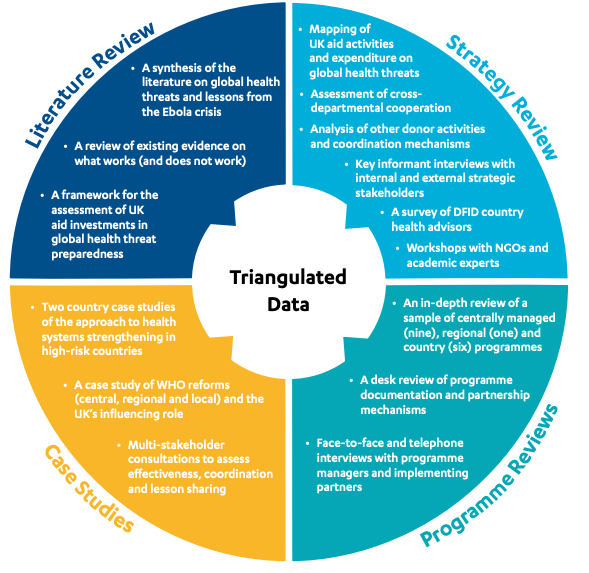
Component 1 – Literature review: We will conduct a literature review to explore definitional issues, the nature of global health threats (focusing on infectious diseases and AMR), weaknesses within the international health system, and the key lessons learnt from the Ebola crisis. This will provide a framework for the systematic assessment of the relevance of UK aid investments to global health threat preparedness, as well as their coherence. We will also review existing evidence on what works, to help assess the emerging effectiveness of UK aid investments (including any early evaluative work on the strategy or on specific programmes themselves). The review will provide a synthesis of academic and grey literature, covering international and country-level health systems, bilateral and multilateral donor activity as well as the work of non-governmental, philanthropic and private sector actors. It will also cover recent diagnostic, forecasting and horizon-scanning, and other data on global health threats. This will help us to assess the relevance of investments in individual diseases and in AMR (as well as more generally the balance of resources across the areas of prevention, detection and response). It will therefore be critical for the literature review to provide a relevant and robust framework; this will be achieved by undertaking a structured assessment of the quality of each source (eg according to type of publication), and weighting the evidence in the analysis accordingly.
Component 2 – Strategic review: To assess the relevance of UK aid investments, we will first review the response of participating departments (DH, DFID, BEIS, Defra, the Cabinet Office and associated agencies) to the priority of addressing global health risks as outlined in the UK aid strategy. This will involve a desk-based mapping exercise of relevant strategies, priorities and programmes within the global health security portfolio, as well as expenditure within the context of overall UK aid spend on global health, including on established infectious diseases. We will cover centrally managed programmes, research and influencing work, as well as relevant HSS in priority countries, funded through bilateral and multilateral channels. We will request evidence of the departments’ analysis of the state of global health threat preparedness, as well as UK horizon scanning, diagnostic work and other research into specific global health threats. We will also collect details of intra-departmental and cross-government coordination mechanisms, as well as links within and across programmes (including with UK aid-funded research). Furthermore, we will review any cross-government evaluation and learning mechanisms as well as evidence of findings being disseminated. Finally, as part of the mapping we will briefly review the strategies and major investments of other donors (including in particular the WHO and USAID) as well as key private sector and philanthropic organisations (for example the Bill & Melinda Gates Foundation and the Wellcome Trust). We will look to identify any associated coordinating mechanisms established by the UK government, as well as evidence of partnership working and the exchange of intelligence and learning.
We will also conduct key informant interviews with relevant UK government departments and agencies (including policy, research and corporate teams), other donors (for example the US, Canada, Germany and Japan), multilateral agencies (the WHO, the World Bank, UNICEF and Gavi), non-government sector organisations (non-governmental organisations, trusts and foundations and the private sector) and external expert observers (drawing on the considerable academic expertise on infectious diseases within the UK). Interviews will be semi-structured and conducted in person and by telephone, and will assist with accessing as well as interpreting the mapping evidence. We will hold stakeholder workshops in London with international non-governmental organisations active in this field and with external experts at the start and end of the review, to help shape our approach and test our findings. We will also conduct a survey of DFID country health advisors, exploring the themes above from a specific country programming and HSS perspective. Analysis and triangulation of this evidence will enable us to assess: i) the relevance of the UK aid strategy and individual investments to the existing literature on gaps, risks and priorities; ii) the added value of UK aid investments and influencing work; iii) the visibility and coherence of the overall approach; iv) emerging effectiveness, including influence and leverage; v) the effectiveness of cross-government coordination (and coordination with external actors); and vi) any ongoing learning and dissemination.
Component 3 – Programme reviews: A cross section of programmes will be selected for more in-depth review, to further assess relevance and coherence, emerging effectiveness and coordination and evidence of research links and lesson learning, within the UK government and internationally. We will select a representative sample of interventions from the range of centrally managed programmes and influencing mechanisms developed by the responsible departments in response to the UK aid strategy. We will also sample a smaller set of country-level programmes, to explore DFID’s developing approach to HSS and global health threat preparedness within high-risk countries. Programme reviews will involve desk reviews of programme documentation (business cases, annual reviews, monitoring and expenditure data and commitments) and partnership mechanisms with bilateral and multilateral donors and key non-governmental, philanthropic and private sector organisations. It will also involve face-to-face and telephone interviews with programme managers and key implementing partners. This evidence will be gathered, analysed and triangulated using a detailed assessment framework for each programme, designed to enable systematic assessment against the review questions.
Component 4 – Case studies: We will conduct two country case studies in order to expand upon the evidence collected through the programme reviews. These will involve short visits to assess the relevance, coherence and progress of UK aid investments on the ground (this time from the perspective of multiple stakeholders). In particular, the visits will review any evidence of coordination, as well as influence and lesson sharing, across the responsible departments, with other relevant sectors including in particular water, sanitation and hygiene (WASH), and with partner governments, donors and other relevant actors.
In each country we will consult with a range of relevant DFID, DH and PHE staff (including health and humanitarian advisors and logisticians), government representatives, bilateral and multilateral partners (including WHO country offices, other UN agencies such as UNICEF, World Food Programme and coordinating functions, and relevant multilateral health funds including Gavi), and non-governmental and civil society organisations.
Given the critical role of the WHO in coordinating international efforts to prevent, detect and respond to disease outbreaks and AMR, we will also conduct a specific case study of WHO reform measures. The purpose will be to explore in more depth the relevance and efficacy of the UK government’s efforts (and associated funding) to influence key multilateral partners and strengthen the international health system (and the learning from this). We will also gather external perspectives on the added-value contribution of UK aid to global health threat preparedness (for example to the Global Action Plan on AMR),10 and how well this is coordinated and learning is shared. The case study will involve in-person or telephone interviews with staff in the WHO headquarters in Geneva and regional offices and key multilateral partners (including the Food and Agriculture Organization of the United Nations and the World Organisation for Animal Health, given the One-Health approach). The case study will enable us to speak to a wide range of stakeholders directly and indirectly involved with UK ODA, as well as to access further relevant documents and data not included in the desk review.
The evidence from each case study will be gathered, analysed and triangulated using an expanded assessment framework designed to enable systematic assessment against the review questions.
5. Sampling approach
We have selected a sample of nine centrally managed programmes, one regional programme and six country programmes for in-depth review.
The centrally managed programmes were selected to explore the range of UK aid investments across the “Stronger, Smarter, Swifter” framework, as well as complementary HSS work within (multilateral) funded programmes targeting more established diseases. The programme sample includes activities led by both DFID and DH or jointly.
Table 2: Centrally managed programme sample
| Strategic objective | Programme/project |
|---|---|
| Stronger (health system strengthening) |
|
| Smarter (research and development) |
|
| Swifter (emergency response) |
|
The sampled programmes cover the majority of allocated funds within the Ross Fund Portfolio (£1 billion).12 In addition, we will examine the UK’s core voluntary contribution to the WHO (£58 million), which supports the reform programme, the UK’s contribution to the WHO’s new Health Emergencies Fund (£11 million) and a £16 million investment in strengthening the implementation of the International Health Regulations (IHR), managed by PHE. When combined with the Ross Fund sample, this will mean that the review is able to cover all of the UK’s specific centrally managed investments in global health threat preparedness.
In terms of other multilateral funding, the review will assess the learning from adaptations to HSS through the UK’s investment in Gavi (£1 billion in 2016-20) to support the immunisation of children against vaccine-preventable diseases, including how Gavi is contributing to the efforts of other DFID and DH programming on global health threats in developing countries.
UK Support for Regional Preparedness to Prevent the Spread of Ebola (a £23 million programme, which is in turn informing a new Tackling Deadly Diseases in Africa Programme) was also selected since it is DFID’s main regional investment relevant to the review.
Six country programmes have been provisionally selected based on their potential for maximising learning on DFID’s evolving country-level response (rather than representing the totality of DFID activity in this area). The sample covers a range of health programmes with adaptations to support infectious disease preparedness, including tackling drug-resistant malaria (Burma), post-Ebola HSS (Sierra Leone and Nigeria), and strengthened surveillance (Pakistan).
Finally, the two country case studies, Burma and Sierra Leone, were selected based on a particular confluence of DFID and PHE activity tackling relevant global health threats. This enables us to assess departmental coordination as well as influencing work with governments and other bilateral and multilateral donors (including WHO local offices).
6. Limitations of the methodology
Assessing effectiveness: The UK government’s approach to tackling global health threats is new, with programmes and influencing efforts still in their initial stages. Hard output and outcome data will not be available for many programmes, and stakeholder observations on progress to date will be limited to planning and early implementation phases. This will make it difficult to provide a full assessment of effectiveness. Instead, the review will focus on likely effectiveness, based on rigorous analysis of the strategies and approaches being pursued relative to the scale of the challenge, allocated spend and inputs from other donors, any interim outputs delivered, and the robustness and early outcomes of partnership working. This will be triangulated with external evidence of what works and with expert stakeholder opinion, to arrive at a reasoned judgement.
Review coverage: The review will not attempt to assess the performance of UK aid investments in controlling existing and well-established major diseases such as tuberculosis, malaria and HIV/AIDS. However, it will analyse comparative expenditure in this area and coordination with the major multilateral health funds where relevant, including with regard to country HSS. The strengths and weaknesses of the multilateral health funds and of the WHO and associated areas for improvement are well documented in the current literature, for example in the recent Multilateral Development Review.13
7. Risk management
| Risk | Mitigation and management actions |
|---|---|
| Cross-government responsibility for global health threat preparedness could make evidence gathering challenging. | Close working, regular contact and clear communications with working level contacts to facilitate access and coordinate the review between the relevant departments. |
| Security issues prevent access to data, given the emergent nature of the portfolio. | DFID, DH and the secretariat are to agree protocols on access and handling of restricted documents, as well as timelines for publishing sensitive information. |
| ICAI review of case study countries and the WHO contributes to the overburdening of stakeholders. | The secretariat and the commissioner are to play a role in mediating access challenges through coordination with other reviews and support for the logistical planning of case study visits by liaising with key stakeholders. |
8. Quality assurance
The review will be carried out under the guidance of the ICAI commissioner Richard Gledhill, with support from the ICAI secretariat. The review will be subject to quality assurance by the service provider consortium. Both the methodology and the final report will be peer reviewed by Professor Gill Walt, Emeritus Professor of International Health Policy at the London School of Hygiene and Tropical Medicine.
9. Timing and deliverables
This review will be executed over a period of nine months, beginning in April 2017.
| Phase | Timing and deliverables |
|---|---|
| Inception | Literature review: April to May 2017 Approach paper: June 2017 |
| Data collection | Strategic review: May to June 2017 Programme review: June to August 2017 Case studies: July to August 2017 Evidence pack and emerging findings: September 2017 |
| Reporting | Likely report publication: December 2017 |
Footnotes
- UK aid: tackling global challenges in the national interest, HM Treasury and DFID, November 2015, link.
- Under the strategic objective of “strengthening resilience and response to crises”, the UK aid strategy includes commitments to tackling ongoing crises in the Middle East and North Africa, global public health risks and climate change mitigation and adaptation. Although climate change also poses a risk to public health, it is not covered by this review. UK aid’s contributions in this area have been covered by previous ICAI reviews, most recently in The UK’s International Climate Fund, ICAI, 2014, link.
- This review will be complemented by the ICAI Disaster Resilience Review, which will look at how DFID is building resilience to natural disasters.
- This reflects the UK government’s One-Health approach to slowing the development and spread of antimicrobial resistance (AMR), spanning people, animals, agriculture and the wider environment, link.
- Foresight. Infectious Diseases: preparing for the future. Executive Summary, Office of Science and Innovation, London, 2006, link.
- Summarised from: Note to Cabinet Office on Lessons from the UK Response to the Ebola Crisis and Next Steps, DFID, June 2015, (unpublished); Report of the Ebola Interim Assessment Panel, WHO, July 2015, link; Ebola: Responses to a public health emergency, Government Response to the Committee’s Second Report of Session 2015-16, House of Commons, April 2016, link; Final Heart Review of UK Response to Ebola in West Africa, HEART, January 2017; Protecting Humanity from future Health Crises: Report of the High-level Panel on the Global Response to Health Crises, UN, February 2016, link; Bill Gates, “The Next Epidemic: Lessons from Ebola”, The New England Journal of Medicine, April 2015, link; Ebola: Responses to a public health emergency, International Development Committee, Second Report of Session 2015-16, April 2016, link; UK lessons from Ebola, Science and Technology Committee, January 2016, link; The Ebola response in West Africa, Overseas Development Institute, October 2015, link; A wake-up call, Lessons from Ebola for the world’s health systems, Save the Children, 2015, link.
- Cross-Whitehall Global Health Security Strategic Objectives, July 2015 (unpublished).
- Ross Fund Summary, DH and DFID, January 2016, link.
- IHRs were established in 1969 to limit the spread of infectious diseases across international borders. There were subsequently widened and strengthened from 2007.
- Global Action Plan on Antimicrobial Resistance, WHO, 2015, link.
- The latter two project titles are currently under revision. Full details of DFID’s research investments under the Ross Fund Portfolio will be published after the UK general election.
- Total UK aid spend on global health is estimated at £9 billion over the current spending review period, 2016-20.
- Raising the standard: the Multilateral Development Review, DFID, 2016, link.