UK development partnerships
Executive summary
This review examines the UK’s evolving approach to development partnership between 2020-21 and 2025-26. Focusing on partnerships with and within countries, it considers whether the UK’s approach reflects internationally recognised principles of effective development cooperation, how development partnerships are being built and managed in practice, and whether the systems needed to support impact, accountability and value for money are fit for purpose.
The review recognises that the UK’s partnership approach continues to evolve, in a context of a rapidly reducing official development assistance (ODA) budget and organisational restructuring within the Foreign, Commonwealth and Development Office (FCDO). Rather than assuming a settled approach to partnership, the review examines whether the capabilities, accountability arrangements, evidence systems and other foundations needed for effective partnerships are being established at the pace needed to support its continuing implementation.
Key findings
The UK’s partnership approach reflects development effectiveness principles, but there is less clarity on how partnerships can deliver and demonstrate development outcomes
The review found that the UK’s partnership approach is broadly aligned with longstanding international commitments on development effectiveness, including country ownership, local leadership, inclusive partnerships and mutual accountability. Recent UK policy statements emphasise more equal and respectful relationships with partner countries and recognise the importance of working through a wider range of actors beyond government.
ICAI found differing understandings of what development partnerships are intended to achieve, how partnership principles should guide decisions and how success should be assessed. As a result, stakeholders did not always share a common understanding of how partnerships were expected to contribute to development outcomes, how results would be assessed, or who was expected to benefit. It was not always clear how partnerships are expected to contribute to poverty reduction, given that development objectives are increasingly pursued alongside wider UK priorities and delivered with non-ODA resources. While country ownership was often expressed through government-to-government relationships and alignment with national priorities, ICAI found less clarity on how wider societal perspectives were reflected in partnership priorities and their intended outcomes.
The review found promising examples of partnerships, but limited evidence of a systematic approach to identifying and sustaining the capabilities needed for the evolving partnership approach
The review found promising examples of partnership working, where the UK combined ODA, technical expertise and diplomatic influence to support national development priorities, including long-term health workforce reform in Zimbabwe and support for vulnerable populations in Myanmar. Across the case study countries, stakeholders consistently highlighted the value of the UK’s technical expertise, contextual knowledge, longstanding relationships and the ability to convene and influence other actors.
However, the review found limited evidence of a systematic approach to identifying which capabilities will remain important to the partnership and how they will be retained. Many were developed through the delivery of bilateral programmes that are now being reduced, creating a risk that expertise, relationships and institutional memory could be eroded as staffing structures and country portfolios change and ODA programmes are reduced or phased out in some countries.
Mutual accountability remains underdeveloped in practice
Mutual accountability remains an underdeveloped element of the new partnership approach, despite being central to its stated ambitions. Stakeholders were frequently unclear how priorities had been determined, how consultation had influenced decisions, and how they could challenge or influence UK choices. Country ownership, local leadership and more equal partnerships all depend on shared objectives, mutual commitments and clear accountability arrangements. However, the review found varying interpretations of how partnership principles should be applied in practice.
The partnership approach is being implemented before supporting systems for learning, evaluation and value for money are fully established
The partnership approach is still evolving and is intended to remain flexible, through context-specific implementation. This increases the importance of systems that can generate, share and apply learning as the partnership approach continues to evolve. While there is a strong appetite for learning and examples of innovation, learning remains largely dependent on local initiative and informal networks, rather than institutionalised processes.
The UK has significantly changed how it pursues development outcomes while systems for monitoring, tracking progress toward outcomes and evaluating partnership contributions remain under development. Current approaches to monitoring, evaluation and value for money are more closely aligned with traditional programme delivery than with a partnership approach based on influence, expertise, coordination and relationship-building. Although FCDO has begun to develop new planning, monitoring and evaluation systems, these remain at an early stage and do not yet provide a consistent basis for assessing partnership performance, contribution to development outcomes or value for money.
Conclusion
The review found widespread commitment to the UK’s partnership approach and promising examples of partnership contributing to development objectives. The approach is broadly aligned with international development principles and seeks to combine aid, expertise, diplomacy, investment and influence in support of development outcomes.
However, ICAI found that greater clarity is needed on how partnerships are expected to contribute to development outcomes and how results should be assessed. In several areas, including capability planning, mutual accountability and assessment of results, the review found limited evidence of systematic approaches to support implementation, learning and accountability.
Many of the capabilities on which the partnership approach relies, including technical expertise, contextual understanding and trusted relationships, have been developed through the delivery of bilateral programmes. As these programmes are reduced or phased out more quickly than new ways of working are established, ICAI heard that critical capabilities and relationships could be lost before arrangements to sustain and renew them are in place. The review found limited evidence of work to identify which capabilities will remain most important to the partnership approach and how they will be retained and renewed.
Recommendations
Recommendation 1: FCDO should publish a clear statement explaining how its partnership approach is expected to contribute to development outcomes, including poverty reduction, gender equality and inclusion, and how development objectives will be prioritised as they are integrated with wider UK priorities.
Recommendation 2: FCDO should develop a strategic capability plan for the partnership approach, identifying the capabilities, expertise and relationships most critical to its future effectiveness and how these will be sustained, strengthened and renewed through the current transition.
Recommendation 3: FCDO should develop and apply a framework to support mutual accountability within its development partnerships, setting out how shared objectives should be agreed between the UK and partners, how commitments and responsibilities should be allocated, as well as review mechanisms and opportunities for partner feedback and challenge.
Recommendation 4: FCDO should establish, as a priority, an evaluative framework for assessing how development partnerships contribute to development outcomes and demonstrate value for money, and use the evidence generated through this framework as a consistent basis for accountability, learning and continuous improvement.
1. Introduction
1.1 This review examines the UK’s approach to development partnerships at a time of significant change in global development cooperation. It assesses whether the UK’s partnership approach remains consistent with internationally recognised principles of effective development cooperation, how bilateral development partnerships are being built and managed in practice, and whether the systems used to support oversight, learning, development impact and value for money are fit for purpose. The review questions are presented below in Table 1.
Table 1: Review questions
| Review questions | |
|---|---|
| 1 | Has the UK’s approach to partnerships reflected global commitments? |
| 2 | How well has the UK built and managed bilateral partnerships since 2020-21? |
| 3 | To what extent has the UK ensured that its recent and current bilateral development partnerships can maximise impact and value for money? |
1.2 The review focuses on the UK’s bilateral development partnerships with and in ODA-eligible countries between 2020-21 and 2025-26. It examines how development objectives are pursued through country-level partnerships, and the continuing shift towards combining official development assistance (ODA) with other forms of UK engagement, including diplomacy, expertise and investment. The review considers engagement with partner governments, civil society, other development actors and, where relevant, multilateral organisations within those countries. It does not provide a comprehensive assessment of partnerships with multilaterals, civil society organisations, the private sector or development finance institutions such as British International Investment (BII). The findings reflect that the UK’s partnerships are in a period of significant transition, rather than representing a settled approach.
1.3 The review sits within a wider body of Independent Commission for Aid Impact (ICAI) work examining how the UK pursues development objectives in contexts where bilateral grant aid is no longer the primary instrument of engagement and where development is increasingly integrated with wider UK priorities. Previous ICAI reviews have explored how development impact can be sustained as bilateral aid declines, how development objectives are balanced alongside economic and foreign policy interests, and how accountability and value for money can be retained in more integrated approaches to development cooperation.1 This review builds on these themes. It also complements recent inquiries by Parliament’s International Development Committee into the changing nature of UK development cooperation and the assessment of value for money in ODA spending.2
1.4 Recent years have seen major global shifts in international development cooperation. ODA spending has declined and development objectives have become increasingly integrated into foreign policy goals.3 In this context, development partnerships have moved from being primarily about the management of aid towards a focus on promoting development through other forms of influence.
1.5 Partner countries expect development relationships to be more equal and responsive to their own priorities. At the same time, there is an increased focus in development cooperation towards global challenges, such as climate change, health risks, financial governance and security, that require collective action by multiple actors, including developing countries.
1.6 These changes are reflected in UK development policy. In July 2026, the government published ‘The UK’s modern development approach’, which sets out four shifts in how the UK promotes development: from donor to investor, from service delivery to systems change, from grants to expertise, and from international intervention to local provision. The government’s position is that stronger, more equitable and mutually beneficial relationships are needed to support development in a changing global context.
1.7 The new approach to partnership is also an adaptation to reductions in UK and global ODA spending. As Baroness Chapman, former Minister of State for International Development and Africa in the Foreign, Commonwealth and Development Office (FCDO), stated:
“The cuts to spending around the world have forced us to accelerate changes already underway and long overdue, to genuinely prioritise, and to focus on working in a different way, more in tune with what partners around the world tell us they want – modern development focused on investment, expertise and partnerships.”
Baroness Chapman, ‘Four Shifts’ in ‘Promising Development: The Future of Aid in an Uncertain World’, September 2025
1.8 In February 2025, the government announced that UK ODA spending would fall from 0.5% to 0.3% of gross national income by 2027.4 In July 2026, three-year ODA allocations and FCDO spending plans confirmed a major reshaping of the UK’s development offer.5 They indicate a £6.5 billion or 42% ODA reduction over the four years to 2027-28. The government has committed to spending 70% of its country allocations in fragile and conflict-affected states, while some of the UK’s longest-standing development partners will receive annual allocations of just £5 million from 2028-29.6
The scale and pace of these changes mean that the UK’s evolving partnership approach is being implemented during a period of rapid transition, in which traditional bilateral programmes are being reduced or phased out in several longstanding partner countries.
1.9 The shift in the UK’s approach is also taking place alongside broader organisational changes within FCDO, including changing ministerial priorities and the FCDO2030 transformation programme, which involves changes to structures, staffing and ways of working.7 The review therefore considered whether the objectives, capabilities, systems and accountability arrangements needed to support a partnership approach are being developed at the pace required for effective implementation.
1.10 The review applied a mixed-methods research approach, combining qualitative and quantitative evidence across eight research components (see Figure 1). Central to the review were three country case studies: Kenya, Myanmar and Zimbabwe. While these are not representative of all UK development partnerships, they provide illustrative examples of how the new approach is being interpreted and operationalised in different contexts. Fieldwork took place during a period of transition, while country teams were developing new country strategies and new partnership guidance was at different stages of development and use.
Figure 1: Review method
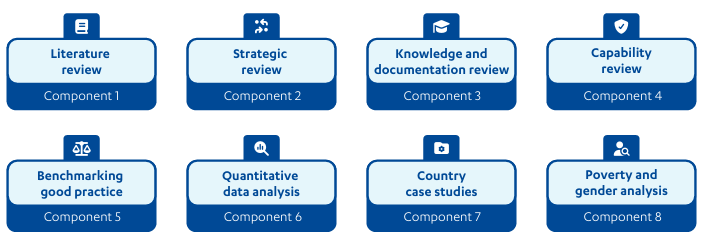
1.11 The review analysed more than 500 documents and drew on interviews, roundtables and consultations with 258 stakeholders across government, partner countries, civil society, multilaterals, bilateral donors, academia and the private sector. Programme examples were used to illustrate partnership practice rather than assess programme performance. Key terms used throughout the review are defined in Annex 1 and further detail on the methodology and its research components can be found in Annex 2.
1.12 The report is structured as follows. Section 2 explains ICAI’s understanding of the UK’s evolving partnership approach. Section 3 presents findings against the review questions, focusing on partnership objectives, country leadership, capabilities, and systems for impact, accountability, learning and value for money. Section 4 sets out the review’s conclusions and recommendations.
2. Background
Partnership in the UK’s approach to development since 2020
2.1 Since 2020, UK development strategies, policy papers and ministerial statements have outlined an evolution in how partnerships are used to pursue development objectives with partner countries. This has taken place against a backdrop of considerable political and ministerial change, with successive prime ministers, foreign secretaries and development ministers bringing different priorities and emphasis to the UK’s international engagement.8
2.2 The approach has shifted from one centred on ODA-funded programmes towards greater emphasis on partner country leadership, drawing on a wider range of UK capabilities, including policy engagement, knowledge and expertise, investment and other sources of development finance beyond the traditional grants. Partnership has increasingly been positioned not simply as a way of delivering
development assistance, but as the primary means through which the UK pursues development objectives. This evolution reflects wider changes in development cooperation, including growing expectations among partner countries for more equal relationships, the growing significance of other sources of development finance relative to official development assistance (ODA) in some contexts, and an expanding range of development actors within a more competitive geopolitical environment. Further detail on the evolution of UK policy is provided in Annex 3.
2.3 Under the previous UK government, several changes in policy contributed to this shift. The ‘Integrated Review of Security, Defence, Development and Foreign Policy’ in March 2021 and ‘Strategy for International Development’ in May 2022 sought to integrate development more closely with diplomacy, security, trade and wider foreign policy, and placed greater emphasis on long-term country partnerships. This was initially accompanied by a greater emphasis on bilateral aid as a means of supporting country-led approaches. Around 75% of Foreign, Commonwealth and Development Office (FCDO) funding allocated at the 2021 Spending Review was intended to be spent through country and bilateral programmes by 20259, enabling support to be more closely aligned with partner country priorities and national development plans.
2.4 From 2023, the government increasingly articulated development partnerships in terms of mutuality, local ownership and a broader offer beyond ODA. The ‘Integrated Review Refresh’ in March 2023 emphasised mutually beneficial partnerships based on reciprocity and shared interests, while the ‘2023 progress update’ on the Strategy for International Development, published in August 2023, explicitly committed to “modernising development partnerships” in response to calls to shift power dynamics in development. The ‘White Paper on International Development’ in November 2023 gave this direction a clearer set of principles, calling for “long-term, reliable and equitable partnerships” based on mutual respect, including partner ownership, mutual accountability, learning, transparency and values. ‘Country Development Partnership Summaries’ were also introduced to set out agreed objectives and increase transparency around UK development activities and financing. FCDO has not updated these summaries since 2024.
2.5 With the election of a new UK government in 2024, this evolution continued, but in a substantially different context. In February 2025, the UK government announced that UK ODA would reduce from 0.5% to 0.3% of gross national income by 2027 to fund increased defence spending.10 In parallel, the government continued to emphasise more equal and mutually beneficial relationships with partner countries, including its ‘New Approach to Africa’ in June 2025. Following a five-month consultation with African governments and other stakeholders, the UK committed to “genuine partnerships” rooted in mutual respect, listening and equality, supporting priorities set by African partners and co-creating development solutions rather than imposing external models.
Partnerships in the UK’s modern development approach
2.6 ‘The UK’s modern development approach’, published in July 2026, sets out the current framework for the UK’s international development cooperation. This has drawn together ideas announced previously in ministerial speeches, strategies, policy statements and guidance. Based on this published material, together with interviews with FCDO officials, this section presents ICAI’s understanding of FCDO’s current approach to development partnerships (summarised in Figure 2).
2.7 The policy paper sets out an approach to development cooperation in which outcomes are pursued through relationships with partner countries and other stakeholders, using ODA less as a primary instrument and drawing more on diplomacy, expertise, investment and wider UK capabilities. The approach is intended to be country-led, based on shared interest and mutual accountability, and recognises the diversity of country contexts. The description of partnerships in the policy paper states that “stakeholders increasingly expect more equal partnership with the UK” and that the UK sees a country-led approach, characterised by “trust and credibility”, as key.11The paper sets down the principles and values that are intended to shape partnerships, the four shifts through which they are expected to be delivered, the range of instruments that can be drawn on, and FCDO’s internal systems for planning, accountability and results management.
Figure 2: The UK’s approach to development partnerships
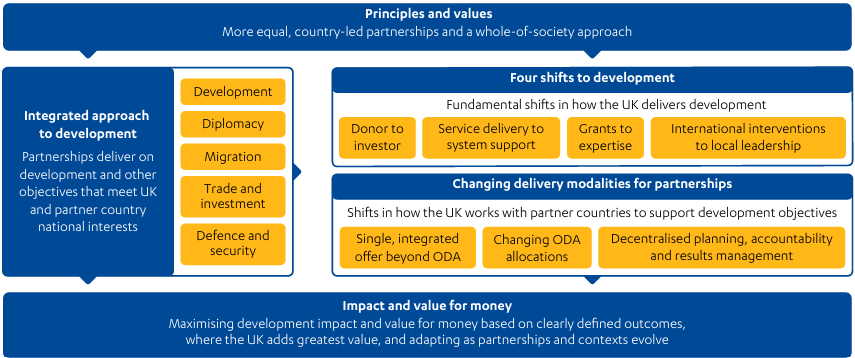
Source: ICAI analysis of Foreign, Commonwealth and Development Office strategies, policy documents and ministerial statements published between 2021 and 2026, as well as interviews with FCDO officials.
Description: The diagram summarises ICAI’s understanding of the UK’s approach to modern development partnerships. It highlights the principles of mutuality underpinning partnerships, the range of objectives they intend to support, how partnerships are delivered including four shifts to development, and their intended contribution to maximising development impact and value for money.
The principles and values of development partnerships
2.8 FCDO has reaffirmed its intention to build partnerships that are equal, respectful and mutually beneficial. It recognises that country leadership requires inclusive engagement with a wide range of government actors, civil society, the private sector, parliamentarians and other national stakeholders. As one FCDO official noted, country-led should not be equated with government-led. ‘The UK’s modern development approach’ policy paper states that, in all contexts, the UK should “seek to engage the whole of society where possible”.12 Although not explicitly stated, this aligns with the UN 2030 Agenda for Sustainable Development. The policy paper also recognises that the appropriate mix of partners will vary by context and that, in some settings, greater emphasis may be placed on engagement with local government, civil society, communities and other actors.
2.9 FCDO has developed a new set of partnership principles, for internal use, intended to shape how the UK and its network of high commissions, embassies and central directorates engage with different partners. Building on themes first articulated in the 2023 ‘White paper on international development’, these new principles centre on the “ideas of mutuality” stated in ‘The UK’s modern development
approach’, including mutual respect, mutual interest, mutual accountability and mutual learning. These principles are now being reflected in other UK public documents and statements, including as part of FCDO’s ‘Programme Operating Framework’ (PrOF) principle on locally led development and in a ministerial statement by Chris Elmore during the UK’s Global Partnerships Conference in March 2026. These partnership principles are still evolving and are not yet fully defined.
An integrated approach to development
2.10 The International Development Act 2002 establishes poverty reduction and gender equality as the formal objectives of UK ODA. However, the UK’s increasingly integrated approach to development cooperation views ODA not as a standalone instrument, but as one of a range of levers for pursuing the UK’s wider foreign policy priorities, including trade and investment, diplomacy, defence, security
and migration. This integrated approach was reflected in former foreign secretary Yvette Cooper’s six priorities for 2026-27, which included ‘development and climate’ and ‘women and girls’ alongside UK interests in security, growth and resilience, and migration. The sixth priority of ‘agile alliances’ is defined as “pursuing resilient, pragmatic partnerships with states where we have shared priorities” and “making Britain a partner of choice in a contested and competitive world”.13 The approach recognises that development outcomes are shaped by a complex ecosystem of actors and influences.
2.11 The new partnership approach is expected to deliver development outcomes in ways that benefit both partner countries and the UK. Under FCDO’s country planning guidance, embassies and high commissions are responsible for building country-led partnerships that should consider how to apply its partnership principles, including mutual interest. Internal FCDO documents, notably the partnership
principles, define mutual interest as finding evidence-based common ground where interests align and delivering benefits for both countries that are politically sustainable and publicly defensible. For example, UK support to improve the investment climate or strengthen trade links may help partner countries attract investment to promote economic growth and create jobs, while also deepening bilateral economic relationships and creating opportunities for UK businesses. FCDO guidance expects these mutual interests to be identified and negotiated through dialogue in each country. In countries where political differences mean that trust is limited and shared priorities are harder to establish, FCDO guidance recognises that partnership may need to be more transactional.
2.12 This raises important questions as to how far donor interests and national development objectives can be aligned, and whether approaches that seek to deliver both can consistently deliver meaningful development outcomes.14 These ongoing debates highlight the opportunities and risks associated with development partnerships based on mutual interest. ICAI has previously reflected on similar questions regarding integrated approaches to development and mutual prosperity agendas (see Box 1).
Box 1: Insights from ICAI reviews on integrated development and mutual prosperity
Past ICAI reviews have highlighted both the potential and the risks of integrating development objectives and mutual prosperity. ICAI’s 2016 review of ‘When aid relationships change: DFID’s approach to managing exit and transition in its development partnerships’ found that transitions towards new development partnerships worked best where the basis for continued cooperation and mutual interest was clearly defined. ICAI’s rapid review (2017) and follow-up review (2018) of ‘The cross-government Prosperity Fund’ highlighted the difficulty of credibly combining development objectives with benefits to UK business, stressing the need for a clear strategy and safeguards to ensure that wider UK national interests remained secondary to the primary development purpose of ODA-funded programmes. ICAI’s information note on ‘The use of UK aid to enhance mutual prosperity’ identified potential for more coherent and equal partnerships based on long-term mutual prosperity, while warning that a mutual prosperity agenda could dilute the poverty focus and that “mutuality” may not in itself produce a more equal partnership.
Four shifts in delivery modalities sit at the centre of FCDO’s partnership approach
2.13 The UK’s modern development approach identifies four fundamental shifts intended to change how the UK delivers development (see Box 2). Taken together, the four shifts reflect a move away from a traditional, top-down donor model centred on ODA and externally delivered interventions. They respond to longstanding challenges in development cooperation, including constraints on ODA
volumes and the growing importance of other financing flows, questions about the sustainability of aid-dependent service delivery, the need to recognise and strengthen local knowledge and capabilities, and calls for local leadership and agency by the partner countries. While the shifts are not new, their significance lies in bringing them together as the foundation of the UK’s evolving development approach.
Box 2: FCDO’s four shifts to development
1. From donor to investor: moving away from the UK being seen primarily as a giver of aid towards acting as an investment partner, working with partners to unlock growth, jobs and trade through innovative finance and private sector investment.
2. From service delivery to system support: helping countries strengthen their own systems so that they can mobilise domestic resources and deliver essential services, with the UK increasingly focused on enabling partners to solve problems rather than directly delivering services itself.
3. From grants to expertise: placing greater emphasis on working alongside partners through UK technical and institutional expertise, drawing on capabilities across the public and private sectors while strengthening rather than replacing local expertise.
4. From international intervention to local leadership: giving local partners greater agency and quality funding to design and deliver approaches that respond to local needs, with local actors more closely involved in decision-making and delivery.15
2.14 These four shifts entail an integrated development offer, combining ODA and non-ODA instruments, including trade, investment, multilateral engagement and technical assistance, and drawing on UK institutions and expertise, to influence development outcomes. What this looks like in practice will vary by country and objective. For example, partnerships might combine ODA with expertise from institutions such as the National Health Service or HM Revenue and Customs to strengthen health or tax systems; use development finance alongside trade, investment and diplomatic relationships to mobilise private capital; bring together universities, businesses and specialist institutions to support research, innovation or regulatory reform; or align locally led programmes with wider UK policy and international engagement. Realising this ambition is likely to depend on the extent to which these instruments can be coordinated and sequenced around clear, shared objectives, while remaining focused on the development outcomes they are intended to support.
2.15 The UK’s new approach to partnerships is being developed in a context of large and rapid reductions to its bilateral aid.16 The government published its country allocations for 2026-27 to 2028-29 in July 2026. ICAI’s recent report, ‘UK aid spending to 2029: the changing profile of development cooperation’, noted that these plans “signal a historic decline in UK aid of approximately £6.5 billion, or a 42% fall over the four years from 2023 to 2027-28”, with a drop in the financial year 2026-27 alone of around £3.1 billion. The priorities for remaining UK bilateral aid have also changed significantly, with 70% allocated to fragile and conflict-affected countries. For 11 longstanding recipients of UK assistance, including Kenya, Tanzania, Rwanda and Malawi, UK bilateral ODA will level off at annual allocations of £5 million by 2028-29. ICAI concluded that this amounts to the most significant set of changes to UK development practice since the 2002 International Development Act.17
2.16 As bilateral ODA declines, the UK’s approach to development partnerships will increasingly depend on combining smaller country allocations with resources and capabilities available through other channels. With the decrease in bilateral ODA, a growing share of UK development finance will be channelled through multilateral institutions such as the World Bank, the African Development Bank, the Global Alliance for Vaccines and Immunisation (Gavi) and the Global Fund, increasing the importance of partnerships and influence alongside direct bilateral programming. British International Investment (BII) will become a more important channel for development finance, alongside efforts to mobilise private investment.18 UK assistance can also be provided to partner countries through centrally managed instruments, including Communities of Expertise that bring together expertise from government, academia, civil society and industry, to provide technical assistance to partner countries. At the time of the review, the level of resources available through central programmes was unclear. This limited ICAI’s understanding of how the wider UK offer would support development partnerships as bilateral ODA allocations became smaller.
2.17 The partnership approach reflects the development effectiveness principle of country ownership, recognising that partner countries should lead decisions about their development priorities and objectives. Embassies and high commissions are asked to balance UK and partner country interests and to integrate ODA and non-ODA levers to support development outcomes. FCDO’s new planning and delivery systems devolve considerable authority to embassies and high commissions, enabling them to shape and manage country portfolios, within a framework of UK government priorities and ministerial accountability. This includes making judgements about how partnerships can support both partner country priorities and wider UK objectives, managing trade-offs, aligning the UK’s different capabilities and resources, and reviewing progress as circumstances change. FCDO’s April 2026 revisions to the ‘Programme Operating Framework’ (PrOF) reflect these changes, and the department outlined that it expects to update the framework further as the UK’s modern development approach evolves. Figure 3 illustrates how FCDO’s planning and delivery systems support decentralised decision-making.
Figure 3: FCDO’s system for portfolio planning, decision-making and oversight
The relationship between departmental, country, portfolio and programme-level mechanisms used to set priorities, allocate resources and oversee programme delivery.
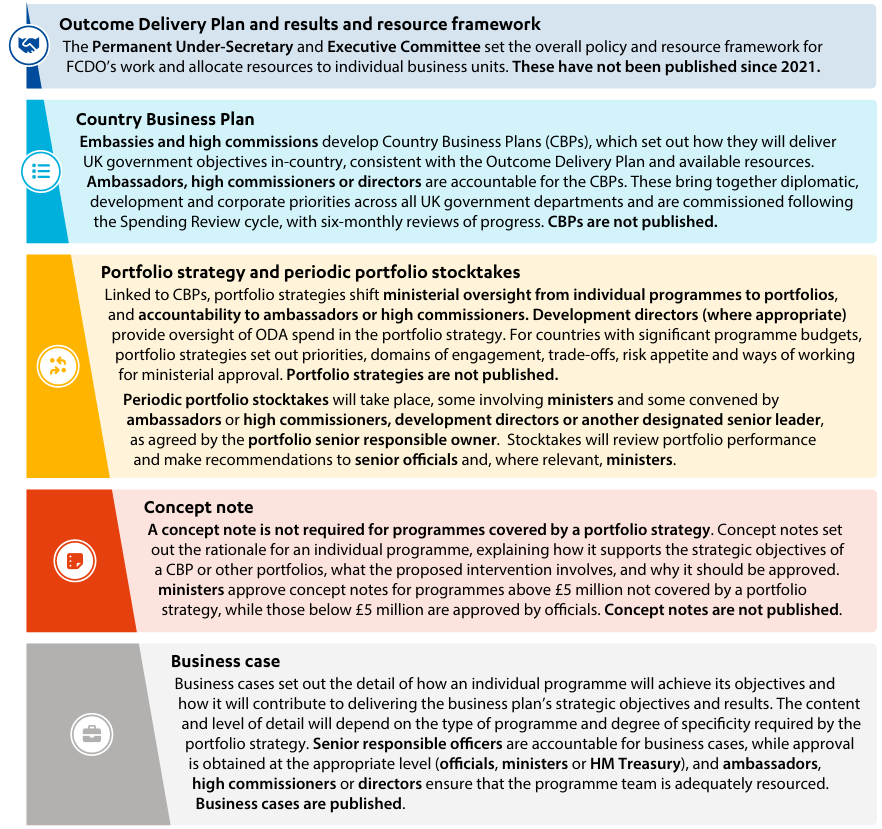
Source: ICAI adaptation of the Programme Operating Framework Life Cycle. Foreign, Commonwealth and Development Office, ‘FCDO Programme Operating Framework’, April 2026, pages 45-51 (accessed 13 October 2026)
Description: The diagram shows how accountability mechanisms operate at different levels of FCDO management. Department-wide strategic frameworks guide Country Business Plans, which in turn inform portfolio strategies, programme concepts and business cases. Together, these mechanisms provide the framework for setting priorities, allocating resources, overseeing delivery and approving programmes. For more information on job titles, roles and responsibilities, see ‘FCDO Programme Operating Framework’
2.18 The first significant update to FCDO’s planning and delivery system has been to the Country Business Plan (CBP) process. FCDO’s Outcome Delivery Plan currently provides the overarching policy and resource framework for the department, while CBPs translate this into a single set of cross-government objectives and intended outcomes across the full range of UK engagement in a particular country. Updated CBP guidance and templates for 2025-26 ask embassies and high commissions to set development objectives that balance UK and partner country interests and begin applying the UK’s four shifts. The guidance and template were updated again following the three-year spending allocations, to embed the UK’s new approach to partnerships more fully into country planning and set longer-term ambitions for outcomes and impact with the resources available to each country.
2.19 In addition, FCDO has introduced portfolio strategies to translate the development priorities and objectives set out in CBPs into delivery. Each portfolio brings together programmes and projects with related influencing activities, policy engagement and wider diplomatic or non-ODA levers around common objectives. Portfolio strategies set out the priorities, areas of engagement, trade-offs, risk appetite and ways of working for significant country or thematic portfolios to advance development objectives.
2.20 This reform shifts ministerial approval and review from individual programmes towards the whole portfolio, giving ministers stronger oversight of its overall direction and priorities. At the same time, the reform strengthens the accountability of embassies and high commissions for their delivery and results, while enabling them to manage the UK’s different instruments and capabilities more coherently in pursuit of shared outcomes. Periodic portfolio stocktakes will take place to review portfolio performance and make recommendations to senior officials. Some stocktakes will involve ministers and some will be convened by ambassadors or high commissioners, development directors or another designated senior leader. FCDO told ICAI that its longer-term ambition is for embassies and high commissions to negotiate portfolio strategies with partners through strategic dialogue before reaching agreement.
2.21 FCDO guidance requires embassies and high commissions to use political economy analysis and interdisciplinary diagnostics to inform CBPs and portfolio strategies. These should combine political insight, an understanding of interests, incentives, power relations and constraints, and sector expertise to support decisions about development objectives and partnership opportunities that align with partner country priorities and UK interest. FCDO recognises that politically informed partnership approaches benefit from external challenge through engagement with a representative range of local actors.
The government expects the new approach to partnerships to maximise the impact and value for money of UK development cooperation
2.22 FCDO expects the new approach to partnerships to maximise development impact and value for money, with a focus on real, sustainable outcomes.19 Its evolving approach emphasises the value the UK can offer beyond the volume of ODA it provides, including through convening, political engagement, technical expertise, influence, leverage and wider UK instruments. FCDO sees this as increasingly important in countries without substantial ODA allocations, where relatively modest financial inputs may be combined with other levers to influence policy and systems, mobilise wider resources and support shared objectives.
2.23 Partnerships are expected to amplify the impact of bilateral ODA resources through integration and alignment with other development finance, private investment, technical and institutional expertise, policy engagement, diplomacy and multilateral engagement. More decentralised country and portfolio planning gives embassies and high commissions a central role in bringing objectives, relationships and capabilities together.
2.24 FCDO’s current approach to value for money is set out in the PrOF. The framework’s principle on value for money lists the ‘Five Es’ of economy, efficiency, effectiveness, equity and cost effectiveness, and addresses these at the programme level, focusing on costs, outputs and outcomes of individual programmes. It states: “[Value for money] means that we should aim for the best feasible programme to achieve maximum impact”. This understanding of value for money takes into consideration not just what is delivered but how and mentions the value of building local capacity in partners and communities. It does not, however, include specific methods for assessing the value for money of partnership modalities that integrate ODA programmes with diplomacy, investment and expertise.20
3. Findings
3.1 The previous section described the evolution of the UK’s partnership approach to development cooperation and the objectives and modalities of the government’s modern development approach. This section presents findings against the three review questions set out in Table 1. It examines whether the UK’s evolving approach to development partnerships remains aligned with international principles for effective development cooperation, how it is being implemented in practice, and whether the capabilities, accountability arrangements and evidence needed to support the approach are keeping pace with its implementation. Particular attention is given to how development objectives are being pursued alongside wider UK interests, how mutual accountability is exercised within the new approach and the extent to which the government can demonstrate a contribution to poverty reduction from the new partnership approach.
Has the UK’s approach to partnerships reflected global commitments?
3.2 This sub-section examines the extent to which the UK’s approach to development partnerships reflects international development effectiveness commitments and principles. The review found that the UK remains formally committed to these principles and has increasingly incorporated them into its policy language. However, there is less clarity on how they should shape decision-making, accountability and delivery in practice, and recent funding changes have created tensions with some principles that depend on sustained engagement, trust and mutual accountability.
The UK remains committed to a complex and evolving set of global partnership commitments
3.3 The UK has repeatedly reaffirmed its commitment to development effectiveness and partnership principles, through longstanding international processes covering development, humanitarian action, peacebuilding and development finance. These included the 2005 Paris Declaration, continuing through the 2008 Accra Agenda for Action, the 2011 Busan Partnership and the Global Partnership for Effective Development Cooperation (GPEDC), and more recent commitments such as the 2025 ‘Sevilla Commitment’ (Compromiso de Sevilla) and the 2026 ‘Global Partnerships Compact’, sponsored by the UK (see Box 3).
3.4 Global commitments have evolved from a focus on aid effectiveness and donor-recipient cooperation towards a broader development effectiveness agenda. This evolution reflects a more complex landscape, characterised by partner country leadership, growing geopolitical competition, constrained official development assistance (ODA) and increasing reliance on instruments beyond aid. Annex 3 presents a timeline and summary of global commitments as well as UK strategies and policy papers between 1997 and 2026.
3.5 Established following the Busan Partnership, the GPEDC – a multi-stakeholder platform – provides an international framework for effective development cooperation. As a member of the GPEDC, the UK has endorsed its four guiding principles: country ownership, focus on results, inclusive partnerships, and transparency and mutual accountability.21 Given its broad international recognition, the GPEDC provides a benchmark for ICAI’s assessment of the UK’s approach. These principles form part of a wider set of commitments and ways of working, including local leadership, wider societal engagement, mutual benefit, sustainable results, and stronger local systems, institutions and capabilities. They are complemented by overarching commitments, including ‘leave no one behind’ (a cross-cutting commitment in the UN 2030 Agenda for Sustainable Development) and mobilising resources beyond ODA. More recent commitments, including the 2026 Global Partnerships Compact, closely reflect GPEDC principles, although they do not explicitly reference them.
Box 3: The Global Partnerships Conference, May 2026
The Global Partnerships Conference was convened in London by the UK Foreign, Commonwealth and Development Office (FCDO), together with co hosts the Republic of South Africa, the Children’s Investment Fund Foundation (CIFF) and the UK’s development finance institution, British International Investment (BII). The event brought together governments, investors, businesses, philanthropic foundations, international organisations and civil society around the twin themes of mobilising investment for sustainable development and strengthening locally led development. Its centrepiece outcome was the three page ‘Global Partnerships Compact’, which sets out shared principles to shift power and resources closer to countries and communities, while mobilising finance, technology and more equitable partnerships. Commentators broadly welcomed the Compact as a signal that the UK was seeking to reassert leadership in development cooperation after a period of aid budget reductions, but questioned whether ambitions around country ownership, local leadership and equitable partnerships could be realised in the context of sharply reducing ODA.
3.6 Together, these international frameworks provide a shared understanding of effective development cooperation, through broad principles, commitments and ways of working. They leave considerable discretion to governments in how partnership principles are interpreted, prioritised and applied.
Broad alignment with international partnership principles has not yet been translated into sufficiently clear guidance for decision-making across country contexts
3.7 The review finds that the UK’s stated approach to development partnerships is broadly aligned with international development effectiveness commitments and principles. Since 2022, UK development strategies, policies and ministerial statements have used language consistent with global partnership commitments, including country ownership, transparency, localisation, long-term engagement and mutual benefit. This alignment is often implicit rather than explicit. Only two UK aid strategies – ‘Making Governance Work for the Poor’ (2006) and ‘Building Our Common Future’ (2009) – have made explicit reference to the Paris Declaration and the Accra Agenda for Action, particularly country ownership. While FCDO’s current partnership principles include mutual accountability, they are not linked explicitly to the Global Partnership for Effective Development Cooperation principles or wider international development effectiveness frameworks.
3.8 Broad alignment with international partnership principles has not yet been translated into a clear framework for decision-making across country contexts. During most of the review period, the UK’s approach to development partnerships was guided by a combination of development strategies, ministerial statements, country planning processes and evolving partnership principles, without a clear articulation of how international partnership principles should be interpreted and applied across different contexts. FCDO’s July 2026 policy paper, ‘The UK’s modern development approach’, represents a step forward, linking the four shifts to the UK’s ambition for more systematic, country-led relationships based on mutuality and trust. It also provides greater clarity on the range of actors that development partnerships may involve (as detailed further in Section 2). However, the policy paper does not fully explain how the four shifts relate to FCDO’s partnership principles, how they should inform policy choices and delivery models, or how the UK’s partnership approach relates to and operationalises the international development effectiveness commitments and principles the UK has endorsed. The review found that guidance and expectations for applying partnership principles in practice remain under development, resulting in differing interpretations across the organisation about how they should shape priorities, partnerships, delivery models and development outcomes.
3.9 Stakeholders consulted for the review highlighted uncertainty about which commitments continue to guide the UK’s approach to partnerships, and how partnership principles translate into operational requirements and accountability arrangements. Think tanks noted that partnership commitments have been repeatedly restated under different labels, while civil society organisations (CSOs) and partner country stakeholders questioned whether the current approach would bring meaningful change.
Reduced predictability of UK aid has posed challenges to the trust and credibility needed for effective UK partnerships
3.10 The literature describes trust as both a condition for and an outcome of effective development partnerships, and this was confirmed by the country case studies and broader stakeholder engagement conducted for this review. Across these sources, stakeholders associated stronger partnerships with predictable financing, open and timely communication, inclusive dialogue, reliability and willingness to share risk and adapt. The review found some positive examples, such as transparent communication about funding constraints and flexible delivery, which helped sustain relationships with local partners in Myanmar. Conversely, delays in release of budgets, abrupt or poorly communicated funding changes, repeated programme redesign and closure, weak consultation feedback loops and limited use of country systems were highlighted to ICAI as behaviours that have undermined trust in the UK as a partner.
3.11 The credibility of partnership commitments depends not only on policy statements, but on how these are reflected in funding and delivery decisions. In recent years, rapid reductions in aid budgets and short planning horizons have been features of the UK’s development cooperation.22 The introduction of three-year ODA allocations for 2026-27 to 2028-29 represents a significant return to medium-term predictability for embassies, high commissions and the UK’s partners after several years of volatility.
3.12 However, this improvement is qualified by the timing and sequencing of the allocations, which coincide with substantial reductions in bilateral ODA for all partners, implemented over three years. More broadly, while predictability has improved, the scale and pace of the reductions raises questions about how partnership principles that depend on sustained engagement, trusted relationships, local
leadership and mutual accountability will be maintained as traditional bilateral programmes are scaled back or phased out. This tension is significant because many of the behaviours associated with effective partnerships are built over time and rely on sustained engagement, making them harder to sustain during periods of rapid transition and declining resources.
How well has the UK built and managed bilateral partnerships since 2020-21?
3.13 Having considered the extent to which the UK’s partnership approach reflects international principles, this sub-section examines review question 2 on the UK’s bilateral partnerships. It covers the balance between development, partner country and wider UK objectives, poverty reduction and gender equality, disability, and social inclusion (GEDSI), country ownership, mutual accountability, and the capabilities needed for delivery through locally led development. The review found strengths in the UK’s expertise and relationships, convening power and ability to adapt partnerships to different contexts. It also identified opportunities to clarify objectives and trade-offs, strengthen the articulation and tracking of poverty and GEDSI outcomes, broaden stakeholder participation and embed mutual accountability and locally led approaches more consistently. Many of the strengths identified in UK partnerships
were underpinned by technical expertise, contextual knowledge and longstanding relationships that stakeholders consistently valued.
The UK’s partnership approach combines development objectives, partner country priorities and wider UK interests, but it is not yet sufficiently clear how these objectives should be prioritised, balanced and communicated in practice
3.14 Across the three country case studies, ICAI saw development objectives prioritised differently within a broad set of UK foreign policy objectives. For example, FCDO officials that ICAI spoke to in Kenya noted uncertainty about whether the partnership approach is principally development-focused or driven by UK interests. In all three country case studies, some stakeholder interviewees said it was difficult to understand how development objectives informed decisions within the wider country relationship, particularly where UK interests, partner government priorities and wider development objectives did not fully align. Stakeholders interviewed in Kenya and Zimbabwe called for greater clarity on the results that UK development partnerships are intended to deliver, particularly in a context of reduced resources. They sought earlier and more open communication about UK interests, and greater clarity on how the UK would handle trade-offs between development and other objectives, especially where decisions may be difficult or unpopular. These findings echo an earlier conclusion from the OECD’s development cooperation peer review of the UK in 2020 that the purpose of and strategic rationale for UK development cooperation were not clearly or consistently articulated, making it difficult for partners to understand UK priorities (see also paragraph 3.39).
“[The Department for International Development] had a very clear mandate. It is not the same now, it is more nuanced. Things need to be in the UK interest, and follow the rules of ODA, but the clear focus is not there any more. The key message is about growth.”
FCDO country official, interview
3.15 Country Business Plans (CBPs) are the primary strategic planning document for FCDO’s country engagement, setting out priorities, delivery mechanisms and ways of working across development and diplomatic activities, while portfolio strategies translate these into operational priorities and approaches for delivery. However, ICAI found considerable variation in how country teams interpreted and used these planning frameworks, reflecting limited common guidance on how to balance development objectives, partner country priorities and wider UK interests. While this flexibility enabled adaptation to country contexts, the absence of a sufficiently common framework for articulating priorities and trade-offs made it harder to demonstrate how partnership decisions were reached and how development objectives were being advanced.
3.16 These challenges are more acute in an increasingly difficult operating environment. Over the review period, reductions in ODA, shifting policy and ministerial priorities, stronger emphasis on national interests, and the need to integrate ODA and non-ODA instruments have made it more difficult for FCDO to set and communicate clear priorities. In Kenya and Zimbabwe, stakeholders noted that uncertainty around ODA allocations and funding decisions has affected continuity, trust and long-term planning with partners.
3.17 The review found broad agreement that development objectives should be pursued based on mutual interests, but less clarity about how country teams should prioritise, balance and communicate development objectives alongside UK interests. The success of the partnership approach depends on country teams making informed choices and communicating well about where the UK can add value and what outcomes it is seeking to support. ICAI found that the approach is being interpreted differently across countries and stakeholders. This makes it harder for partners to understand what the UK is seeking to achieve, for officials to explain how priorities and trade-offs have been determined, and for FCDO to assess how partnership approaches contribute to intended development outcomes and achieve value for money.
3.18 The findings suggest that, within the new partnership approach, visibility of development commitments and accountability for their delivery will depend on clearer articulation of how partnership choices and trade-offs contribute to poverty reduction and broader development outcomes.
Poverty reduction remains central to UK development cooperation, but the pathways through which it will be delivered are not always clear.
3.19 ICAI found that poverty reduction remains a core objective of UK development cooperation, but it is not always explicit how it is prioritised and pursued within broader partnerships that also seek to promote growth, investment, diplomatic ties and other objectives. Across the country case studies, different
partnership approaches varied in how explicitly poverty reduction goals and the pathways towards them were articulated in planning and strategy documents.
3.20 UK government officials at both headquarters and country level were clear that ODA should contribute to poverty reduction, in line with the statutory purpose of UK development assistance. Our assessment of portfolio strategies and CBPs in Kenya, Zimbabwe, Uganda and Pakistan23 found that poverty reduction is embedded within broader objectives. This is consistent with a partnership approach that emphasises country priorities and an increasing focus on growth, investment, systems strengthening and influencing. Stakeholders interviewed in Zimbabwe and Kenya described growth, systems strengthening and influencing as important routes to poverty reduction that could also reflect partner country and UK priorities. However, the plans and partnership frameworks explained these indirect pathways from broader objectives to poverty reduction inconsistently, making trade-offs and their management harder to assess. One FCDO country official interviewee reflected that:
“There is not a clear line of sight to poverty reduction…You have a bunch of objectives. ODA is part of that, but it is not the only objective. We need to be clear about what our objectives are,
and where there is ODA, [ensure] we have that line of sight.”FCDO country official, interview
3.21 ICAI’s strategic review of FCDO documents found limited clarity on how poverty reduction should be articulated, prioritised and assessed within the UK’s partnership approach. The review’s country case studies showed that this can create uncertainty for partners and stakeholders about the purpose and priorities of partnerships, and make it more difficult to assess how UK development cooperation is expected to contribute to poverty reduction and whether it is doing so effectively. This finding is consistent with earlier ICAI reviews highlighting challenges with visibility and clarity on poverty reduction (see Box 4). This review did not find evidence that learning from previous experience of integrated approaches to development has informed the evolution of FCDO’s partnership approach.
3.22 The Kenya case study found that UK poverty reduction objectives are increasingly being pursued indirectly through broader partnership objectives, but without the oversight mechanisms needed to ensure that development outcomes are clear and measurable. In the second UK-Kenya Strategic Partnership framework (2025-30), poverty reduction is integrated across strategic pillars rather than forming a standalone pillar, as had been the case in the previous framework for 2020-25.24 There is no formal requirement for the Country Board – an important oversight function – to assess or report on poverty impact as a standalone requirement (rather it is considered through broader oversight and decision-making processes). This raises a question about how contributions to poverty reduction will be demonstrated if poverty reduction objectives are not made explicit and tracked.
Box 4: Findings on poverty reduction through partnerships in previous ICAI reviews
Previous ICAI reviews identified recurring challenges relevant to the UK’s approach to development partnerships, particularly the risk that poverty reduction becomes assumed rather than explicitly articulated, evidenced and monitored.
ICAI’s 2017 review of ‘The cross-government Prosperity Fund’ found that poverty reduction was formally the Fund’s primary purpose but was poorly defined and weakly evidenced in programme design. Business cases often asserted links to poverty reduction without credible pathways, and approval thresholds did not consistently require robust demonstration of likely impact. The Fund’s dual focus on prosperity and UK interests also created ambiguity over prioritisation, with a risk that poverty outcomes became secondary rather than driving decisions.
The ‘ICAI follow up of the cross-government Prosperity Fund’ in 2018 found some improvements in processes, but continued gaps in defining and evidencing poverty outcomes where programmes pursued wider economic aims.
ICAI’s 2019 information note on ‘The use of UK aid to enhance mutual prosperity’ highlighted the absence of clear safeguards to ensure that poverty reduction is prioritised when balanced with UK interests.
ICAI’s 2023 review of ‘UK aid for trade’ showed that programmes continue to rely on assumptions that trade and growth will reduce poverty, without consistently demonstrating who benefits in practice.
The 2024 follow-up review to ICAI’s report on ‘UK aid to India’ highlighted similar challenges in a portfolio that combined investment, technical assistance, research and development diplomacy. While FCDO only partially accepted ICAI’s recommendation to focus more explicitly on inclusive and pro-poor growth, it committed to greater use of theories of change across its portfolio. However, ICAI concluded that the evidence linking portfolio activities to poverty reduction remained weak and that a stronger rationale for how different interventions contribute to development outcomes was still needed.
Gender equality, disability and social inclusion objectives are increasingly mainstreamed, but are not consistently prioritised within the partnership approach
3.23 The review found that FCDO expects gender equality, disability and social inclusion (GEDSI) outcomes to be delivered by integrating them across broader partnership objectives, rather than through programmes designed specifically to address equity and inclusion. While poverty reduction focuses on overall development outcomes, GEDSI objectives help determine who benefits from those outcomes
and clarify whether the benefits of development are reaching women, girls and marginalised groups. As with poverty reduction, the review found insufficient clarity and consistency in how GEDSI objectives are prioritised, implemented and assessed within the partnership approach
3.24 The UK has pledged that 90% of its bilateral ODA will contribute to gender equality (as a principal or significant objective) by 2030 and has established frameworks for tracking this commitment at programme level. It has repeatedly reaffirmed the importance of women and girls across its development and foreign policy agenda, including diplomacy, security and trade.25 As development outcomes are pursued through partnerships rather than dedicated bilateral programmes, it is less clear how GEDSI objectives are prioritised, articulated and assessed within the partnership approach.
3.25 The review found that the effectiveness of mainstreaming depended heavily on whether GEDSI objectives were explicit, supported by specialist capability and reflected in accountability arrangements. Myanmar provided a positive example. A cross-embassy Gender Equality, Disability and Social Inclusion Strategy and Action Plan had been developed, with monthly monitoring via the Country Board. This was an example of embedding gender, equality and rights beyond individual programme teams, although the absence of a social development adviser reportedly contributed to some strategic gender and inclusion goals being deprioritised. By contrast, in Kenya, gender and inclusion were not consistently embedded in framing at the strategic partnership level, and dedicated advisory support was again limited. In Zimbabwe, stakeholders reported limited evidence of GEDSI mainstreaming impact in sector work, and interviewees indicated that ODA reductions have reduced the capacity to focus on marginalised groups. In Uganda’s draft portfolio strategy, despite a stated commitment to mainstreaming, only half of the portfolio goals explicitly reference women and girls. These examples suggest that FCDO does not currently have a clear and consistent approach, leading to uneven coverage and quality across portfolios. This makes it more difficult for FCDO to demonstrate how partnership approaches are contributing to its commitments on GEDSI across different contexts.
The UK lacks a clear approach to assessing gender equality and inclusion outcomes across partnerships that combine aid, diplomacy, investment and wider policy engagement
3.26 While FCDO has established mechanisms for tracking gender equality within ODA spending, including through OECD Development Assistance Committee (OECD-DAC) gender markers, these mechanisms do not provide a comprehensive picture of how gender equality and inclusion commitments are being met across the UK’s approach (see Box 5).
Box 5: The limitations of current systems for tracking gender equality outcomes
OECD-DAC markers apply mainly to ODA spending, depend on self-reporting and have recognised limitations. In 2024, 10% of UK bilateral allocable ODA was not screened for gender and 18% was assessed to have no gender element.26 ODA delivered through centrally managed programmes, multilateral agencies or other government departments is less consistently covered by gender markers.27 Gaps are even more pronounced for non-ODA instruments, which are not tied to poverty reduction and gender objectives and are largely excluded from standardised markers. Country-level data shows similar limitations. In Zimbabwe, 12 of the 19 programmes active in October 2026 (63%) had a gender marker, including all five bilateral programmes managed by the British Embassy. Gender was a significant objective for ten programmes (53%), while only two had gender as a principal objective (11%) and six tracked disability objectives (32%). The remaining seven programmes managed outside FCDO (37%) were not screened at all.
3.27 As the UK seeks to deliver development outcomes through a partnership approach, the challenges of measuring gender and equity-related ODA spending are compounded by the lack of a clear method to assess whether the non-ODA elements of the partnership approach are contributing to more inclusive development outcomes and reaching those most at risk of being left behind.
Country ownership is being interpreted differently across contexts, with varying levels of transparency about how priorities, trade-offs and partnership decisions are determined
3.28 As described in Section 2, the new partnership approach gives embassies and high commissions greater discretion to determine development objectives based on mutual interests according to country context. This is consistent with the central development effectiveness principle of country ownership, whereby development cooperation should be country-led. ICAI found that what it means for partnerships to be country-led is interpreted differently across contexts, reflecting both the flexibility needed to respond to differing country circumstances and the absence of clear expectations for what it should entail in practice. This increases the importance of transparency over how priorities are set, whose voices are included, and how partners can hold the UK to account.
3.29 In each of the review case studies, partnerships took distinct forms. In Kenya, a strategic government-to-government partnership, with a strong focus on growth, trade and investment, is central to the UK-Kenya bilateral relationship. CSOs and other institutions had no formal role in the partnership’s negotiation and governance, while stakeholders questioned how wider civil society and sub-national perspectives were reflected in strategic priorities. In Zimbabwe, the UK is moving from a portfolio of programmes towards partnerships in particular sectors, including health, while balancing engagement with government, civil society and other actors. In Myanmar, where formal partnership with the national government is not possible, the UK adopted a broader whole-of-society approach, working with sub-national administrations and civil society to respond to humanitarian needs and build resilience. These examples demonstrate that alignment with the local context shapes the extent to which bilateral government relationships define country ownership.
3.30 There is no single internationally recognised way of translating country ownership into practice; development partners make different choices about how they balance engagement with governments, civil society, local communities and other actors. The literature review and benchmarking conducted for this ICAI review did, however, identify a range of features associated with stronger country ownership including: broad inclusive stakeholder dialogue; clarity on shared benefits, roles and commitments; joint planning and review; predictable engagement; appropriate risk sharing; mutual learning; and honest, transparent communication. The critical issue is therefore not whether all partnerships look the same, but whether – as also raised by stakeholders in case study countries – there is sufficient transparency about how priorities are agreed, who is accountable, whose views are taken into account, and the responsibilities and resources made available to different partners. Civil society stakeholders in Kenya and Zimbabwe did not feel that this transparency was in place, reporting uncertainty about how their perspectives had informed UK priorities, while stakeholders in both countries raised concerns about holding the UK accountable for its commitments (see paragraphs 3.33-3.34 and 3.40-3.42).
Country ownership takes different forms across contexts, but there is limited clarity on how wider societal perspectives should inform partnership decisions
3.31 As outlined in Section 2, the UK’s partnership approach is intended to be inclusive of a broad range of national actors, engaging government, business, civil society and communities. This aligns with development effectiveness principles. It recognises that national development priorities are shaped by local political processes and that different groups experience development outcomes differently. While it is important for development partnerships to align with national government plans and priorities and support bilateral government relations, country ownership should also include the perspectives of other actors.
3.32 Across the country case studies, the review found variation in how different stakeholder perspectives informed the UK’s priorities. This was most evident in Kenya and Zimbabwe, where government-to-government engagement and alignment with national priorities were central features of the UK’s partnership approach, reflecting the importance of sovereign government leadership in setting development priorities. However, civil society stakeholders expressed concern that their influence over strategic priorities was decreasing and questioned whether the perspectives of civil society and marginalised groups could inform strategic choices, as per FCDO’s stated ‘whole-of-society’ approach.
3.33 The UK-Kenya Strategic Partnership established strong country ownership at the central government level. However, Kenyan CSOs and other institutions had no formal role in its negotiation or governance and reported that their perspectives were less consistently reflected in strategic discussions. FCDO officials stated that they remain open to engaging with CSOs, including as part of the UK’s Approach to Africa consultations, as well as around issues such as anti-corruption and vulnerability. However, CSOs reported that they were not always clear how their inputs were used, and felt that they had less opportunity to influence strategic discussions on issues such as human rights and inclusion. Non-government stakeholders questioned the extent to which national government priorities reflected Kenya’s diversity, particularly beyond Nairobi, stating: “Kenya is not Nairobi; Nairobi is not Kenya.” ICAI heard concerns from civil society that country ownership understood primarily through government priorities may not reflect wider societal perspectives.
3.34 In Zimbabwe, the review similarly identified uncertainty about how different perspectives had informed strategic priorities. The CBP aligned UK engagement with the government’s Vision 2030 and National Development Strategy. Consistent with the planning approach described in Section 2, the embassy used an interdisciplinary development diagnostic centred on political economy analysis to assess political will, incentives and the feasibility of its ambitions.28Drawing on cross-embassy expertise from staff in regular contact with government, civil society and other partners, as well as commissioned work and secondary data sources, this provided a broad analytical basis informing investment criteria, portfolio risks and a typology of possible partnerships. However, civil society stakeholders interviewed for the review said they had not been directly consulted on strategic priorities. They were unclear about the UK’s focus areas and whether or how their perspectives, including concerns about issues they felt were not sufficiently addressed in national strategies, had influenced UK priorities.
3.35 Across the review’s consultations, stakeholders highlighted a risk that a strong focus on national government relationships, particularly in the context of decreasing resources, could narrow the range of perspectives informing partnership priorities, or the range of issues addressed through development partnerships, making it harder to demonstrate how the whole of society is reflected in decision-making. Civil society stakeholders perceived a shift towards engagement with organisations working closely with national governments and expressed concern that there were fewer opportunities to question existing priorities or highlight issues not otherwise reflected in partnership arrangements. These stakeholders were concerned that this could reduce the visibility of some issues and perspectives within strategic dialogue.
3.36 In Kenya and Zimbabwe, some CSOs linked this to a perceived reduction in UK support for and engagement in more politically sensitive areas, including corruption, rights and government accountability. The British Embassy and High Commission in each country respectively state that they maintain broad engagement with civil society through policy dialogue, diplomacy and continued programme activity. Civil society stakeholders interviewed globally were concerned that reduced engagement with civil society groups could mean reduced space for organisations representing marginalised groups to challenge government priorities, raise different perspectives and hold partnerships to account. Taken together, the evidence suggests that partnerships rely primarily on government-to-government relationships without the transparency needed to demonstrate how wider perspectives are reflected. This concern is reinforced by earlier findings that gender equality and social inclusion are not consistently considered in the setting of partnership priorities and implementation.
“… Now we are only working with civil society who are willing to engage and advocate with the government in a constructive way…That is certainly a shift.”
FCDO country official, interview
3.37 Myanmar illustrates a different approach to country ownership, in a context where engagement with central government is restricted. Here, the UK has engaged extensively with local organisations, sub-national actors and community networks. While challenges remained, particularly around accountability and transparency, the case study demonstrates a fuller, whole-of-society approach, albeit without national government engagement. The UK has maintained direct and long-term relationships with a wide range of local organisations and sub-national actors in Myanmar, even where funding is channelled through UN agencies, international non- governmental organisations (NGOs), pooled funds and other intermediaries. Local partners contributed to contextual analysis and were engaged in developing the CBPs. Programme evidence highlighted persistent challenges related to uneven inclusion and difficulties applying accountability mechanisms consistently, particularly where security risks constrained transparency and direct engagement with affected populations. Even so, local ownership and accountability remained evident, including through actions linked to humanitarian principles such as the Grand Bargain and Good Humanitarian Donorship. Taken together, the case studies suggest that country ownership takes different forms across contexts, but stakeholders were consistently unclear how wider societal perspectives had informed partnership priorities and decision-making.
Mutual accountability remains an underdeveloped element of the partnership approach
3.38 Mutual accountability sits alongside country ownership as a longstanding development effectiveness principle and is one of FCDO’s four stated partnership principles. In practice, it depends on partners having clear, shared objectives and commitments, agreed roles and responsibilities, and mechanisms for jointly reviewing progress. Evidence from interviews and roundtables suggests that this can be difficult to achieve, as differences in influence and resources mean that donors and partner countries are not equally able to hold one another to account. This challenge is reflected in wider global evidence. As the global platform for monitoring development effectiveness commitments, the GPEDC has consistently found mutual accountability to be one of the weaker and more unevenly implemented development effectiveness principles. GPEDC evidence suggests that donor accountability is often weak, due to the absence of effective sanctions and a reported recent decline in mutual accountability mechanisms. Civil society stakeholders consulted for the review similarly described accountability as often operating unevenly, with arrangements for holding partners to account stronger than those for donors.
3.39 The review found that some aspects of the UK’s behaviour as a donor over the review period had reduced transparency and predictability, making the conditions for mutual accountability more difficult to achieve in practice. Short- and medium-term funding unpredictability, late communication of policy and budget changes, and limited transparency about priorities and commitments reduced partners’ ability to plan or challenge UK decisions. ICAI’s analysis of GPEDC data found that, compared with many other development partners, the UK was less consistent in making country strategies publicly available over the review period.29 While ‘country and regional development partnership summaries’ were published in 2024, there has been no update since then. FCDO officials consulted for the review recognised the value of publishing long-term development partnership agreements with country governments, as had been previous practice.
3.40 As already noted, a recurring theme from stakeholder consultations was limited visibility of how contributions to consultation processes informed priorities and decisions. FCDO undertook substantial consultation on the ‘International Development White Paper’ and the UK’s ‘Approach to Africa’, involving governments, civil society, diaspora groups, researchers, suppliers and the private sector. However, stakeholders interviewed for this review reported broken feedback loops and limited explanation of how their contributions had informed decisions. For example, in Kenya, while High Commission officials reported that consultation on the UK’s Approach to Africa informed the second Strategic Partnership, both civil society stakeholders and High Commission staff questioned how far their contributions had influenced UK priorities.
3.41 The review found substantial variation in how accountability arrangements are documented and organised across partnerships. This variation partly reflects differences in country context and the UK’s intention to adapt partnership approaches accordingly. For example, a formal partnership agreement with a national government may not be appropriate or possible in all contexts, such as Myanmar. Arrangements ranged from a formal UK-Kenya Strategic Partnership to development-specific agreements, sector compacts, Memorandums of Understanding and less formal mechanisms. This flexibility allows partnerships to adapt to context, but there is insufficient clarity about how objectives, commitments, responsibilities and monitoring arrangements should be documented and communicated. This makes it harder for FCDO, partners and stakeholders to understand what mutual accountability means in practice, what commitments different actors have made and how progress against those commitments is reviewed.
3.42 Each of the case study countries reviewed had accountability mechanisms, but partners questioned whether they operate in a genuinely reciprocal way. In Kenya, stakeholders – including government counterparts and CSOs – felt that arrangements for holding the Kenyan government to account were stronger than those providing opportunities to challenge UK behaviours. They cited limited responses to requests from government counterparts and delays in communicating changes in UK policy commitments. As noted previously, civil society has no formal role in governance of the UK-Kenya Strategic Partnership. In Zimbabwe, joint accountability was concentrated at programme or sector level, such as through the Health Workforce Investment Compact (see also Box 10). Some stakeholders reported that these agreements specified government delivery responsibilities more clearly than reciprocal UK obligations. By contrast, in Myanmar, the review found examples of mutual accountability to affected populations and local partners. Community feedback systems, third-party monitoring and locally led context monitoring offered channels for accountability, and partners welcomed the embassy’s openness and sharing of contextual and scenario-planning information where possible. Taken together, these examples suggest that mutual accountability is often understood more clearly as a requirement for partners than as a shared framework through which both the UK and its partners make commitments, explain decisions and review progress. This can make it harder for partners to understand how UK priorities are determined, challenge decisions or hold the UK accountable for its own commitments.
3.43 While mutual accountability remains underdeveloped in practice, FCDO is beginning to put in place mechanisms intended to strengthen mutual accountability. For example, it has developed a partnership self-assessment tool, which embassies and high commissions may choose to use to put mutual accountability into practice. The tool advises teams to work through existing country-led donor coordination mechanisms, agree frameworks in which partners share risk and responsibility, jointly and transparently monitor progress against outcomes, leave space to iterate and adapt, and establish mechanisms to challenge non-delivery or escalate sensitive issues. It also encourages engagement with a representative and diverse range of country actors. The tool highlights Nepal’s GEDSI Advisory Board, which involves activists, young people, practitioners and individuals with lived experience of marginalisation. This is cited as a practical example of an external group helping improve the quality and accountability of FCDO programmes and policies. However, the review found that learning from good practice has yet to be systematically applied across partnerships.
3.44 FCDO is also introducing planning and review processes that may provide a stronger basis for mutual accountability over time. The introduction of CBPs, portfolio strategies and regular stocktakes – as detailed in Section 2 – is intended to provide a more structured basis for agreeing priorities, reviewing progress and managing trade-offs. Emerging planning arrangements provide early examples of how these expectations might support countries to establish – or re-establish – clearer mechanisms for mutual accountability. For example, in Pakistan, the British High Commission and the Government of Pakistan are re-establishing federal-level dialogue on development cooperation, led by ministers, after an eight-year gap. In Uganda, the UK plans to introduce a joint accountability and results framework aligned with shared development objectives and government-led coordination structures.
3.45 While the donor examples in Box 6 are not directly transferable to FCDO’s partnership approach, they illustrate arrangements for linking stakeholder engagement to strategy development, documenting perspectives and commitments, and reviewing progress. Their relevance relates to how these processes support transparency and mutual accountability throughout the partnership cycle.
Box 6: How other donors strengthen transparency and mutual accountability in country partnerships: Sweden and Australia
Evidence from other donors suggests that analysis and stakeholder engagement can support mutual accountability by making objectives, commitments and review processes transparent throughout the partnership cycle.
Sweden uses multidimensional poverty analysis to inform country strategies and shares this analysis with stakeholders as part of the strategy process. Stakeholder consultation takes place during strategy development at key points across the five-year strategy cycle: during strategy operationalisation, through implementation, and again before strategy renewal to capture lessons and identify future
priorities. Consultation is undertaken both in partner countries and in Sweden, involving governments, civil society, multilaterals, academia, community groups, implementing partners and the private sector. Consultation records are formally documented, creating a transparent record of external views and how they informed strategic choices. Progress is reviewed periodically across the strategy cycle.
Australia similarly publishes Development Partnership Plans for larger country and regional programmes. These plans are developed with partner governments and non-government stakeholders, set out shared objectives and contributions, and are publicly available, including in sensitive contexts like Myanmar.
Consultation is linked to implementation and review processes, creating a basis for accountability and dialogue throughout implementation rather than at a single point in time.30
Despite examples of locally led development, institutional processes and delivery arrangements are not yet aligned with the UK’s ambitions on local leadership and agency
3.46 Country-led development and mutual accountability, as discussed above, focus on how development priorities are set and how progress is monitored. Locally led development, another partnership principle (see Box 7), raises a related but distinct set of questions on the extent to which local actors play a meaningful role beyond implementation, whether UK partnerships are shifting decision-making and agency closer to those they are intended to support, and whether local knowledge and leadership are being used to shape more effective and sustainable development responses.
Box 7: Country ownership and locally led development
Country ownership and locally led development are related but distinct concepts. Country ownership concerns who shapes and leads the national development agenda and overall partnership priorities. Locally led development concerns the agency and decision-making power of diverse national and local organisations across the development process – including design, funding/resource decisions, delivery, accountability and learning. Locally led delivery practice can therefore strengthen country ownership, but evidence of local participation in programme delivery does not by itself demonstrate shared influence over the wider country partnership.31
3.47 The review found promising examples of locally led practice, but these were typically associated with particular country contexts, humanitarian settings or longstanding programme investments, rather than being systematically supported through the UK’s partnership approach. One example of a locally led approach, broadly aligned with the partnership principles, was found in Myanmar
(see Box 8). The embassy has built relationships with a wide range of national actors, including subnational administrations and CSOs, over almost two decades. This has enabled local actors to contribute not only to programme delivery, but also to strategic discussions about priorities, risks and implementation, helping to ground the UK’s approach in local knowledge and experience.
Box 8: British Embassy Yangon’s approach to supporting locally led development
Following the COVID-19 pandemic and the military coup, FCDO increased the proportion of funding that reached local actors working more directly to address specific needs of communities. Funding to local actors delivered through partnerships in a health programme reportedly increased from 27% before COVID-19 to 60% in 2025, while more than 62% of humanitarian funding flowed through local organisations.
In tandem with increasing funding to local actors, FCDO consulted on both strategic and delivery issues, informing its understanding of context, risks, sensitivities and partner needs. In addition, local actors were engaged as strategic partners as well as project implementers, even where intermediaries such as multilateral organisations and international NGOs managed funding. Finally, FCDO adapted its local procedures for the use of cash as a form of humanitarian assistance to facilitate working with local actors in difficult operating contexts.
Stakeholders consulted by ICAI saw FCDO as being people-centric and valued its responsive approach and willingness to listen to diverse perspectives.
3.48 FCDO’s centrally managed programme ‘Shifting the Power’ (see Box 9) provides further evidence that the UK has experience of designing funding, governance and risk arrangements that support the agency of local actors. The programme illustrates some of the institutional factors associated with locally led development, including long-term funding, shared approaches to risk, and mechanisms for broader participation in decision-making.
Box 9: Learning example – supporting locally led development in practice
FCDO’s centrally managed programme ‘Shifting the Power’ illustrates a number of approaches that can support the agency and decision-making of national and local organisations across the development process, long-term financing, local governance arrangements and a shared approach to risk.
Delivered in Ghana, Zambia and Malawi through civil society ‘anchor partners’, the programme uses ODA funds to enhance civil society capacity to respond to locally defined needs. Partners receive long-term, flexible funding for at least five years, helping to counterbalance the negative effects of short-term, project-based donor funding.
The programme’s ‘reimagining risk’ approach seeks to share fiduciary risk more equitably and reduce compliance and financial exposure for local organisations, addressing one of the main barriers reported for direct donor funding of local actors. This is done by distributing risk between funders, intermediaries and local organisations.
Additionally, locally based advisory panels and steering committees ensure that there are opportunities for locally based actors to determine priorities.
3.49 The review found that local actors often had significant influence over delivery but less influence over funding decisions, governance arrangements and strategic choices. In Zimbabwe, for example, some stakeholders argued that funding channelled through international NGOs or UK-based organisations could leave national organisations acting primarily as implementers rather than strategic partners, potentially limiting the extent to which local knowledge and experience shape decisions and sustainability.
3.50 Taken together, evidence from the case study countries, the poverty and gender analysis, and the capability review supported what one stakeholder described as an institutional “culture and system gap” between ambitions for local leadership and the systems used to implement development cooperation in practice.32 The case studies suggest that organisational culture, delivery processes and accountability arrangements are not yet consistently aligned with the objective of shifting agency and decision-making power towards local actors. As a result, locally led approaches often appear as examples of good practice rather than a routine feature of UK development partnerships, making their contribution to wider development outcomes and partnership effectiveness harder to assess. This raises a broader question about whether FCDO’s capabilities, incentives and systems are evolving at the pace needed to support wider adoption of locally led approaches and demonstrate their contribution to development outcomes.
The UK’s expertise, relationships and convening power are widely valued and support effective partnership working
3.51 The review found consistent and strong appreciation among all external stakeholders for the UK’s staff, who were recognised for their combination of technical credibility and diplomatic skills. In Zimbabwe, stakeholders noted the role that the UK plays in convening and coordinating multilateral and bilateral dialogues, for example on macroeconomic and debt sustainability issues, where it also provided analysis that was valued by other donors. In Myanmar, the review found that the UK has acted as convenor and broker for UN relationships, establishing trust and avoiding parallel systems. The UK’s contribution to this process has depended heavily on strong staff capability and longstanding relationships and the credibility these bring to partnership.
3.52 Partnership delivery requires country teams to perform a broad set of functions in addition to programme management, including identifying needs and opportunities, sustaining relationships, convening partners, coordinating across government and translating evidence into action. For example, the literature on development partnerships highlights that influencing is both skill-intensive and
relationship-dependent. It requires technical know-how, deep country knowledge, political judgement and sustained investments in relationships.33 The four shifts also suggest a strong emphasis on expertise, systems change and local leadership, while inclusive, multi-actor partnerships require an understanding of complex social and political dynamics and how to engage with a wide range of social groups.34 These capabilities have long been important to effective development cooperation. However, as the UK seeks to achieve development outcomes through partnerships, influence and systems change, rather than through large bilateral programmes, they become a more central means through which results are expected to be achieved.
3.53 The UK’s development cooperation has previously been delivered in a less resource-constrained environment. Several FCDO stakeholders argued that the evolving partnership approach can be highly dependent on staff time, expertise and relationships management, despite involving less direct programme delivery. Stakeholders argued that an effective partnership approach requires a sustained investment in people, expertise and coordination, even when overall ODA budgets are smaller. Evidence from the review, including from FCDO officials, highlighted concerns that reductions in ODA could be accompanied by reductions in staffing and expertise at a time when the UK’s ability to influence development outcomes increasingly depends on influence, relationships and specialist knowledge.
“In fact, this new way of working is more resource-intensive: listening more and delivering smaller, more hands-on interventions.”
FCDO official, interview
The review found examples of effective partnership working, but these depend on capabilities that need to be sustained
3.54 The review found that the UK’s partnership approach depends on a combination of capabilities extending beyond traditional programme management. These include technical expertise, country knowledge, political judgement, trusted relationships, convening power and the ability to coordinate multiple forms of UK engagement around shared development objectives, as already noted. The country case studies provided examples of where these capabilities had enabled the UK to influence decisions and contribute to development outcomes through a broader mix of instruments than ODA alone.
3.55 Country case studies suggest that UK influence, expertise, relationships and coordination can extend the impact of programme funding and help mobilise wider resources. However, long-term bilateral funding often provided an important foundation for these to be developed and used effectively. In Kenya, the UK leveraged its long-term investment in social protection, combined with technical
expertise, local knowledge and adaptive delivery, to influence reforms that prompted funding of $127 million from the World Bank and $25 million from CIFF.35 In Myanmar, the British Embassy combines its influence through pooled funding mechanisms, sustained relationships with local partners, and a brokering role to support a broad peacebuilding ecosystem. Box 10 illustrates how ODA, technical expertise, diplomatic relationships and multilateral partnerships can be combined to support long-term systems change.
Box 10: An example of how the UK uses influence, expertise and partnerships to support systems change in Zimbabwe
The British Embassy in Zimbabwe supported the Government of Zimbabwe to become one of the first countries to adopt a Health Workforce Investment Compact (2024-2026), aligned with the World Health Organisation’s (WHO) Africa Health Workforce Charter. This is a framework designed to address critical health workforce gaps by coordinating partners around a plan for long-term health workforce reform and increasing domestic financing commitments while reducing reliance on development partner funding.
Over three to four years, the embassy used its working relationships with the Ministry of Health and Child Care, Health Services Commission, WHO, and the Global Fund, while also using its wider political levers and networks to ensure enough partners would sign the Compact. This process included leveraging its bilateral ODA-funded Health Resilience Fund programme to support financing, the UK’s centrally managed National Health Service (NHS) Connect programme which strengthened government buy-in, and the Global Fund Accelerator’s Clinton Health Access Initiative to provide ongoing monitoring of performance against Compact commitments. The Government of Zimbabwe formally approved 14,060 additional health workforce posts, with more than 5,000 posts filled in 2025, and funding has been secured for a health worker retention scheme in rural areas alongside wider efforts to strengthen village health worker support.36 However, partners highlight that sustained financing and partner coordination remain critical to fully implement planned workforce reforms and improve health outcomes.
3.56 These examples demonstrate the potential of the partnership approach where bilateral funding is combined with influence, technical expertise, relationships and coordination. They also highlight the extent to which successful partnerships depend on capabilities and relationships developed over time, underlining the importance of managing transition carefully, as emphasised by FCDO officials consulted for this review.
There is limited evidence that workforce and capability planning has been aligned to the requirements of the partnership approach
3.57 Many of the capabilities required for the partnership approach have been developed through the UK’s long history of delivering bilateral aid programmes. Long-term ODA investments have not only funded development activity but have also built relationships, contextual knowledge, political economy understanding, technical credibility and institutional memory. These capabilities underpin the UK’s ability to influence decisions, mobilise resources and contribute to development outcomes through partnerships, expertise and wider engagement.
3.58 The partnership approach places increasing responsibility on embassies and high commissions to integrate a UK offer, including bilateral programmes. The requirement to coordinate is not new, but partnerships depend heavily on the strategic combination of different instruments and expertise to achieve development objectives. As described in Section 2, FCDO’s planning and delivery reforms devolve greater authority to ambassadors and high commissioners to support management of country portfolios. Exercising this role effectively also requires country teams to have information about relevant UK activity, working arrangements with centrally managed programmes and other government departments, and sufficient capacity to coordinate their contributions.
3.59 Evidence from Kenya and Zimbabwe, however, illustrates practical constraints to this role. In Kenya, there were an estimated 126 centrally managed programmes active in June 2025, but the High Commission was only able to maintain some level of engagement or alignment with 48 of these. Staff noted that the value of centrally managed programmes depends both on programmes reaching out to the staff in-country and on the High Commission having the resources to coordinate and manage the relationship with national counterparts. Similarly, the British Embassy in Zimbabwe highlighted limited visibility and oversight of activity led by central FCDO teams and other government departments, making it difficult to bring these together into a coherent country-level offer. Officials noted that cross-government coordination was improving, but unevenly across channels: some UK government departments engaged the embassy directly, while engagement through Communities of Expertise varied and often depended on individual advisers’ knowledge and networks.
3.60 ICAI found limited evidence that workforce and capability needs had been explicitly aligned with the requirements of the evolving partnership approach. During the review period, FCDO was undertaking a capability self-assessment. In the meantime, however, ICAI noted that technical experts, national staff and specialist capacity in embassies and high commissions is declining. For example, at the time of this review, only five or six of the UK’s embassies and high commissions retain a senior governance adviser (with the number not settled due to ongoing staff changes), a role that is instrumental in political economy analysis and understanding the complexities of national policy-making processes. Senior FCDO officials expect the number of advisers to continue to fall over the coming year. This follows on from previous declines in development capabilities, with expert development adviser roles falling by 14% between 2019 and 2022, from 867 to 747.37
“The loss of capacity is harder to reverse. Investment/funding could be reversed… Who knows where we will be, but loss in capacity could be irreversible.”
Donor and implementing partner stakeholder (country case study), interview
3.62 The International Development Committee has also raised concerns about the pace and scale of changes to staffing being implemented.38 Planned workforce reductions under FCDO 2030, including headcount reductions of 15% to 25%, heighten the potential risks to existing capabilities important to the UK’s partnership approach. While the review did not examine these specific changes, ICAI found limited evidence of a systematic assessment of which capabilities are most critical for partnership effectiveness and how they will be maintained as workforce changes, which could present a risk for future implementation. FCDO is making workforce decisions in the context of significant cost pressures, making it particularly important that constrained resources are deployed strategically against the capabilities needed to deliver a new and evolving partnership approach.
3.63 The planned UK ODA reduction to £5 million a year for many countries with longstanding bilateral partnerships makes this challenge more significant, particularly as assets built through long-term development engagement could be lost before replacement approaches are fully established. It raises important questions about what capabilities and country presence are required to maintain meaningful development partnerships and support development outcomes in different contexts. At the time of the review, ICAI did not see a clear articulation of the capabilities, country presence and engagement required to sustain effective partnerships under these lower-resource models. Evidence from other donors illustrates that maintaining development partnerships with low ODA while leveraging wider levers can be challenging (see Box 11). They depend on sustained presence in partner countries, long-term relationships, sound contextual and political judgement, and the ability to draw on the right technical, political and operational expertise at the right time.
Box 11: What capabilities do donors need to deliver development partnerships?
Expertise France provides a relevant comparator for the UK’s shift towards expertise-led partnerships.39 Its model shows that expertise needs to be demand-led, technically credible and embedded in partner priorities. Experts are deployed to support partner institutions, and their terms of reference are validated by the partner country, which also selects the expert profile. The Expertise France model emphasises that experts’ understanding of, and ability to work within, the local context are as important as the technical knowledge they bring, with localisation of expertise encouraged wherever possible.
Sweden’s approach highlights the importance of decentralised capability and flexible, country-level decision-making. The Team Sweden approach pools expertise from the Ministry for Foreign Affairs, Sida, other ministries and business actors to support global development processes in a unified way. This is supported by a decentralised model of development co-operation, with almost 40% of Sida’s workforce located abroad, and budgetary flexibility that enables country programming to be designed and managed in partner countries, drawing on strong knowledge of the context.40
The Netherlands’ experience highlights the capabilities needed to sustain long-term partnerships. Its strategic partnerships with CSOs are built around long-term, context-specific relationships, jointly defined strategic goals and flexibility for CSOs to determine results. Embassies support this through diplomatic engagement and dialogue to maintain an open civic space, while an innovation hub supports learning and adaptation among Dutch CSOs and partner country CSOs. This sits within a broader framework set by the Dutch Ministry of Foreign Affairs to do less, better and more flexibly (Minder, Beter, Flexibeler), including a more streamlined portfolio of longer-term programming and recognition of development cooperation as a specific career track, reinforcing the specialist expertise and capacity to deliver results over time.41
3.64 One implication of the partnership approach is greater reliance on technical expertise and specialist knowledge as instruments of development cooperation. FCDO plans to use central expertise mechanisms to support this aspect of the approach. The review found that these can complement country-level capability but are unlikely to substitute for country presence, relationships and contextual knowledge that enable expertise to be translated into influence and development outcomes.
3.65 Technical expertise mechanisms including Communities of Expertise bring together expertise from government, academia, civil society and industry to support partner countries on major development challenges and draw on the UK’s recognised strengths. Although not examined in detail for this review, evidence from the knowledge and documentation assessment including interviews with FCDO, examination of Communities of Expertise usage data and reviews of centrally managed expertise mechanisms – Public Finance Resource Centre (PFRC) and the Partnerships for Development (P4D) programme – suggests that short-term technical assistance can play an important role in providing specialist advice or expertise that may not be available in country-based teams. For example, in 2025, the Politics, Governance and Rights Community of Expertise reported that it had responded to 163 requests across regions, with 49% of requests resulting in repeat use, indicating demand for this type of support.42
3.66 Evidence from FCDO’s PFRC and the P4D programme suggests that these mechanisms work best when embassies or high commissions have sufficient in-house capability, contextual knowledge and political judgement to identify needs, broker the right support, connect experts to relevant partners, and translate advice into action (see Box 12). One FCDO official noted that Communities of Expertise are “not the answer to everything” and that the complexities involved in meeting the demand for expertise should not be underestimated. This underlines the need for staffing models that include brokering and coordinating capabilities in-country and across government, alongside specialist expertise from FCDO, other government departments, and external networks.
Box 12: Lessons from PFRC and P4D on mechanisms to provide expertise
Evidence from both the PFRC and the P4D programme shows that mechanisms designed to provide technical expertise and peer-to-peer support depend on embassies and high commissions having sufficient capacity, ownership and political judgement to identify needs, convene the right actors and sustain engagement with government and partners. PFRC examples showed country teams leading scoping and government engagement, with support from a specialist network of regional advisers, while P4D evidence highlighted the value of embedded, relationship-based expertise, including advisers working inside partner ministries or acting as “critical friends”.43
Both examples, however, also show the limits of flexible, demand-led expertise where in-house capacity is constrained. For both PFRC and P4D, demand exceeded available capacity and resource to deliver, meaning that support had to be prioritised rather than made universally available. Under P4D, in response to decreased funding, programme staff reductions from 15.8 to 4.5 full-time equivalent staff reduced capacity on all aspects of the programme and hindered delivery of programme outputs.44 An interview with PFRC stakeholders noted that “managing demand has perhaps been one of our biggest challenges”. Deployable expertise can help to fill delivery gaps: evidence suggests that it is most effective when embassy and high commission teams have enough capacity to manage relationships, judge political entry points and translate advice into influence.
3.67 Overall, the evidence suggests that the UK’s partnership approach depends on capabilities such as technical expertise, political economy analysis, relationship management, coordination, and learning that have been built over many years through bilateral development engagement – a strength of the UK’s development offer. The UK increasingly relies on influence, expertise and partnerships, rather than ODA-funded programmes, to achieve development outcomes. The review found limited evidence that capability planning had been systematically aligned to the requirements of the evolving partnership approach, or that the capabilities most critical to future partnership effectiveness had been explicitly identified and prioritised.
To what extent has the UK ensured that its recent and current bilateral development partnerships can maximise impact and value for money?
3.68 The first two review questions examined the UK’s partnership principles and how they are being translated into practice through country ownership, mutual accountability and local leadership. The third review question assesses how these partnerships are contributing to development outcomes and how this can be assessed. As the UK increasingly relies on influence, expertise, investment and wider relationships to achieve development objectives, this final set of findings considers whether the government’s approach to monitoring, evaluation and learning is equipped to assess impact and value for money, generate evidence on what works and support adaptation of an evolving partnership approach.
The UK increasingly relies on influence and partnerships to contribute to national development outcomes, but systems for evidencing results, learning and adaptation have not yet fully adapted to this approach
3.69 Unlike traditional aid programmes, the partnership approach seeks to influence outcomes indirectly, through changes in policies, institutions, relationships, investment decisions, and the actions of other actors. This makes it more difficult to assess the UK’s contribution to change and requires greater emphasis on understanding how different actors and influences combine to shape development outcomes. The review found that while country teams had plausible narratives explaining how partnerships were expected to influence outcomes, systems for testing, evidencing and learning from those pathways had not developed at the same pace as implementation, making it harder to assess contribution to development outcomes and adapt approaches over time.
3.70 Partnership requires an approach to monitoring and evaluation suited to outcomes that emerge through indirect influence, shared action and longer-term processes of change. FCDO officials, think tanks and CSOs interviewed for the review broadly agreed that existing systems are not well suited to this task. ICAI found that this is because legacy results systems remain geared towards short-term, attributable programme inputs and outputs of ODA-funded projects. These were more often within FCDO’s control and linked to clearly defined objectives, results metrics and targets to measure.
“We are not living in the outputs or results framework world that we were living in ten years ago.”
FCDO official at headquarters, interview
“The line of sight to impact is not as clear as it used to be.”
FCDO official based in-country, interview
3.71 Across the case studies, partnership impact was reported but not always evidenced. Explanations of partnership impact often relied on fragmented information and the institutional memory of individual staff, rather than systematic monitoring and evaluation. As a result, it was frequently difficult for officials to demonstrate how partnership contributed to intended development outcomes or who benefited from them, or to identify lessons to improve future practice. As staff rotate, programmes close and partnerships evolve, there is a risk that important knowledge and evidence are lost, making learning, transparency and accountability more difficult to maintain.
3.72 The review found that country teams were beginning to experiment with ways of monitoring partnership impact. In Kenya, progress was tracked through periodic CBP and Strategic Partnership reviews, which intended to provide oversight on the performance and impact of the UK’s full portfolio of activity. While monitoring arrangements were still evolving at the time of fieldwork, the review found that information on the full range of UK programmes, projects and activities contributing to partnership goals was not always brought together in a way that enabled a comprehensive assessment of how different instruments collectively contributed to development outcomes across sectors. In Zimbabwe, officials recognised the importance of tracking the contribution of technical expertise, relationships and influencing activity alongside more traditional programme results. While there was a strong narrative about how these factors contributed to progress, approaches for systematically assessing and comparing these contributions over time were still emerging.
3.73 FCDO does not yet have a clear and consistent approach for monitoring and evaluating its influence through development partnerships, although guidance is beginning to emerge. The department’s new ‘Evaluation Strategy (2026-2030)’ emphasises the need to understand how different levers work together to contribute to strategic outcomes, and to integrate evaluative thinking to support adaptive learning. In practice, ICAI’s assessment of FCDO’s evidence and learning systems found that most evaluation remains decentralised and programme‑focused, with a lack of investment in strategic, portfolio and country-level evaluations designed to address this. The FCDO Centre for Delivery’s Solutions Hub is piloting a toolkit for measuring relative change with portfolio, programme and policy teams, which FCDO officials expect will provide practical learning to assess partnerships’ influence and contribution to change.
3.74 While no single approach has emerged as the international standard, several development agencies are experimenting with ways of assessing partnership quality, influence and portfolio-level outcomes (see Box 13). This includes some examples from FCDO. However, these remain emerging areas of practice rather than established systems for monitoring and assessing partnerships. Approaches that have been explored more broadly point to the value of establishing theories of influence,45 portfolio or systems-based approaches to evaluation,46 and adaptive and locally led monitoring and learning systems.47 They also highlight the importance of contribution-based approaches to accountability, alignment with mutual accountability frameworks, and greater attention to assessing partnership quality, power dynamics and added value, alongside the mutual benefits and outcomes achieved.48
Box 13: Promising examples of evaluation and learning for development partnership by FCDO and other donors
Donors, including FCDO, are already experimenting with ways of evaluating partnerships and portfolios.
For example:
• The UK’s Partnerships for Development (P4D) programme used adaptive monitoring and learning to understand how capability (C), opportunity (O) and motivation (M) influenced partnership behaviours (B) – the COM-B framework.49 Regular reflection points, theory of change reviews and sense-making tools exploring trust, cooperation and partnership effectiveness support real-time adaptation.
• The 2025 ‘British High Commission Tanzania: Sustainable Growth and Investment Partnerships Evaluation’ applied contribution analysis, outcome harvesting and process evaluation to assess how diplomacy, technical assistance, partnerships and catalytic finance across government contributed to change across a complex portfolio focused on policy reform, investment, infrastructure and private sector engagement.
ICAI conducted a benchmarking exercise, which found that other donors have also been developing new approaches to evaluating development partnerships and portfolios:
• Australia’s 2022 ‘evaluation of its ten-year partnership with the Pacific Community’ explicitly examined its shift towards a partnership approach. It assessed the effectiveness and added value of the partnership beyond traditional project funding in strengthening country and regional development outcomes.
• More recently, the German Institute for Development Evaluation developed an ‘Evaluation Format for Country Portfolio Evaluations’ to address evidence gaps in bilateral development cooperation with partner countries and strengthen accountability, strategic steering and institutional learning.
• Denmark has planned a country-level evaluation of its Ethiopia Bilateral Development Programme 2025- 2029, recognising this as an evidence gap and combining a portfolio perspective with learning on the bilateral partnership and the evolution of Danish approaches to development.50
FCDO is beginning to define how partnership quality and performance will be assessed, but systems remain at an early stage of development
3.75 The preceding paragraphs articulated the challenges and emerging examples of measuring whether and how change happens given the nature of development partnerships. A related but distinct issue is how FCDO has sought to monitor and manage implementation of the partnership approach itself. This includes questions about partnership quality, institutional performance and accountability within a more devolved system. It is important to note that FCDO’s organisation-wide reforms which attempt to address this issue are still evolving, having been formally introduced from May 2026, and are being implemented alongside wider organisational restructuring within the department. FCDO expects these systems to mature through further implementation, testing and successive review cycles.
3.76 The review found that FCDO is beginning to develop and test mechanisms for assessing partnership quality, implementation and performance of the partnership approach itself. These include proposals for central dashboards, process indicators, and practical tools and approaches intended to monitor how partnerships are operating in practice. For example, FCDO has developed a voluntary Self‑Assessment Tool for embassies and high commissions to track progress against their partnership ambitions. This tool is intended to establish baselines, set practical standards for partnership, and support annual reflection on areas such as joint priority setting, mutual accountability, transparency, learning and adaptation. However, this work remains at an early stage. At the time of the review, it was too early to assess how these mechanisms are influencing decision-making or supporting the quality of implementation. Important questions remain about what can be meaningfully measured, how far progress on partnership ambitions can be aggregated across different contexts, and whether these emerging approaches, several of which are voluntary self-assessment approaches, will provide sufficient evidence on partnership effectiveness, development outcomes and value for money.
3.77 In advance of a fully developed framework setting out what could be tracked in the partnership approach across the UK’s overseas network, CBPs and portfolio strategies represent an important strategic planning and accountability framework for oversight and performance management of the UK’s development partnerships at country level. High commissions and embassies use these to define and monitor progress against their strategic objectives and intended outcomes, including how development, diplomatic, investment and other UK levers will be brought together to achieve them.
3.78 ICAI found that country teams are experimenting with different approaches to define and monitor different aspects of the UK’s partnership approach using their CBPs and portfolio strategies. For instance, in Pakistan, the High Commission’s portfolio strategy identifies the major changes it seeks to achieve, and sets out an intention to monitor associated outcomes, changes to its ways of working in alignment with the four shifts, and how these link to actions across government to support delivery. In Uganda, the British High Commission intends to establish a Joint Accountability and Results Framework led by the Government of Uganda and annual reviews to track impact, including qualitative feedback from senior government officials on the quality of the partnership. In Zimbabwe, the British Embassy has developed indicators that aim to measure signals of systems change, such as improvements in the Government of Zimbabwe’s health budget execution and the contribution of UK-Zimbabwe health partnerships to government reforms.
3.79 However, FCDO acknowledges that CBPs and portfolio strategies alone are unlikely to provide sufficient evidence on whether partnerships are contributing to development outcomes. Drawing on official accounts, the CBPs and portfolio strategies reviewed, and associated guidance, ICAI found that strategic objectives are broad and intended outcomes are not always easily measurable. Interviews with central and country-based FCDO officials highlighted that objectives are often ambitious, long-term and influenced by factors beyond the UK’s control. In contexts such as Myanmar, indicators are viewed as ‘stretch indicators’ to encourage ambition, rather than providing a realistic basis for accountability where full achievement is uncertain. Rapidly changing country contexts and relationships can also make it difficult for FCDO to hold itself accountable when it fails to achieve intended results – a challenge highlighted in Zimbabwe. CBPs and portfolio strategies also do not clearly articulate the causal pathways, assumptions and risks behind how diverse and small interventions are expected to combine and contribute to longer-term objectives. In Pakistan and Uganda, portfolio strategies set out activities and intended outcomes but do not articulate the causal pathways linking them. For example, while the High Commission in Uganda had developed a theory of change for its portfolio strategy, it did not explain how its activities and outputs were expected to contribute to outcomes, and in Kenya a theory of change was not clearly defined at the time of the review.
3.80 CBPs and portfolio strategies require a dedicated portfolio management architecture to track and learn from progress, assess the contribution of partnerships to change, and identify where adaptation is needed. FCDO has already recognised the need for a different oversight model, with increasing emphasis on portfolio-level monitoring, evaluation and learning (PMEL) systems to fill this gap. PMEL offers a potential route towards more coherent oversight of partnership quality, performance and development impact, while creating a stronger basis for learning and adaptation. This can support assessments of progress and inform portfolio strategies and CBPs, while helping assess the extent to which partnerships contribute to development outcomes, impact and value for money. Several embassies and high commissions, including in Kenya, Nepal, Nigeria, Pakistan, Somalia, Sudan and Uganda, have established or are developing PMEL systems, although implementation remains at an early stage and should be proportionate with the size and complexity of country or thematic portfolios.
3.81 Interviews with FCDO officials centrally and in case study countries highlighted continuing challenges in applying emerging PMEL approaches to assess contribution across the complex portfolios and multiple levers underpinning development partnerships. For example, in Kenya, officials highlighted concerns about how PMEL would assess alignment and contribution across the different levers used within partnerships. ODA-funded activities generally have more established monitoring, reporting and accountability requirements than non-ODA levers. This presents a challenge for emerging PMEL approaches seeking to build a fuller portfolio picture encompassing ODA, non-ODA, cross-government and influencing activity, including their collective contribution to development outcomes, and a need to identify and transparently report on evidence gaps and limitations. In humanitarian settings, such as Myanmar, third-party monitoring provides important monitoring and accountability evidence and may need to be complemented by additional analytical and learning approaches to understand influencing outcomes and the contribution of wider UK engagement.
3.82 ICAI found that PMEL arrangements need to be proportionate to the complexity, risk and ambition of the portfolio, and are most effective when embedded within governance and accountability processes such as periodic portfolio stocktakes. Some portfolios with higher levels of risk or innovation may require additional evaluation or analysis to assess longer-term development impact and value for money. PMEL systems are intended to provide evidence, analysis and learning to inform portfolio management and decision-making, assess delivery against CBPs and portfolio strategies, and understand the contribution of partnerships to development outcomes, impact and value for money.
3.83 There is growing interest among FCDO interviewees in specifically assessing how the quality and added value of partnership influences the achievement of specific outcomes. However, there was limited evidence that these factors were being monitored systematically across country portfolios or used consistently to assess partnership effectiveness. One example of good practice identified is the UK’s Growth and Investment Partnerships (GIP), which uses a learning-oriented framework to assess how and why partnerships contribute to shared outcomes across a wide portfolio (see Box 14). This approach is currently being piloted in two countries.
Box 14: Monitoring and learning from UK Growth and Investment Partnerships (GIP)
The GIP team within FCDO developed a qualitative scorecard approach to monitor and learn from its partnerships and the wider UK offer. Its key performance indicators not only monitor the development outcomes for partner countries and UK growth but also attempt to assess the added value of partnerships. This includes the coherence of the UK offer, policy influence on key reforms, mutual benefits (UK and partner country), and UK reputational effects.
The team also developed a ‘maturity ladder’ to define what good looks like in coordinating instruments as a portfolio, showing that value comes from deliberately aligning how instruments are selected, sequenced and adapted. At higher levels this moves beyond coordination to full integration, where instruments operate as a single system delivering outcomes that no one instrument could achieve alone. The GIP team also sets out a plan to build a structured and systematic learning loop, including capturing common themes, best practices and challenges through annual country reviews, global synthesis, reflection workshops, and encouraging feedback from partner governments.
3.84 As well as challenges in defining and assessing progress against increasingly broad and context-specific partnership objectives, FCDO faces the practical challenge of designing accountability systems that are proportionate to a more decentralised partnership model. Stakeholders interviewed within FCDO also highlighted the need to right-size and streamline the accountability architecture for UK development partnerships. In Kenya, at the time of the review, FCDO staff highlighted concerns about insufficient differentiation between the Strategic Partnership, CBPs and portfolio strategies, which risked overlap in planning and reporting. Staff perceived that this could lead to duplicative activities, additional transaction costs, and information generated by multiple systems that may not always support synthesis or feed back into decision-making at the Strategic Partnership level. FCDO officials in Zimbabwe expressed concern that efforts to simplify portfolio-level oversight could be undermined by new intervention-level controls and approval requirements. The evidence suggests an ongoing tension between generating meaningful evidence and avoiding administrative burdens that are disproportionate to the resources being managed.
The UK increasingly seeks value through influence, relationships and systems change, but existing value for money approaches have not adapted to the partnership approach
3.85 The review found that FCDO’s current value for money framework is not adapted to the partnership approach. While development partnerships are expected to generate value through influence, expertise, relationships, systems change and mobilisation of wider resources, existing value for money systems remain largely centred on the costs, outputs and outcomes of individual programmes. Similar concerns have previously been raised by the International Development Committee, which highlighted the need for value for money approaches that are better adapted to evolving delivery models and longer-term development outcomes.51
3.86 The review found limited evidence that FCDO systematically identifies the full costs or the benefits associated with partnership working. FCDO officials from Zimbabwe and Kenya noted that some of the activities central to the partnership approach, including relationship-building, dialogue, trust, coordination and influencing, can require significant time and effort but are not always easily captured within existing approaches to assessing value for money. This creates a risk that activities which are important to achieving longer-term development outcomes are underweighted in decision-making because their contribution is harder to evidence using programme-focused metrics.
3.87 While FCDO’s Programme Operating Framework (PrOF) recognises that value can arise from how programmes are delivered, for example through local systems strengthening and fostering local capacity rather than direct programme delivery, its value for money framework does not provide sufficient guidance on how to assess the wider relational and systemic value generated through partnership approaches, such as country ownership and localisation. The framework articulated in the PrOF primarily assesses value through attributable programme outputs and outcomes. Many of the activities expected to create value under the partnership approach, including relationship-building, policy dialogue, coordination, brokering expertise and supporting local leadership, require significant investments of time and capability. However, these costs are not always visible in existing management information and are rarely assessed alongside the development value they are intended to generate.
3.88 Without a value for money framework that is aligned with the partnership approach, FCDO does not yet have a clear approach to tracking the transaction costs of development partnerships. Many of the activities connected to working through development partnerships listed in FCDO’s Self-Assessment Tool (see paragraph 3.43) – including dialogue, co-design, cross-government coordination, brokering access to expertise or finance, and investing in locally led monitoring systems – may require knowledge, time, networks and relationships as well as financial resources. This was visible in the review’s country case studies. In Zimbabwe, partners identified costs that are not currently monitored arising from dialogue, coordination and engagement. In Myanmar, the costs of access, third-party monitoring and coordination were difficult to evidence or benchmark with comparisons. In Kenya, transaction costs absorbed through staff time were not captured in MEL and other reporting systems, limiting the potential to assess value for money and learn from their implications.
3.89 These examples highlight that assessing value for money under a partnership approach requires attention not only to costs but also to the different ways in which partnerships create value, including influence, coordination, local leadership, institutional strengthening and mobilisation of wider resources. Many of the activities that create value under the partnership approach depend on staff capability, relationships and sustained engagement, meaning that the costs of maintaining expertise and country presence are part of the value for money equation.
3.90 Understanding the costs of partnerships is only one element of value for money. It also requires weighing the full costs of different partnership approaches against the value they add through factors such as scale, access, expertise, risk management and stronger relationships. Partnerships that involve a network or chain of intermediaries can increase costs through additional layers of management, coordination and oversight. The cost may be justified if intermediaries provide access, scale, risk management or specialist capabilities. Nevertheless, in Myanmar and Zimbabwe, partners expressed the view that UN-managed pooled funds add an additional layer to the delivery chain and can involve high overhead costs for the partners. In Zimbabwe, FCDO highlighted that pooled funds enabled results at scale, but entailed high and visible administration and overhead costs, which partners perceived as reducing the proportion of funding reaching local implementing organisations. These examples illustrate that assessing value for money under the partnership approach requires consideration and transparency over how different forms of engagement create value, the resources they require, and their contribution to development outcomes.
3.91 The UK’s Communities of Expertise are perceived by central and in-country FCDO officials as relatively low-cost and efficient, particularly if sourcing UK public sector or local contractors’ expertise, while adding value by making it easier for high commissions, embassies and partners to rapidly access expertise on a demand-driven basis. On the other hand, staff noted that facilitating peer‑to‑peer partnerships, as observed between UK and Zimbabwean government institutions as well as health workers, are time-intensive. Co‑creation processes, as observed under the UK’s Shifting the Power programme, require significant investment.
3.92 In sum, without a clear and proportionate approach to assessing value for money under the partnership approach, FCDO risks making decisions without a clear understanding of the costs, benefits and trade-offs – or indeed the overall value – associated with different ways of operationalising partnerships in practice. This limits the department’s ability to prioritise scarce resources, demonstrate accountability, learn from experience and assess whether partnerships are contributing sufficient development value to justify the resources invested. Partnerships generate value in ways that are different from traditional programmes, through influence, coordination, relationship-building, systems change and the mobilisation of wider resources. FCDO’s current framework has not yet adapted to these forms of value. As the partnership approach expands, a clearer and more proportionate approach to assessing value for money will be important for accountability, prioritisation and continuous improvement.
Learning is taking place, but there is no clear organisational approach to systematically capturing and applying it
3.93 At the time of the review, FCDO was still developing the partnership approach, including its supporting guidance and systems, while seeking to learn from countries already working in ways aligned with its emerging direction. For an approach that is expected to evolve and adapt through experience, the ability to generate, share and act on learning becomes increasingly important.
3.94 ICAI found that FCDO used some evidence and stakeholder consultations to inform its approach to development partnerships. For example, ICAI found that the approach was informed by broad and structured consultations from the UK’s ‘White Paper on International Development’ in 2023 and ‘UK’s Approach to Africa’ in 2024-25, which revealed partnerships across governments, multilaterals, civil society, diaspora groups, the private sector, and researchers in partner countries and the UK as a central theme. In addition, in 2024, FCDO commissioned two rapid evidence reviews from the ‘Knowledge for Development and Diplomacy (K4DD) programme’ on development partnership approaches, which are not published.
3.95 However, the review found limited evidence that FCDO had systematically drawn together and applied relevant learning from its own experience, other donors or wider development practice to inform implementation of the partnership approach in practice. This included learning from other bilateral development agencies with which the UK has ongoing development dialogues, as well as earlier ICAI reviews and the UK’s own experience of partnerships. For instance, other government departments consulted for this review highlighted that many aspects of the partnership approach have long been standard practice given their smaller ODA budgets and partnership-focused delivery models.
3.96 ICAI observed a strong learning appetite among FCDO officials, with efforts emerging to build peer learning and feedback loop systems to inform how to build strong development partnerships. For instance, senior leaders as well as officials from embassies and high commissions have independently contributed reflections relevant to partnership delivery, such as blogs from the British Embassy Harare in Zimbabwe and from leaders of Communities of Expertise. FCDO also appears to have well-established learning forums relevant to the partnership approach, such as the humanitarian and fragility partnerships forum chaired by the British Embassy in Myanmar, as well as communities of practice around the four shifts to development, including on ‘how to be locally led’.
3.97 Informal learning is taking place across FCDO, but there is no clear organisational approach in the department to support staff to generate, share and use the learning that will be needed for an adaptive or emergent approach to operationalising partnerships. Learning remains largely dependent on individual initiative rather than an institutionalised process, limiting FCDO’s ability to systematically test assumptions, adapt its approach and build evidence of what works. FCDO recognises that development partnerships require new ways of working, and that there are different levels of readiness in different parts of the organisation. It acknowledges that some embassies and high commissions have experienced a more significant shift towards partnership-based approaches, particularly where ODA budgets have been substantially reduced, and highlights the importance of systematically learning from countries that are further ahead in implementation.
4. Conclusions and recommendations
4.1 The review concludes that the UK’s evolving partnership approach is broadly aligned with international development effectiveness principles, but implementation is advancing more quickly than the supporting frameworks, guidance and systems needed to support it. ICAI found limited shared understanding of how partnerships are expected to contribute to development outcomes, including poverty reduction, gender equality and inclusion, how different objectives should be balanced, and how results should be assessed.
4.2 The effectiveness of the UK’s partnership approach in and with partner countries depends heavily on expertise, relationships, contextual knowledge and institutional memory built through long-term development engagement. While these remain a significant strength of the UK’s development offer, ICAI identified a risk that they may be eroded as ODA-funded programming is scaled back or phased out. The review found limited evidence of work to identify which capabilities will remain important.
4.3 Mutual accountability remains an underdeveloped element of the partnership approach. Partnership objectives, commitments and review arrangements are not always clearly articulated, making it difficult for partners and stakeholders to understand how decisions are made, how commitments are monitored and how challenge can be exercised. This contributes to wider concerns around transparency, country ownership and accountability for results.
4.4 The partnership approach is being implemented while it continues to evolve and is intentionally flexible across different contexts. This increases the importance of systems that can capture, share and apply learning across the organisation. While the review found evidence of innovation and experimentation, there was limited evidence of a systematic approach to generating, comparing and applying lessons across the organisation. As a result, successful practices may remain isolated and opportunities to strengthen implementation may be missed.
4.5 Finally, the review concludes that the systems used to assess impact, value for money and accountability have not yet adapted fully to the partnership approach. FCDO has recognised this challenge and is developing new approaches, but these remain at an early stage. As development outcomes are increasingly pursued through influence, expertise, coordination and wider forms of engagement, the ability to assess contribution, demonstrate value, and support accountability and learning becomes increasingly important. Without a stronger and more systematic approach, FCDO risks finding it difficult to demonstrate consistently how the partnership approach contributes to development outcomes and value for money, potentially undermining confidence among partner governments and other stakeholders.
Recommendations
Recommendation 1: FCDO should publish a clear statement explaining how its partnership approach is expected to contribute to development outcomes, including poverty reduction, gender equality and inclusion, and how development objectives will be prioritised as they are integrated with wider UK priorities.
Problem statements:
- A new approach to partnership is increasingly central to UK development cooperation, but there is no clearly articulated explanation of how it is expected to contribute to development outcomes.
- As development objectives are increasingly pursued through the integration of diplomacy, expertise, investment and influence, there is insufficient clarity over who is expected to benefit, how development objectives influence partnership decisions, and how trade-offs are managed alongside wider UK priorities.
- Different interpretations of partnership principles across the organisation contribute to differing understandings of how partnerships are intended to contribute to development outcomes.
- The absence of a sufficiently clear articulation of partnerships’ purpose, intended beneficiaries and expected development outcomes makes it harder to understand what success looks like and how partnership decisions should be made in practice
Recommendation 2: FCDO should develop a strategic capability plan for the partnership approach, identifying the capabilities, expertise and relationships most critical to its future effectiveness and how these will be sustained, strengthened and renewed through the current transition.
Problem statements:
- The review found limited evidence that the transition to the partnership approach was informed by systematic assessment of which capabilities, relationships and forms of UK country presence are most critical to success.
- Organisational restructuring, workforce and ODA reductions are being implemented at the same time as the partnership approach is rolling out, with limited evidence of an integrated, strategic approach to transition.
- As the UK reduces or exits from traditional bilateral programmes, reductions in specialist expertise, institutional memory and in-country presence could weaken the quality of partnerships, limit the UK’s ability to influence outcomes and reduce its effectiveness as a development partner.
- It is unclear how the capabilities developed through long-term bilateral programmes will be sustained or how externally sourced expertise would complement country capability as ODA programmes are reduced or phased out.
Recommendation 3: FCDO should develop and apply a framework to support mutual accountability within its development partnerships, setting out how shared objectives should be agreed between the UK and partners, how commitments and responsibilities should be allocated, as well as review mechanisms and opportunities for partner feedback and challenge.
Problem statements:
- Partnership objectives, commitments, responsibilities and review arrangements are not consistently transparent, making it difficult for partners and stakeholders to understand what the UK has committed to, how progress will be assessed or how to engage with the UK.
- Stakeholders and partners were often unclear how country priorities had been determined and how different perspectives had informed UK decisions, limiting their ability to understand, challenge and hold the UK accountable for partnership choices.
- While implementing partners are subject to clear reporting and performance requirements, mechanisms through which the UK can be held accountable for its own commitments are less consistently articulated.
- Variation in how partnerships are documented, governed and reviewed across contexts makes it difficult for partners and stakeholders to understand how mutual accountability is intended to function in practice.
Recommendation 4: FCDO should establish, as a priority, an evaluative framework for assessing how development partnerships contribute to development outcomes and demonstrate value for money, and use the evidence generated through this framework as a consistent basis for accountability, learning and continuous improvement.
Problem statements:
- The UK increasingly pursues development outcomes through partnerships which involve influence, expertise, relationships and systems change, but existing systems of monitoring, evaluation, accountability and learning are not fully aligned.
- Country Business Plans and portfolio strategies do not consistently articulate the pathways, assumptions and risks through which partnerships are expected to contribute to development outcomes.
- The partnership approach is still evolving and being implemented differently across contexts. However, learning remains dependent on informal exchange rather than a systematic institutional approach to generating, sharing and applying evidence.
- FCDO is developing new approaches to assessing partnership quality, effectiveness, value for money and evaluation, but these remain at an early stage while the new approach is rolled out alongside ODA reductions. These approaches are not sufficiently embedded to establish a meaningful baseline for assessing progress over time or provide consistent assurance, accountability and learning.
Annex 1: Glossary of key terms
The terms below have broad definitions. Here, we state how terms have been understood and what they refer to in the context of this review.
Ambassadors/High commissioners: People appointed as senior diplomats to individual nations. They are usually appointed as ambassadors, except in member countries of the Commonwealth of Nations where a high commissioner is appointed.
Bilateral: An arrangement, relationship or form of cooperation between two countries.
Citizen: Someone who is a legally recognised member of a state or nation, establishing their formal rights and duties with that state/nation.
Civil society: The collective of NGOs, community groups, and associations that operate independently of the state and the market. Civil society fosters civic engagement, promotes social justice, and advocates for public interests.52
Civil society organisation (CSO): Non-state, not-for-profit, voluntary entities formed by people in the social sphere that are separate from the state and the market. CSOs represent a wide range of interests and ties. They can include community-based organisations as well as non governmental organisations (NGOs). In the context of the UN Guiding Principles Reporting Framework, CSOs do not include business or for-profit associations.53
Communities of Expertise: UK-led multidisciplinary hubs that bring together expertise from government, academia, civil society and industry to support partner countries on major development challenges.
Country Business Plan: A strategic, multi-year plan (as of April 2026) that sets out the UK’s objectives, priorities and intended outcomes in a country, and aligns activities and resources towards them.
Country-led/whole-of-society: As framed by FCDO, where development is led, shaped and implemented through inclusive engagement of government, civil society, the private sector, parliamentarians, local actors and other stakeholders.
Fragile and conflict-affected states and situations (FCAS): Contexts where governments are unable or unwilling to provide basic public services (such as health, education or sanitation) to the majority of their population, including the poor. They also may not have the authority or capacity to protect their citizens from violence and often lack widespread legitimacy. There may be limited democracy, a strong role played by the military in government, suppression of political opposition, control of media or absence of civil and political liberties.54
Government-led: A partnership in which priorities, decision-making and implementation are primarily directed through national governments, where engagement is prioritised between donor and partner country governments, and other stakeholders such as civil society, communities, academia and the private sector play supporting or consultative roles
Intermediaries: Organisations that sit between development funders and local actors, including international CSOs, UN agencies, contractors, and national organisations based in affected countries. They receive and manage resources on behalf of donors while supporting programme delivery, partnership management, capacity strengthening, risk management and coordination of interventions
Levers: Forms of UK resources and influence such as diplomacy, policy engagement, technical expertise including peer-to-peer learning, trade, investment, development finance, research and innovation, and defence and security cooperation at bilateral and multilateral levels.55
Local actors: Individuals and entities based and operating in the local context of reference, subject to local laws, whose actions are centred on local issues. Local actors comprise governmental (national and subnational) entities, parliaments, NGOs, grassroots associations, community-based organisations, Indigenous, traditional and spiritual leaders as well as developing country-based universities, media and private sector entities. Local actors or entities do not include: (i) international CSOs, including their country offices in partner countries; (ii) multilateral organisations; and (iii) international private sector organisations.56
Localisation: A set of deliberate reforms and practices undertaken by development and humanitarian actors to increase the participation, resourcing and visibility of local actors in externally funded interventions, particularly in planning, delivery and accountability processes.57
Local leadership: Local actors have the authority, influence, and decision-making power to shape priorities and how resources are used.
Locally led development: An ongoing development process of a country, whose diverse local actors exercise agency across policy and programme dimensions (framing, design, delivery, accountability and learning) in local operating contexts across development, humanitarian or peace efforts (some development partners refer to ‘locally led action’ to denote that it encompasses development, humanitarian, climate and peace efforts).58
Marginalised groups: Individuals or groups that are systematically excluded from active participation in the economic, political, social and cultural life of their communities.59 These can include women and girls, rural dwellers, indigenous peoples, ethnic minorities, people with disabilities, migrants and refugees, and the LGBTQ+ community.
Multilateral: An arrangement, organisation or form of cooperation formed by three or more nations working together towards shared objectives. This is often delivered through international organisations.60
Multilateral institution: An entity formed by three or more countries to address issues of mutual interest that require collective action.
Mutual accountability: A process by which two (or multiple) partners agree to be held responsible for the commitments that they have voluntarily made to each other. It relies on trust and partnership around shared agendas, rather than on ‘hard’ sanctions for non-compliance, to encourage the behaviour change needed to meet commitments. It is supported by evidence that is collected and shared among all partners.61
Mutual benefit: Development cooperation that generates reciprocal benefits for all partners, while recognising that those benefits may differ according to each partner’s interests and priorities. For ODA, this means aid that genuinely serves recipients’ development goals and, in doing so, also benefits donor countries.
Mutual interest: Development cooperation that genuinely serves recipients’ development goals and, in doing so, also benefits the other party (for example, donor countries in the case of ODA).62 There is, however, no agreed definition. See also Mutual benefit.
Non-governmental organisation (NGO): An NGO is an entity that is not part of the government. This can include non-profit and for-profit entities, and can be organised on a local, national and international level.
Non-official development assistance (non-ODA): While there is no formal definition of non-ODA resources, it can be understood as public spending that does not qualify as ODA under OECD-DAC rules. Its application could include diplomatic, security, defence, trade, investment, and other foreign policy instruments.
Official development assistance (ODA): Aid by governments and official agencies to a list of ODA-eligible countries or via specified multilateral organisations, with the promotion of the economic development and welfare of developing countries as its main objective.63
Partner countries: The term partner countries is used throughout this review to refer to countries with which the UK engages through development partnerships. In most cases these are low- and middle-income countries, although they represent a diverse group with differing contexts, priorities and levels of income.
Partnership: Where the UK government works directly with partner governments and other in-country, non-state actors to pursue shared objectives. Modern development partnerships are understood as a way of working that shapes how the UK engages with other actors across its development cooperation, rather than as a discrete model or delivery instrument.
Portfolio: A collection of programmes, projects and other related work that are managed together to achieve strategic objectives.64
Portfolio strategy: A strategic framework for a significant country or thematic programme portfolio, setting out its priorities, areas of engagement, trade-offs, risk appetite and ways of working. It provides ministerial approval for the strategic direction of the portfolio and the basis for the detailed design of new programmes and material changes to existing programmes.65
Poverty reduction: Actions that reduce the number of people living in poverty and improve their living standards, opportunities and wellbeing. The International Development Act 2002 states that development assistance can be provided only if ministers are satisfied that it is “likely to contribute to a reduction in poverty”. Discretion to determine how best to achieve this is therefore left to ministers.
Trade-offs: The losses and gains involved in a particular course of action. Most issues involve multiple trade-offs at different levels and the complexity of potential unintended consequences.66
Value for money: The optimal use of resources (economy, efficiency and effectiveness) to achieve the intended outcomes.67
Annex 2: Methodology
To respond to the review questions and take account of the breadth of issues pertinent to understanding the UK’s approach to development partnerships, this review applied a mixed-methods approach that integrated qualitative and quantitative evidence and interrogated findings across three interconnected levels of analysis:
- The UK’s strategy and principles for development partnerships.
- FCDO and cross-government institutional arrangements, incentives and capacities to build and maintain development partnerships.
- The experience and practice of the UK’s bilateral partnership approach observed in selected case study countries.
A key aim of this review is to generate evidence that can inform the UK’s evolving approach to bilateral development partnerships, providing learning while also supporting accountability for how the approach is being translated into practice. As such, the review assessed the systems, processes and ways of working to understand whether the UK’s approach reflects global partnership commitments, how well the UK has built and managed development partnerships since 2020-21 and whether the UK’s partnerships are set up to maximise development impact and value for money.
The review applied a phased, iterative approach to ensure that evidence generated in each stage informed and strengthened subsequent stages. Each methodological component drew on documentary review and/ or interviews with relevant stakeholders, as well as the analysis of quantitative data where required, to build a comprehensive evidence base. Evidence from each component was organised according to the review framework, which acted as the central structure and facilitated triangulation across sources.
The eight methodological components were:
- Literature review – to establish a foundational understanding of development partnerships through analysis of global commitments, norms and standards alongside external commentary on the UK’s approach to development partnerships. The literature review prioritised sources published within the past decade, given the review’s focus on the recent past.
- Strategic review – exploring the UK’s strategic positioning and policy on development partnerships; assessing clarity, consistency and relevance, including to global commitments, standards and norms as well as targets on spending.
- Knowledge and documentation review – reviewing selected instruments that are/will be used to deliver partnership approaches (by considering a selected number of centrally managed programmes illustrative of these instruments, rather than assessing individual programme performance), as well as evidence, knowledge and learning which is generated/commissioned or utilised by FCDO and other government departments relevant to development partnerships.
- Capability review – exploring FCDO’s organisational capability to deliver its partnership approach through documents and interviews, including evidence from the country case studies (see Component 7). The review considered issues related to staffing and skills, as well as the flexibility of the system.
- Benchmarking approaches to development partnerships – developing a benchmark on good practices around development partnerships, drawing on the review of a select number of other donors (France, Iceland and Sweden) as well as on documented learning from other donors on issues relevant, for example, to locally led development, country partnership frameworks, results systems and accountability. Donors were selected based on an initial document review, and analysis of Global Partnership for Effective Development Cooperation (GPEDC) data examined country-level, self-reported data from development partners on key dimensions of effective development cooperation, such as alignment with country systems, use of public financial management systems, predictability, transparency and inclusiveness.
- Quantitative data analysis – in addition to analysis of GPEDC monitoring data, this included a trend analysis of UK bilateral ODA and other official flows, including changes in funding allocations and delivery channels, across country contexts over time. ODA data, for instance, was gathered from 2009 to 2025, before the release of three-year funding allocations for 2026-27 to 2028-29.
- Country case studies and programme reviews – forming a central component of the review and assessment of how the UK built and managed bilateral development partnerships in practice. Each country case study involved: (i) a desk-based portfolio review, which also generated evidence to inform other methodological components; and (ii) an in-country or virtual visit and set of interviews. From a shortlist of 20 countries, two countries were selected for in-person visits (Kenya and Zimbabwe), and one country for a virtual visit (Myanmar). Countries were selected in consultation with the FCDO based on their learning potential and feasibility, including the embassy or high commission capacity to coordinate a visit within the review timeline and wider country context.68At the time of selection, the countries represented three different categories of partnerships identified by FCDO. Kenya was selected as a country prioritised as an example of a broad development offer with relatively large planned bilateral ODA budget, although this selection predated reductions in its bilateral ODA and shifts to the partnership model. Zimbabwe was selected as an example of a partnership focused on investment and expertise and which had already transitioned to a lower level of ODA, and Myanmar as an example of a partnership in a primarily humanitarian context. Within each country case study, three sectors and relevant programmes were selected to explore and illustrate partnership practice rather than assess programme performance. Fieldwork took place while country teams were preparing country strategies and using emerging partnership guidance before being informed of their future resource envelopes. The new allocations have subsequently changed the funding position of some case study countries during the evidence gathering stage.
- Poverty and gender analysis – collating evidence from other components and expanding that material as well as convening roundtable discussions with CSOs, diaspora networks, think tanks and expert groups. This provided an opportunity to gather diverse perspectives on the extent to which poverty reduction, gender equality, inclusion and mutual accountability priorities and objectives are reflected in the UK’s approach to development partnerships in policy and in practice.
Overall, the review involved the analysis and triangulation of:
- 527 documents, including 252 non-publicly available documents and 275 publicly available documents.
92 interviews or discussions, engaging 258 stakeholders (see Table 2).
12 programmes across Zimbabwe, Kenya, Myanmar and centrally managed programmes.
3 development and partnership data sources, including the UK Statistics for International Development (2009-2025), the Organisation for Economic Cooperation and Development’s Development Assistance Committee (OECD-DAC) Creditor Reporting System DAC2B (2010-2024), and the Global Partnership for Effective Development Cooperation’s Global Partnership Monitoring (2023-2026).
Table 2: Breakdown of stakeholder types interviewed
| Stakeholder type | Number |
|---|---|
| UK government (FCDO and other government departments) | 118 (114 and 4) |
| CSOs/NGOs | 29 |
| International NGOs | 18 |
| Multilateral development agencies | 18 |
| Research institutions and think tanks | 17 |
| Partner governments | 16 |
| Other stakeholder types (including independent experts and representatives) | 16 |
| Bilateral development agencies | 12 |
| Private sector actors | 11 |
| UK non-departmental bodies | 3 |
| Total | 258 |
Annex 3: Global partnership commitments and UK development strategies and policies
A timeline setting out major global development partnership commitments alongside key UK development strategies and policy documents from 1997 to 2026.
| Year | Global partnership commitments | UK development strategies and policies |
|---|---|---|
| 1997 | Eliminating world poverty: a challenge for the 21st century (UK white paper) Set out a vision of development partnerships, committing the UK to work in long-term partnership with developing countries and alongside other donors, civil society, the private sector and researchers to eliminate poverty. |
|
| 2003 | Principles and Good Practice of Humanitarian Donorship Established a set of guiding principles and good practices to help donor governments deliver more effective, needs-based and accountable humanitarian aid, while ensuring that relief is independent of political, economic or military interests. | |
| 2005 | Paris Declaration on Aid Effectiveness Established a shared framework to improve the quality of aid and its impact on development cooperation based on five principles – ownership, alignment, harmonisation, managing for results, and mutual accountability. Group of 77 Second South Summit Reaffirmed South-South cooperation based on respect for national sovereignty, equality, non-conditionality, non-interference and mutual benefit. | Partnerships for poverty reduction: rethinking conditionality (UK policy paper) Defined effective aid partnerships as shared commitments to poverty reduction, human rights and financial management, guided by five principles – country ownership, participatory and evidence-based policymaking, predictability, harmonisation, and transparency and accountability. Introduced 10-year Development Partnership Arrangements. |
| 2006 | Eliminating world poverty: making governance work for the poor (UK white paper) Building effective states and better governance that work for poor people requires partnerships beyond government relationships through broader engagement with citizens, parliaments, the media, civil society and international partners to deliver the commitments made in 2005. Makes explicit reference to the Paris Declaration. |
|
| 2007 | OECD Principles for Good International Engagement in Fragile States and Situations Established ten principles for engagement in fragile and conflict-affected settings, such as context-specific approaches, state-building, local ownership, international coordination and long-term commitment. | |
| 2008 | Accra Agenda for Action Greater emphasis on strengthening country ownership including beyond governments, inclusive partnerships, and development results, while reducing prominence of donor harmonisation and alignment. | |
| 2009 | Eliminating world poverty: building our common future (UK white paper) Committed to broader and deeper partnerships based on mutual respect and common interest with developing countries, civil society, faith groups, trade unions, philanthropic organisations and the private sector to address poverty, climate change, conflict and global economic challenges. Makes explicit reference to the Paris Declaration and Accra Agenda for Action. |
|
| 2011 | Busan Partnership for Effective Development Cooperation Broadened aid effectiveness to development effectiveness, establishing the Global Partnership for Effective Development Cooperation to monitor progress on country ownership, focus on results, inclusive partnerships, and transparency and mutual accountability. The New Deal for Engagement in Fragile States Global agreement to shift away from externally imposed solutions towards country-owned and country-led transitions out of fragility through the Peacebuilding and Statebuilding Goals (PSGs) and the FOCUS and TRUST principles (acronyms for defined sets of principles) | |
| 2014 | First High-Level Meeting of the Global Partnership for Effective Development Cooperation in Mexico First global review of Global Partnership for Effective Development Cooperation principles, including discussion of domestic resource mobilisation, private sector engagement, South-South cooperation and inclusive partnerships. | DFID guidance note on the partnership principles Codified UK partnership commitments into four operational criteria – poverty reduction, human rights, financial management, and domestic accountability – to guide decisions on when and how to provide bilateral aid. |
| 2015 | 2030 Agenda for Sustainable Development Recognised that implementation requires a revitalised Global Partnership bringing together governments, civil society, the private sector, philanthropy, the UN system and other actors. | UK aid: tackling global challenges in the national interest (UK aid strategy) Committed to eliminating poverty while advancing UK national interests through a whole-of-government approach to ODA, recognising development ‘beyond aid’, and ending traditional general budget support in favour of more targeted programme-based financing. Partnerships not a defining feature. |
| 2016 | Addis Ababa Action Agenda Established a global framework for financing sustainable development, aligning all financing flows and policies with sustainable development priorities. | |
| 2017 | Grand Bargain (updated in 2021 and 2023 – see below) Committed major donors and humanitarian organisations to strengthen localisation in humanitarian partnerships, including transparency, funding, participation of affected people, reporting requirements, and coordination. | |
| 2019 | Kampala Principles for Effective Private Sector Engagement Established principles for more effective private sector engagement through development cooperation given the growing role of the private sector in sustainable development. DAC Recommendation on the Humanitarian-Development-Peace Nexus Promoted joined-up humanitarian, development and peace action through stronger collaboration, coherence, complementarity and collective outcomes. | |
| 2021 | OECD DAC Recommendation on Enabling Civil Society in Development Cooperation and Humanitarian Assistance Established the first international standard for enabling civil society through protecting civic space, strengthening engagement and promoting the effectiveness of civil society organisations. Updated in 2025, implementation shifted towards locally led development by operationalising these commitments through more equitable partnerships and funding approaches. | Global Britain in a Competitive Age: the Integrated Review of Security, Defence, Development and Foreign Policy (refreshed in 2023) After the UK Foreign, Commonwealth and Development Office merger, positioned development alongside diplomacy, defence and trade, as well as strategic partnerships and alliances to advance UK national and mutual interests. |
| 2022 | The UK government's strategy for international development (progress updated in 2023) In 2022, the UK committed to more, closer and locally owned bilateral partnerships through a patient, long-term approach, rebalancing official development assistance towards bilateral channels while combining the UK’s full diplomatic, technical and financial capabilities. In 2023, the UK placed “modernising development partnerships” at the centre of its development approach and introduced Country Development Partnership Summaries to articulate shared objectives and cross-government activities. |
|
| 2023 | Grand Bargain 3.0 Shifted from global commitments to country-level implementation, positioning the Grand Bargain as a catalyst for sector-wide transformation through strengthened partnerships, localisation, quality funding and the humanitarian-development-peace nexus. | International development in a contested world: ending extreme poverty and tackling climate change (UK white paper) Reaffirmed long-term, mutually respectful and locally led development partnerships as central to UK development policy, going beyond traditional donor-recipient relationships. Encompassed greater ownership, mutuality / mutual accountability, transparency and UK values. Poverty reduction is central to all parts of development partnerships. |
| 2025 | The Sevilla Commitment Responded to widening sustainable development goal financing gaps, rising debt burdens and constrained aid budgets by renewing commitments to reform the international financial architecture and strengthen partnerships to mobilise public and private finance. | The UK’s new approach to Africa (UK policy paper) Committed to a new UK-Africa relationship based on genuine partnerships, rooted in mutual respect, listening, equality and African-led priorities. The UK’s four shifts to country development partnerships Outlined four shifts from donor to investor, service delivery to system support, grants to expertise, and international intervention to local leadership. |
| 2026 | The Global Partnerships Compact A shared framework and principles for modern development partnerships that shift power and strengthen local leadership. The UK’s modern development approach (UK policy paper) Highlights the importance of equal, partner-led relationships built on trust, mutuality and long-term cooperation, with partnerships adapted to context and extending across different levels of governments, civil society, philanthropy and other influential non-state actors. |
Description: The timeline presents major international commitments relating to development partnerships alongside key UK development strategies and policy documents from 1997 to 2026.
Source: ICAI analysis of key international declarations, OECD recommendations, UN agreements and UK government policy documents published between 1997 and 2026.
References
- 1 The relevant ICAI reviews include: ‘When aid relationships change: DFID’s approach to managing exit and transition in its development partnerships’ (2016), ‘The changing nature of UK aid in Ghana’ (2020), and ‘UK aid to India’ (2023), which explored how the UK maintains development impact as aid relationships evolve and bilateral funding declines. This review also builds on ICAI’s reviews ‘The cross-government Prosperity Fund’ (2017) and ‘The use of UK aid to enhance mutual prosperity’ (2019), which explored the consequences of pursuing UK economic interests in tandem with development cooperation (accessed 13 October 2026) ↩
- 2 International Development Committee, ‘UK aid and development assistance in a fracturing world: Strengthening resilience and cooperation’, Eleventh Report of Session 2024-26, 28 April 2026; International Development Committee, ‘Assessing Value, Ensuring Impact: The FCDO’s Approach to Value for Money in Official Development Assistance’, Seventh Report of Session 2024-26, 29 October 2025 (accessed 13 October 2026) ↩
- 3 Organisation for Economic Cooperation and Development, ‘Policy Brief: ODA projections for 2026 and the near-term: Implications for vulnerable countries and sectors’, June 2026 (accessed 13 October 2026) ↩
- 4 Philip Brien and Philip Loft, ‘UK to reduce aid to 0.3% of gross national income from 2027’, House of Commons Library, 28 February 2025 (accessed 13 October 2026) ↩
- 5 Foreign, Commonwealth and Development Office, ‘FCDO annual report and accounts 2025 to 2026’, 23 July 2026 (accessed 13 October 2026) ↩
- 6 Independent Commission for Aid Impact, ‘UK aid spending to 2029: the changing profile of development cooperation’, 16 July 2026 (accessed 13 October 2026) ↩
- 7 International Development Committee, ‘Future of UK aid and development assistance: interim report’, February 2026 (accessed 13 October 2026) ↩
- 8 In September 2020, the UK government merged the Department for International Development and the Foreign and Commonwealth Office to form FCDO. Since 2020, five prime ministers have held office: Boris Johnson (2019-22), Liz Truss (2022), Rishi Sunak (2022-24), Keir Starmer (2024-26) and Andy Burnham (2026-present). Over the same period, there have been seven foreign secretaries: Dominic Raab (2019-21), Liz Truss (2021-22), James Cleverly (2022-23), David Cameron (2023-24), David Lammy (2024-25), Yvette Cooper (2025-26) and Ed Miliband (2026-present). Ministerial responsibility for development has also changed repeatedly, including Vicky Ford (2022), Andrew Mitchell (2022-24), Anneliese Dodds (2024-25), Baroness Chapman of Darlington (2025-26) and Kirsty McNeill (2026-present). ↩
- 9 Foreign, Commonwealth and Development Office, ‘The UK government’s strategy for international development’, August 2023, Paragraph 37 (accessed 29 October 2026) enabling support to be more closely aligned with partner country priorities and national development plans. ↩
- 10 Foreign, Commonwealth and Development Office, ‘FCDO annual report and accounts 2025 to 2026’, 23 July 2026 (accessed 13 October 2026) ↩
- 11 Foreign, Commonwealth and Development Office, ‘Policy Paper: The UK’s modern development approach, July 2026’, 16 July 2026 (accessed 13 October 2026) ↩
- 12 Foreign, Commonwealth and Development Office, ‘Policy Paper: The UK’s modern development approach, July 2026’, 16 July
2026 (accessed 13 October 2026) ↩ - 13 Foreign, Commonwealth and Development Office, ‘Foreign, Commonwealth & Development Office Main Estimates Memorandum 2026 to 2027’, May 2025 (accessed 13 October 2026) ↩
- 14 Stefan Dercon, ‘Making aid work in the new geopolitical era will be an uphill battle’, Atlantic Council, 8 April 2026 (accessed 13
October 2026) ↩ - 15 Foreign, Commonwealth and Development Office, ‘Policy Paper: The UK’s modern development approach, July 2026’, 16 July
2026 (accessed 13 October 2026) ↩ - 16 Foreign, Commonwealth and Development Office, ‘FCDO annual report and accounts 2025 to 2026’, July 2026, Annex A (accessed 13 October 2026) ↩
- 17 Independent Commission for Aid Impact, ‘UK aid spending to 2029: the changing profile of development cooperation’, 16 July 2026 (accessed 13 October 2026)4 ↩
- 18 Independent Commission for Aid Impact, ‘UK aid spending to 2029: the changing profile of development cooperation’, 16 July 2026 (accessed 13 October 2026) ↩
- 19 Foreign, Commonwealth and Development Office, ‘Policy Paper: The UK’s modern development approach, July 2026’, 16 July 2026 (accessed 13 October 2026) ↩
- 20 Foreign, Commonwealth and Development Office, ‘Programme Operating Framework’, updated April 2026, page 6. The current approach to value for money is also set out in the government’s response to the report by Parliament’s International Development Committee on FCDO’s approach to value for money. See: International Development Committee, ‘Assessing value, ensuring impact: the FCDO’s approach to value for money in official development assistance: Government Response’, Eighth Special Report of Session 2024-26, 20 January 2026 (accessed 13 October 2026) ↩
- 21 Global Partnership for Effective Development Co-operation, ‘Stronger Partnerships for Sustainable Development’, no date (accessed 13 October 2026) ↩
- 22 Independent Commission for Aid Impact, ‘Management of the official development assistance spending target 2021-25’, March 2026 (accessed 13 October 2026) ↩
- 23 Draft portfolio strategy documents were reviewed by ICAI for Uganda and Pakistan. ↩
- 24 The UK-Kenya Strategic Partnership is a five-year framework agreed between the two governments to guide cooperation across their bilateral relationship. First established for 2020-25, the Strategic Partnership was renewed for 2025-30, covering trade and investment, green growth and climate, science and technology, and security and stability. ↩
- 25 Foreign, Commonwealth and Development Office, ‘International Women and Girls Strategy 2023 to 2030’, 8 March 2023 (accessed 13 October 2026) ↩
- 26 Based on UK ODA activities across all sectors to all developing countries. Organisation for Economic Cooperation and Development, ‘Gender Equality: Aid (ODA) activities in support of gender equality and women’s empowerment’, Creditor Reporting System (accessed 13 October 2026) ↩
- 27 Nilima Gulrajani and Nerea Craviotto, ‘A blurred picture: three global gender data gaps that need plugging’, Overseas Development Institute, 13 June 2024, (accessed 13 October 2026) ↩
- 28 British Embassy Harare, ‘Development Diagnostic for British Embassy Harare: progressing the Sustainable Development Goals in Zimbabwe’, May 2024, unpublished; British Embassy Harare, ‘Zimbabwe Diagnostic Refresh Report’, October 2025, unpublished. ↩
- 29 This is based on quantitative analysis undertaken for the review, where country-level GPEDC monitoring files were compiled for all reporting countries and indicators analysed for the UK. The indicator on “Public availability of country-level strategy” was assessed against other donors, with the UK found to be less strong on making country strategies available. ↩
- 30 Australian Government Department of Foreign Affairs and Trade, ‘International Development Programming Guide’, July 2025 (accessed 13 October 2026) ↩
- 31 Organisation for Economic Cooperation and Development, ‘Practical Guidelines for Supporting Locally Led Development:
Menu of Options for Shifting Agency and Resources to Local Actors’, May 2026 (accessed 13 October 2026) ↩ - 32 These concerns are not new and have been highlighted in earlier ICAI reviews, including ‘UK aid to Sudan’, October 2025 (accessed 13 October 2026), which found that complex funding requirements impeded direct support to local Sudanese organisations. While ‘ICAI’s assessment of initial follow-up’ of this review in July 2026 (accessed 13 October 2026) welcomed commitments to more than double support to local responders to £15 million and channel 30% of humanitarian funding through locally led initiatives by 2029, it was too early to assess whether these steps would deliver improved results. ↩
- 33 London School of Economics and Political Science, ‘The big choices that will shape the future of UK aid’, Will Paxton and Guy Lodge, May 2025 (accessed 13 October 2026) ↩
- 34 International Development Committee, ‘Future of UK aid and development assistance: interim report’, February 2026 (accessed 13 October 2026) ↩
- 35 35 World Bank, ‘Second Kenya Social and Economic Inclusion Project: Project Appraisal Document’, 27 May 2025 (accessed 13 October 2026) ↩
- 36 World Health Organisation, ‘Zimbabwe strengthens health workforce to advance universal health coverage’, 1 July 2026 (accessed 13 October 2026) ↩
- 37 National Audit Office, ‘Progress with the merger of the Foreign & Commonwealth Office (FCO) and the Department for International Development (DFID)’, March 2024 (accessed 13 October 2026) ↩
- 38 38 House of Commons International Development Committee, ‘UK Aid and Development Assistance in a Fracturing World: Strengthening Resilience and Cooperation’, Eleventh Report of Session 2024-26, HC 1835, 28 April 2026 (accessed 13 October 2026) ↩
- 39 Expertise France Groupe AFD, ‘Our partner countries and organisations’, no date (accessed 13 October 2026) ↩
- 40 Organisation for Economic Cooperation and Development, ‘Development Co operation Peer Reviews: Sweden 2019’, 2019 (accessed 13 October 2026) ↩
- 41 The Netherlands’ streamlined development co operation portfolio for greater impact (EN) ↩
- 42 Foreign, Commonwealth and Development Office, ‘Annex C: Selected Consultation Contributions’, 2025, unpublished ↩
- 43 Foreign, Commonwealth and Development Office, ‘Partnerships for Development: Addendum to the Business Case’, November 2018 (accessed 13 October 2026) ↩
- 44 Foreign, Commonwealth and Development Office, ‘Partnerships for Development: Annual review – September 2020’, March 2021 (accessed 13 October 2026) ↩
- 45 Department for International Development, ‘How to note: Evaluating Influence – A DFID practice paper’, March 2013; Jacqueline Hicks, ‘Defining and Measuring Diplomatic Influence’, February 2021, K4D Helpdesk Report 950, Institute of Development Studies; Sarah Bolger, ‘Theory of Influence: An integrated approach to influencing change’, May 2026, Evaluative Practice, UK Evaluation Society (accessed 13 October 2026) ↩
- 46 United Nations Development Programme Independent Evaluation Office, ‘Portfolio Evaluation Guidelines’, January 2026 (accessed 13 October 2026) ↩
- 47 Organisation for Economic Cooperation and Development, ‘Chapter 9 – Action Area: Locally led monitoring, evaluation and learning’ in ‘Practical Guidelines for Supporting Locally Led Development: Menu of Options for Shifting Agency and Resources to Local Actors’, May 2026 (accessed 13 October 2026) ↩
- 48 Aoiffe Corcoran, Raymond Hyma, Briony Jones, Chavi Ilwadhi and Daeun Jung, ‘Evaluating Partnerships: Equitable Participation for Effective ODA Delivery’, September 2026, Warwick Interdisciplinary Research Centre for International Development & Humanitarian Advisory Group; Darian Stibbe, Stuart Reid and Julia Gilbert, ‘Maximising the impact of partnerships for the SDGs: A practical guide to partnership value creation’, January 2019, The Partnering Initiative and United Nations Department of Economic and Social Affairs (accessed 13 October 2026) ↩
- 49 The Decision Lab, ‘The COM-B Model for Behavior Change’, no date (accessed 13 October 2026) ↩
- 50 Ministry of Foreign Affairs of Denmark, ‘Evaluation Programme 2025-2026’, 2024, Department for Evaluation, Learning and Quality (LÆRING) (accessed 13 October 2026) ↩
- 51 International Development Committee, ‘Assessing Value, Ensuring Impact: The FCDO’s Approach to Value for Money in Official Development Assistance: Government Response’, February 2026 (accessed 13 October 2026) ↩
- 52 United Nations Educational, Scientific and Cultural Organisation (UNESCO), ‘Civil Society’, no date (accessed 13 October 2026) ↩
- 53 UN Guiding Principles Reporting Framework, ‘Civil Society Organisations’, no date (accessed 13 October 2026) ↩
- 54 Didi Alayli, ‘Policy Brief – Building Civil Society Capacity in Fragile and Conflict-Affected States’, June 2017; Katie McIntosh and Joanna Buckley, ‘Economic development in fragile and conflict-affected states: Topic guide’, Governance and Social Development Research Centre, September 2015 (accessed 13 October 2026) ↩
- 55 Westminster Foundation for Democracy, ‘UK Government Centres of Expertise Politics and Governance’, 2025 (accessed 13
October 2026) ↩ - 56 Organisation for Economic Cooperation and Development, ‘Practical Guidelines for Supporting Locally Led Development: Menu of Options for Shifting Agency and Resources to Local Actors’, May 2026, (accessed 13 October 2026) ↩
- 57 Organisation for Economic Cooperation and Development, ‘Practical Guidelines for Supporting Locally Led Development: Menu of Options for Shifting Agency and Resources to Local Actors’, May 2026, (accessed 13 October 2026) ↩
- 58 Organisation for Economic Cooperation and Development, ‘Practical Guidelines for Supporting Locally Led Development: Menu of Options for Shifting Agency and Resources to Local Actors’, May 2026, (accessed 13 October 2026) ↩
- 59 UKAID Match, ‘Defining marginalised – the Foreign, Commonwealth & Development Office’s ‘Leaving no one behind’ agenda’, September 2020 (accessed 13 October 2026) ↩
- 60 United Nations, ‘Global Issues: Multilateral System’, no date (accessed 13 October 2026) ↩
- 61 Global Partnership for Effective Development Cooperation, ‘Effectiveness Dictionary: Mutual Accountability’, no date (accessed 13 October 2026) ↩
- 62 Hope, A., ‘The security and geopolitical benefits of aid’, Kiel Institut and Global Nation, February 2026 (accessed 13 October 2026) ↩
- 63 Organisation for Economic Cooperation and Development, ‘Official development assistance – definition and coverage’, no date (accessed 13 October 2026) ↩
- 64 Government Project Delivery, ‘The Teal Book: Part A – Project Delivery in Government, Chapter 3: Portfolios, Programmes and Projects’, July 2024 (accessed 13 October 2026) ↩
- 65 Foreign, Commonwealth and Development Office, ‘FCDO Programme Operating Framework’, April 2026 (accessed 13 October 2026) ↩
- 66 Foreign, Commonwealth and Development Office, ‘Understanding institutional analysis’, September 2023 (accessed 13 October 2026) ↩
- 67 National Audit Office, ‘About Us: Value for Money’, no date (accessed 13 October 2026) ↩
- 68 Note: Nepal was originally selected but a site visit was not considered possible by FCDO on the review research timeline due to elections in March 2026. ↩